Key Takeaways
- Training completion records confirm that a module was assigned and marked done; they do not confirm that the underlying behavior changed or that the knowledge transferred to floor conditions.
- High turnover in accommodation and food services means a significant share of any property’s staff is newly onboarded at any given time, creating persistent exposure even when aggregate completion rates look strong.
- The incident categories that recur most frequently in hospitality operations are not correlated with missing training records; they are correlated with the gap between what training records document and what actually happens at the point of service.
- Connecting incident reports to training history enables operations leaders to identify which skill areas, roles, and cohorts are producing incidents rather than treating incidents as isolated events.
- A closed-loop system between incident management and training assignment does what completion dashboards cannot do, changing what gets trained based on what is actually causing harm.
Aline cook at a mid-scale hotel calls in sick on a Saturday morning. The backup assigned to the station has clean training records. Food Safety Training is complete. ServSafe is current. The temperature control module was finished three weeks ago. The supervisor checks the training dashboard, sees green, and moves on. By Sunday afternoon, a guest complaint is filed. By Monday, it is the third food-related incident at that property in sixty days, and the training records remained clean throughout.
This sequence repeats across hospitality operations at hotels, full-service restaurants, catering facilities, and quick-service locations. What makes it persistent is that the answer operations leaders reach for first, better training compliance, does not address the actual mechanism producing the incident. The mechanism sits in the gap between what completion records document and what actually happens when an undertrained employee makes a judgment call on a busy floor.
When Training Records Are Current and the Floor Tells a Different Story
The Pattern Hospitality Operations Directors Recognize
Operations directors at multi-unit hospitality companies describe a recognizable pattern in which an inspection, a guest complaint, or a health agency notification triggers a review of training records that come back showing the relevant training was completed. The documentation is clean and the incident occurred anyway.
This pattern tends to produce one of two responses. The first is to add more training, assigning a refresher or an additional module in the same topic area. The second is to review the records more carefully to find a gap that explains the failure. Both responses share an assumption that the incident can be traced to something the training system failed to do. In many cases that assumption is incorrect, because the training system did what it was designed to do, the records show what they always show, and the actual gap lies somewhere the records cannot see.
Why the Same Incident Categories Recur Across Properties and Seasons
The accommodation and food services sector has one of the highest employee separation rates in the US economy. The National Restaurant Association, citing Bureau of Labor Statistics data, recorded an annual separation rate of 74.9% in 2018. Bureau of Labor Statistics Job Openings and Labor Turnover Survey data shows that leisure and hospitality has persistently ranked among the highest quit-rate sectors in the US labor market, a pattern that continued through 2025 and 2026.
What this rate means operationally is that a significant share of any property’s hourly staff is, at any given time, newly onboarded and recently trained but not yet experienced in the specific conditions, pressures, and workflows of that location, even when their training records are current and complete. Their practical familiarity with how the kitchen behaves during a Saturday dinner rush, how the expeditor manages temperature violations under time pressure, or how the line communicates when two stations are short-staffed is limited. The Bureau of Labor Statistics Survey of Occupational Injuries and Illnesses consistently identifies accommodation and food services among the higher-incidence industry sectors for workplace injuries, reflecting the physical demands and time-pressured conditions of service environments.
OSHA identifies slips, burns, and temperature management failures as the most frequently occurring hazard categories in commercial kitchen environments, and the BLS Survey of Occupational Injuries and Illnesses consistently places accommodation and food services among the higher-incidence sectors, reflecting the physical demands and time-pressured conditions in which these incidents occur. Temperature violations, cross-contamination events, alcohol service errors, and slip-related injuries recur across properties and across seasons because the conditions that produce them are structural features of hospitality operations that persist regardless of whether the training records are current.
What a Completion Certificate Actually Confirms
The Legitimate Value of Completion Records
Training completion records have genuine value, confirming that a curriculum was assigned and that the employee moved through it, providing documentation for regulatory compliance, health inspections, alcohol licensing reviews, and insurance audits, and creating a baseline standard that ensures every employee has been exposed to the same material before they begin working a role.
Health departments, licensing authorities, and liability insurers rely on completion documentation, and operations leaders need to know that the exposure happened. The issue arises when completion records are treated as a proxy for the thing they cannot measure.
What the Certificate Does Not Certify
A completion certificate confirms that a module was opened, progressed through, and marked done. It does not confirm that the employee retained the information at a level sufficient to apply it under conditions of fatigue, time pressure, or workflow disruption, that the behavior the training was intended to shape has actually changed, or that the employee knows what to do when two variables the training module did not include arrive simultaneously on a busy floor.
Industry Data
The CDC estimates 48 million Americans experience foodborne illness each year, resulting in approximately 128,000 hospitalizations and 3,000 deaths annually. Food service establishments are among the most frequently identified settings in foodborne illness outbreaks tracked by public health agencies.
The properties where those outbreaks occur are not, in most cases, properties where training records are missing. They are properties where the gap between what the training record documents and what happens at the point of food handling has not been identified or addressed.
Source: CDC. Facts About Food Poisoning.
What the completion certificate cannot certify is readiness. Readiness depends on what the employee does when the training context is gone and the floor conditions are real. That information does not appear in the training record but shows up, eventually, in the incident record, and only when someone connects the two.
The Behaviors That Do Not Appear in Training Records
Where Hospitality Safety Incidents Begin
Most hospitality safety incidents do not begin with an employee who forgot a rule. They begin with an employee making a real-time judgment call under conditions that the training did not simulate, such as a walk-in running three degrees high on a night when the property is at 94% occupancy, and the kitchen manager left at 11 PM, or a bar serving its fourth table in a section designed for three because two call-outs happened between 5 and 7 PM.
These conditions, occupancy pressure, short-staffing, equipment variance, and peak-service compounding, are not edge cases in hospitality. They are the regular conditions in which hospitality safety incidents occur. A training module that addresses temperature holding standards in a controlled learning environment addresses the rule correctly, but leaves unaddressed the judgment call that happens when the rule conflicts with the operational reality at 9:45 on a Saturday night.
See How KnowledgeCity Connects Incident Data to Training
KnowledgeCity gives hospitality operations leaders the tools to link what is happening on the floor to what is being assigned in training, so that incident patterns inform curriculum, not just compliance reports.
The Operational Pressure Variables No Module Replicates
Training modules replicate the rule but cannot replicate the operational pressure variable that determines whether the rule is followed when it matters. An alcohol service module teaches the criteria for cutting off a guest, but the server applying those criteria in real time is also managing a regular at a large table with an open tab while the manager is on the other side of the room. A food safety module teaches temperature thresholds, but what an employee does when the only available thermometer is giving an inconsistent reading at 9:45 on a Saturday night is a judgment call the module never addressed.
These are the moments where hospitality safety incidents are generated, and the training record does not capture what happened in them. The incident record does, or it should, when the incident system is capturing enough structured detail to be useful for training decisions.
How Operations Leaders Are Closing the Gap
Connecting Incident Reports to Training History
The operations leaders who are making progress on recurring incident patterns are doing something different from what the completion dashboard approach permits. They are looking at incident reports and asking who was involved, what their role was, what their training history looked like, and when they last received training on the specific skill area relevant to the incident. When those questions are being asked systematically, patterns become visible that the completion dashboard cannot surface.
A property might find that temperature-related incidents are concentrated in a particular shift, that the staff members involved completed their food safety training within the last 30 days, and that nearly all of them were onboarded during the same high-season hiring period. That finding points to an onboarding cohort that needs a different kind of support, more contextual, more hands-on, more connected to the specific conditions of that property’s kitchen, rather than pointing to a training compliance gap.
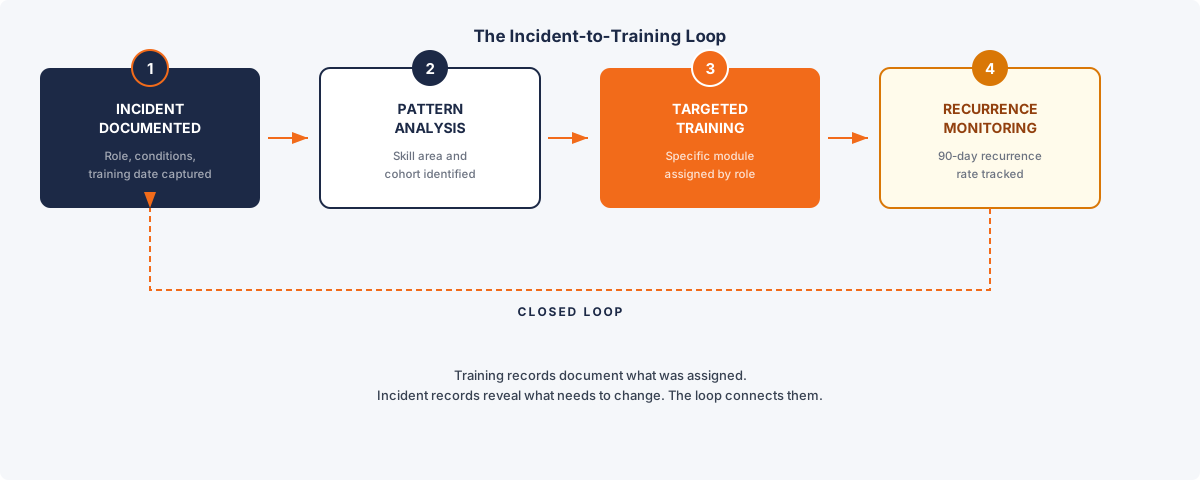
Making this connection requires that incident reports include enough structured detail to be cross-referenced with training records. A log that captures the employee’s role, the date and shift, the specific nature of the incident, and the relevant skill area creates the raw material for that analysis, while a log that captures only the event and the corrective action taken leaves nothing to cross-reference.
The operational practices that distinguish properties making progress on incident reduction from those cycling through the same patterns are the following.
- Capturing structured incident data by role, shift, location, and incident category rather than logging incidents as free-text narratives
- Cross-referencing incident records with training completion dates to surface whether the employee had recent training in the relevant skill area and whether that training was associated with incidents at a higher or lower rate
- Assigning targeted retraining based on incident data rather than on calendar schedule, so that the curriculum responds to what is actually happening on the floor
- Tracking recurrence rates in the 60 to 90 days following a training intervention to measure whether the intervention changed anything, and adjusting the approach if it did not
What a Functional Incident-to-Training Loop Requires
The Three Capabilities the System Needs
A functional incident-to-training loop requires three capabilities that many hospitality operations currently manage in separate systems that do not communicate with each other. The first is structured incident capture, meaning a system that records incidents with enough categorical detail to be analyzed by role, skill area, location, and time period, since narrative-only incident logs cannot be queried in the way that cross-referencing with training records requires.
The second is training history access at the individual level. Identifying a pattern requires knowing not just that the relevant training was completed but when it was completed, whether the employee has had the relevant training more than once, and whether completion was associated with a subsequent incident. That data exists in most LMS systems but is typically queried only for compliance reporting rather than for the incident analysis the loop requires.
The third is the administrative capacity to act on the analysis. A property that identifies a pattern, a specific role producing incidents in a specific category, needs to be able to assign targeted training to the right cohort without building the assignment manually from scratch. The system needs to support that action quickly enough to be operationally useful.
What Operations Leaders Monitor After the Loop Is Built
Once the loop is operational, the relevant metrics change. The completion rate remains relevant for compliance purposes, but it is no longer the primary signal. The primary signals are incident rate by category over time, recurrence rate in the 90 days following training intervention, and the distribution of incidents across roles and shifts. These signals answer the question the completion dashboard cannot answer, specifically whether what is being trained is actually reducing what is harming guests and staff.
Properties that have built this connection describe a shift in how operations reviews are conducted. The training question moves from “are completion rates where they need to be” to “what does the incident data tell us about where training needs to go next.” That shift in the question is what separates properties that reduce incident rates from those that maintain clean records while the same incidents recur.
How Hospitality Operations Will Handle Safety in 2027
The hospitality operations that will be ahead of this problem in 2027 are investing in the connection between training and incident data rather than in more training volume. That connection does not require a wholesale system replacement. It requires that incident capture becomes structured enough to analyze, that training records become accessible enough to cross-reference, and that the people responsible for both have a shared view of what the data shows.
The operations leaders who build this connection in 2026 will be measuring something different by 2027. The primary metric shifts from completion rate against a training calendar to incident recurrence rate in the 90 days following a targeted intervention, which is the number that answers whether the training assignment changed anything on the floor. That is the shift from a compliance system to a safety system, and it starts with how incident reports are structured on the day the next incident occurs.
What changes when the loop is closed is the signal that determines what gets assigned. A module triggered because a calendar refresh is due produces different outcomes than a module triggered because the incident record identified that a specific role, at a specific location, produced three temperature violations in a single month. The content may be identical, but the assignment driven by incident data is addressing an active gap rather than maintaining a record that was already current.
Track What Is Causing Incidents and Train to Close the Gap
KnowledgeCity’s workforce development platform gives hospitality operations leaders a connected view of incident data and training history, so that what gets trained is determined by what is actually causing incidents on the floor rather than by what looks complete on a dashboard.
Frequently Asked Questions
1. Why do hospitality safety incidents keep occurring even when training completion rates are at 100%?
Because completion rates measure whether training was assigned and marked done rather than whether the behavior the training was intended to shape has changed. Incidents occur in operational conditions, under time pressure and with equipment variance, that training modules cannot replicate. The completion record documents the exposure but cannot document what the employee does at the point of service when competing pressures arrive simultaneously.
2. What makes high employee turnover a safety risk in hospitality even when new hires complete training?
New hires complete training in a learning environment rather than a service environment. The accommodation and food services sector’s turnover rate means a significant share of any property’s hourly staff is newly onboarded at any given time, which means a significant share of that staff is applying training knowledge to conditions they are encountering for the first time. High completion rates and high turnover can coexist without producing safety outcomes; the gap is in the transition from training context to floor context.
3. How should operations leaders structure incident reports to make them useful for training decisions?
Incident reports should capture the employee’s role and shift, the specific incident category using a defined taxonomy, the relevant skill area, and the date of the employee’s most recent training in that area. Unlike narrative descriptions, structured categorical fields can be cross-referenced with training records to identify whether incident patterns align with training gaps, recent onboarding cohorts, or specific operational conditions.
4. What does a closed-loop incident-to-training system do that a standard LMS does not?
A standard LMS manages training assignment, delivery, and completion tracking without any visibility into what is happening on the floor. A closed-loop system connects incident records to training history so that training assignments are triggered by what the incident data identifies as the source of harm rather than by compliance calendars or module schedules. The result is that training responds to the actual pattern of incidents rather than to a predetermined curriculum sequence that may have no relationship to what is currently causing harm at a specific property.
References
- CDC. (2025). Facts About Food Poisoning.
- National Restaurant Association. (2019). Hospitality industry turnover rate ticked higher in 2018.
- Bureau of Labor Statistics. (2026). Job Openings and Labor Turnover Survey (JOLTS), Table 4.
- Bureau of Labor Statistics. (2026). Survey of Occupational Injuries and Illnesses, 2024.
- OSHA. (n.d.). Young Workers — Restaurant Safety.