Key Takeaways
- Policy management software creates the audit trail between a policy update and every employee’s confirmed acknowledgment, a distinction regulators treat as legal evidence rather than administrative convenience.
- OSHA, HIPAA, FDA, and the Joint Commission each require organizations to produce documented proof that employees received and understood updated policies rather than records showing only that documents were distributed.
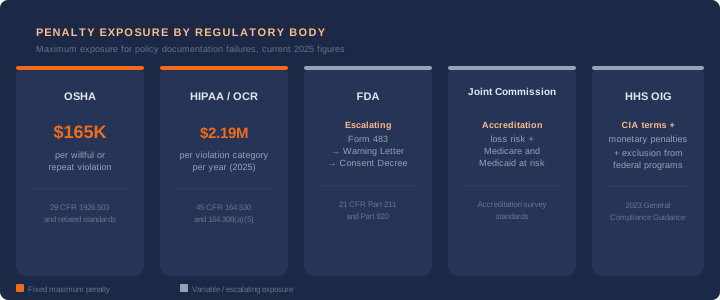
- OSHA willful-violation penalties reach $165,514 per violation under the current 2025 schedule; HIPAA civil monetary penalties can reach $2,190,294 per violation category annually under the 2025 inflation-adjusted cap.
- Automated version control, role-based distribution, and digital acknowledgment capture replace the three manual gaps that leave organizations most exposed at inspection or audit.
A compliance auditor’s first question almost always concerns the record that proves every employee subject to that policy confirmed they read the current version, rather than the policy itself. Organizations that updated their safety procedures in January but cannot show who acknowledged them by March are in the same compliance position as organizations that never updated at all, because the policy change happened but cannot be defended in the absence of that record.
The gap between distributing a policy and proving acknowledgment is where regulatory exposure concentrates. OSHA cited fall protection training failures under 29 CFR 1926.503 as one of its ten most frequently cited violations in fiscal year 2024. The Office for Civil Rights routinely lists workforce training documentation failures in HIPAA enforcement actions. In both cases, the organization often had a policy in place but lacked proof that the people covered by that policy had confirmed their understanding of the current version.
Policy management software addresses this gap at the process level. The question regulators have already answered is whether to close it, so the relevant question is how the software closes each part of it and what the resulting record contains.
Why the Acknowledgment Gap Creates Regulatory Exposure
The acknowledgment gap sits between a policy update and the moment every employee subject to that policy confirms, in a traceable record, that they received and understood the current version. Regulators treat the distance between those two events as an evidentiary problem, and it is the gap that carries legal consequence when an auditor arrives.
The acknowledgment record is legal evidence of compliance rather than a courtesy confirmation. HIPAA’s Privacy Rule at 45 CFR 164.530(b) requires covered entities to document workforce training on policies and procedures. OSHA standards under 29 CFR 1926.503 require employers to document that employees were trained on and understood fall protection requirements. The 2023 update to the HHS Office of Inspector General General Compliance Program Guidance stated that effective compliance programs must include mechanisms “to document that workforce members have received, understood, and will adhere to those policies.” The documentation is the compliance itself, which is why its absence is the violation. 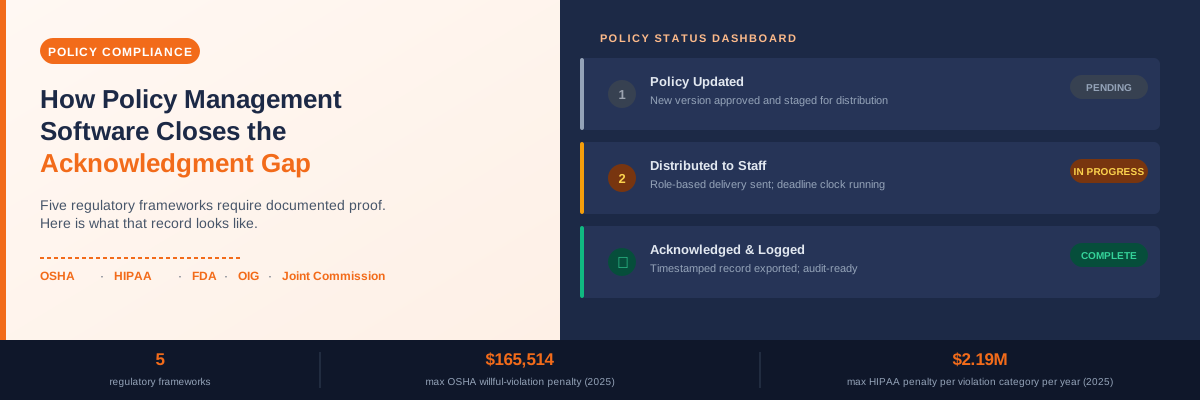
How Organizations Currently Manage Policy Distribution
The Manual Approaches Most Teams Still Rely On
Most organizations distribute updated policies through email, shared drives, or physical bulletin board postings. These channels reach employees and are inexpensive to operate, but none produces a verifiable acknowledgment record without additional steps that rarely happen consistently at scale.
Email distribution creates a delivery record with no information about whether the employee read the policy, understood it, or even opened the attachment. HR teams often ask employees to reply with a confirmation, but response rates on mandatory acknowledgment requests are rarely complete, and there is no automated enforcement mechanism when an employee does not respond. A folder of received replies sorted by the employee’s last name does not constitute an audit-grade log. When a regulator asks whether a night-shift warehouse associate acknowledged the updated lockout/tagout procedure under 29 CFR 1910.147 before an incident date, a folder of email replies rarely answers that question with the specificity required.
Why Email Confirmations and Spreadsheet Logs Fall Short at Audit
The most common workaround is a spreadsheet. HR or operations teams maintain a running list of which employees completed which acknowledgments by which date. Spreadsheets break in practice because they require manual updates, carry no version-control mechanism, and do not link the acknowledgment record to the specific policy version the employee saw. When a policy is updated and the spreadsheet is reset for the new cycle, the prior acknowledgment history is frequently separated from the new log or lost entirely.
The Joint Commission accreditation standards require healthcare facilities to document that staff received education on policies, particularly in high-risk clinical areas including medication management and infection prevention, and surveyors audit those records directly during accreditation visits. A spreadsheet showing “training completed” with no link to which policy version was in effect, which staff credentials were verified, or whether completion occurred before or after the policy change does not satisfy that standard.
What Regulatory Bodies Require When They Ask for Proof
Federal Safety and Occupational Health Requirements
OSHA’s training documentation requirements span dozens of standards. Fall Protection Training under 29 CFR 1926.503 ranked seventh on OSHA’s list of most frequently cited violations in fiscal year 2024. The standard requires that training occur and that the employer verify employees understood it, maintaining records showing when training occurred, who received it, and who conducted it. Employers without those records face serious-violation citations at up to $16,550 per instance. Willful or repeat violations carry penalties up to $165,514 per violation.
HIPAA’s Privacy Rule at 45 CFR 164.530 and Security Rule at 45 CFR 164.308(a)(5) both require covered entities and business associates to document workforce training on policies and procedures, with records demonstrating that training was relevant to each employee’s role. The Office for Civil Rights, which enforces HIPAA, can impose civil monetary penalties ranging from $145 to $73,011 per violation, with annual caps reaching $2,190,294 per violation category under the current 2025 inflation-adjusted schedule. Enforcement actions consistently cite failure to train workforce members and failure to document that training as standalone violations.
Healthcare, Life Sciences, and Industry-Specific Standards
FDA regulations under 21 CFR Part 211, which governs pharmaceutical manufacturing, and Part 820, which covers medical device quality systems, require manufacturers to establish written procedures and maintain records demonstrating that personnel were trained on those procedures. Inspectional observations related to inadequate written procedures and training documentation appear consistently among the most frequent Form 483 findings reported by the FDA across pharmaceutical and device inspections.
The 2023 update to the HHS OIG General Compliance Program Guidance framed documentation as structural rather than clerical. The guidance states that an effective compliance program must include mechanisms to document that workforce members have received, understood, and will adhere to policies, making the acknowledgment record a structural component of program effectiveness rather than a byproduct of it. Organizations subject to OIG oversight that cannot produce those records during an investigation face elevated scrutiny and potentially more demanding Corporate Integrity Agreement terms.
Regulatory Body | Documentation Requirement | Enforcement Mechanism | Max Penalty Exposure |
|---|---|---|---|
OSHA | Written records that employees were trained on specific SOPs and procedures (29 CFR 1926.503 and others) | Citations, civil penalties, abatement orders | $165,514 per willful or repeat violation (2025) |
HIPAA / OCR | Documented workforce training on privacy and security policies, role-relevant (45 CFR 164.530, 164.308) | Civil monetary penalties, corrective action plans | $2,190,294 per violation category per year (2025 inflation-adjusted) |
FDA | Written procedures with personnel training records (21 CFR Part 211, Part 820) | Form 483 observations, Warning Letters, consent decrees | Import alerts, production suspension, consent decree |
Joint Commission | Documented staff education on policies, particularly in high-risk clinical areas | Requirements for Improvement at accreditation survey | Loss of accreditation, Medicare and Medicaid reimbursement risk |
HHS OIG | Mechanisms to document that workforce members received, understood, and agreed to adhere to policies (2023 guidance) | Enhanced scrutiny during investigations, Corporate Integrity Agreement terms | Monetary penalties, exclusion from federal programs |
What Policy Management Software Does at Each Step
Policy Authoring and Version Control
Maintaining a single source of truth across policy versions
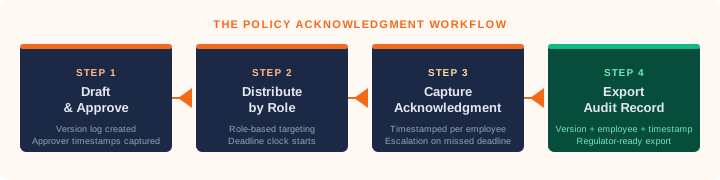
Policy management software assigns every policy a permanent home with a version number, a status field (draft, under review, active, retired), and a complete change history. When a safety manager updates the confined space entry procedure to reflect a new OSHA requirement, the software creates a new version while preserving the prior version for reference. Employees who access the document see only the current active version, while the system logs when the change was made, who approved it, and what the previous version contained.
Version control is the foundation of the audit trail rather than a convenience feature. When a regulator asks which version of a procedure was in effect on a specific date, and whether the employees working under that procedure had acknowledged it, the software produces that answer directly from its version log.
Approval workflows and change logs that create the paper trail before distribution
Policy changes in most organizations pass through informal review in which a manager reads the update, approves it verbally, and distribution follows. Policy management software formalizes that approval with a documented workflow. The department head, compliance officer, and legal reviewer each receive the draft, complete their review within the system, and record their approval with a timestamp. That approval log becomes part of the policy’s permanent record, exportable at any point during an audit.
Targeted Distribution and Acknowledgment Tracking
Two capabilities determine whether targeted distribution produces the audit-ready record regulators require.
Role-based and location-based delivery so only the right employees receive each policy
Policy management software segments the workforce by role, department, location, or employment type and delivers each update only to the employees who need to acknowledge it. A lockout/tagout procedure under OSHA 29 CFR 1910.147 applies to maintenance technicians while leaving administrative staff in the same building outside its scope, and role-based delivery reflects that distinction automatically. That targeting removes the signal-to-noise problem of organization-wide distributions and makes non-acknowledgment visible at the right level. A supervisor can see immediately that three of her twelve technicians have not completed the acknowledgment rather than seeing that an unspecified fraction of eight hundred employees has not responded to an all-staff email.
Automated reminder sequences and escalation when acknowledgment deadlines are missed
Once a policy is distributed, the software tracks completion against a deadline. Employees who have not acknowledged by a set point receive automated reminders through the system. When the deadline passes, the non-completion escalates to the employee’s manager and, if configured, to the HR compliance team. The system generates a real-time report showing completion rates by department, location, or employee group, so organizations can produce a current, exportable acknowledgment record without reconstructing anything under audit pressure.
Connect policy acknowledgment to your compliance
training record.
KnowledgeCity’s workforce development platform links SOP acknowledgment tracking to your organization’s full training history, so every audit starts from a complete record.
Building the Audit-Ready Record Before the Inspection Arrives
What a Complete Policy Acknowledgment Record Contains
Across OSHA, HIPAA, and FDA frameworks, a compliant acknowledgment record shares a consistent set of required elements.
Minimum components regulators expect to see
An acknowledgment record that satisfies OSHA, HIPAA, and FDA documentation requirements shares a consistent set of elements. The record needs to identify the policy by title and version number, identify the employee by name and role, record a timestamp for when the acknowledgment was completed, and show the delivery method, including whether the employee acknowledged through a software portal, a mobile prompt, or a system-generated confirmation that logged their response. Incomplete records, such as those that show a send date but no employee-level confirmation, do not satisfy the documentation standard regardless of how well-organized the surrounding filing system is.
Retention timelines tied to specific regulatory requirements
OSHA training record requirements vary by standard but often specify that records must be retained for the duration of employment plus additional years. HIPAA documentation must be retained for six years from the date of creation or from the date it was last in effect, whichever is later. FDA pharmaceutical training records under 21 CFR Part 211 must be retained for periods tied to batch release requirements, often extending several years past production dates. Policy management software with built-in retention configuration holds records for the required period and can flag when records are approaching their retention limit before they are inadvertently deleted.
Three Common Implementation Gaps That Undermine the Record
Version drift is the first gap, arising when organizations update a policy in the software but fail to retire the previous version, leaving both accessible and creating ambiguity about which version the employee acknowledged. Role mapping is the second, affecting employees who change departments or job functions after completing an acknowledgment and may need to re-acknowledge policies relevant to their new role, which a manual tracking system does not surface automatically. The third gap covers contractor and contingent worker populations. OSHA and HIPAA requirements extend to workers operating under the employer’s supervision or accessing protected information regardless of payroll status, and policy management software that cannot include contractors in its acknowledgment workflows leaves a population of legally covered workers outside the documented record.
“The audit tests whether the record is complete and whether it connects the right version to the right employee on the right date. A well-written policy that cannot be proven to have reached the right people at the right time produces the same audit finding as a policy that was never written.”
How Different Industries Are Applying Policy Management Software
Healthcare organizations and manufacturing operations carry the highest policy documentation burden under current regulatory frameworks, and the approaches each sector has developed toward compliance documentation are instructive for any industry facing layered regulatory requirements.
Healthcare Organizations
HIPAA, Joint Commission, and state licensing board alignment through one documentation system
Hospitals and health systems operate under layered policy requirements in which HIPAA’s workforce training documentation standard, Joint Commission accreditation requirements, and state nursing or pharmacy board rules each mandate evidence that staff were informed about and acknowledged current policies. Healthcare compliance teams using policy management software maintain a single document repository that serves all three frameworks simultaneously. When a Joint Commission survey team asks to see evidence that nursing staff acknowledged the updated medication reconciliation policy after a Q3 revision, the compliance officer pulls one report from the system rather than cross-referencing three separate logs maintained by different departments.
For regulatory compliance training programs in healthcare, connecting the policy acknowledgment record to the LMS training completion record solves one of the most time-consuming pre-audit tasks, which is proving that the same employee who completed a HIPAA privacy training course also acknowledged the current version of the relevant policy, with both events dated before the compliance period in question.
Manufacturing, Distribution, and Multi-Site Operations
Manufacturing operations face the acknowledgment gap in its most visible form. Large numbers of workers across multiple shifts, often at multiple sites, need to acknowledge the same updated procedure before returning to the operations that procedure governs. A policy management software deployment at a multi-site facility allows safety managers at the corporate level to push an updated chemical handling SOP to all locations simultaneously and track acknowledgment completion by shift and by site. When an OSHA inspection arrives at one plant, the local safety manager produces a site-specific acknowledgment log without waiting for a corporate HR team to compile records from other locations. Tracking compliance training metrics alongside acknowledgment rates gives operations leadership a single view of workforce readiness across sites.
What to Evaluate When Selecting Policy Management Software
Core Capabilities That Separate Functional Systems From Audit-Ready Ones
The difference between policy distribution software and policy management software is the audit trail. Sending a document to an employee and creating a defensible record of what that employee acknowledged, when, and on which version are two different capabilities. An audit-ready system creates a version-controlled record connecting the specific document version to the specific employee, captures a timestamped acknowledgment, retains the record for the required period, and exports it in a format regulators can read without supplementary explanation.
Effective compliance training best practices call for policy acknowledgment records to integrate with training completion data rather than existing as separate logs. Organizations that manage compliance training and policy acknowledgment in isolated systems produce two parallel records that cannot be reconciled quickly when a regulator asks whether an employee was both trained on a procedure and acknowledged the current version of it. A combined record answers that question in a single exportable report that satisfies both requirements simultaneously.
Integration With Your Existing Training and HR Infrastructure
Policy management solution that integrates with a learning management system connects acknowledgment records to training completion data, creating a unified compliance record for each employee. An employee who completes a safety training course and acknowledges the current version of the related SOP in the same system generates a record that satisfies both the training documentation requirement and the policy acknowledgment requirement in a single export. For organizations managing SOP software alongside broader HR systems, the integration also ensures that when an employee’s role changes in the HR system, their policy acknowledgment assignments update automatically rather than waiting for a manual correction.
The criteria that frequently separate capable systems from audit-ready ones are worth specifying before any vendor evaluation begins.
- Configurable retention periods tied to specific regulations rather than a single default retention window
- Role-based acknowledgment assignment that updates automatically when HR data changes
- Contractor and contingent worker inclusion in the acknowledgment workflow
- A structured export format that presents version numbers, timestamps, and employee identifiers without requiring additional formatting before submission to a regulator
The Record That Should Exist Before the Auditor Arrives
The question compliance officers dread most is rarely “do you have a policy for that?” since most organizations do. The question that exposes the gap is “show me who acknowledged the current version of that policy, when they acknowledged it, and what version they saw,” and it arrives without warning during an OSHA inspection, a Joint Commission survey visit, an OCR investigation, or an internal audit triggered by an incident. Scrambling to reconstruct acknowledgment records after that question is asked is a sign that the documentation strategy failed before the inspection began.
Policy management software changes what is available in that moment. The record does not need to be assembled after the fact because the organization built it continuously through every policy update, every targeted distribution, and every employee acknowledgment captured through a controlled workflow. The record is current because normal operations built it across every update, distribution, and acknowledgment cycle.
Organizations that feel prepared at inspection share a specific operational characteristic. They built their documentation before the inspection date, through the routine operations that the software makes automatic. For HR and compliance teams evaluating whether their current approach produces the evidence that regulators will accept, the question is whether the system they use today creates a version-controlled, employee-level, timestamped acknowledgment record that holds up when the auditor opens the file. A workforce development platform that connects policy management software to training completion and compliance tracking produces that record as a standard output, before anyone asks for it.
Give your compliance team a record they can produce on the spot.
KnowledgeCity’s workforce development platform connects SOP acknowledgment tracking, compliance training records, and audit-ready exports in one system, so the documentation exists before the question arrives.
Frequently Asked Questions
1. What is the difference between policy distribution software and policy management software?
Policy distribution software sends documents to employees, while policy management software creates a version-controlled record of every policy, logs who approved each change, tracks whether each employee acknowledged the current version by a deadline, and exports those records in a format regulators can audit. OSHA, HIPAA, and FDA all require organizations to demonstrate that employees were trained on and acknowledged current procedures rather than demonstrating only that the documents were sent. The audit trail connecting those two facts is what separates the two types of systems.
2. Which regulations specifically require documented employee acknowledgment of policy updates?
Several major regulatory frameworks require organizations to document employee acknowledgment of policy changes. OSHA standards including 29 CFR 1926.503 require employers to verify and document that employees received and understood safety training, with willful violations carrying penalties up to $165,514 per instance under the current 2025 penalty schedule. HIPAA’s Privacy Rule (45 CFR 164.530) and Security Rule (45 CFR 164.308(a)(5)) require documented workforce training on policies, with annual caps reaching $2,190,294 per violation category under the 2025 inflation-adjusted schedule. FDA regulations under 21 CFR Part 211 and Part 820 require written procedures with training records. The 2023 HHS OIG General Compliance Program Guidance explicitly calls for mechanisms to document that employees received, understood, and agreed to adhere to policies.
3. How long should organizations retain policy acknowledgment records?
Retention requirements vary by regulation. HIPAA documentation must be retained for six years from the date of creation or from the date it was last in effect. OSHA training records often must be retained for the duration of employment plus additional years, depending on the specific standard. FDA pharmaceutical training records under 21 CFR Part 211 must be retained for periods tied to batch release requirements, often extending several years past production dates. Policy management software with configurable retention rules holds records for the required period and flags records approaching their retention limit.
4. How does policy management software handle employees who change roles during an acknowledgment cycle?
Role-based acknowledgment assignment is one of the core capabilities that separates policy management software from simple document distribution. When an employee changes roles or departments, the system reassigns them to the policy groups relevant to their new position and can automatically trigger acknowledgment requirements for policies that apply to the new role. OSHA and HIPAA compliance both tie policy obligations to job function rather than employment status. Without automated role reassignment, organizations frequently find gaps when a promoted employee has acknowledged the policies for their prior role but has no acknowledgment on record for the policies that govern their current one.
5. Can policy management software integrate with a learning management system to combine training and acknowledgment records?
Integration between policy management software and a learning management system creates a unified compliance record that satisfies both training documentation and policy acknowledgment requirements in a single report. When an employee completes a safety training course in the LMS and acknowledges the current version of the related SOP in the policy management system, the integrated record shows both completions with timestamps and version identifiers. Regulators in healthcare settings increasingly expect this combined record, particularly where HIPAA training documentation and policy acknowledgment are parallel requirements under the same enforcement framework.
References
- Occupational Safety and Health Administration. “Top 10 Most Frequently Cited Standards.”
- Occupational Safety and Health Administration. “OSHA Civil Penalties and Penalty Adjustments.”
- U.S. Food and Drug Administration. “Inspection Observations.”
- U.S. Department of Health and Human Services. “HIPAA Enforcement: Resolution Agreements.”
- HHS Office of Inspector General. “General Compliance Program Guidance (2023).”
- The Joint Commission. “Accreditation Standards for Human Resources.”
- Occupational Safety and Health Administration. “Frequently Cited OSHA Standards by NAICS Code.”