
Managers today carry responsibilities that go far beyond assigning tasks or tracking performance. They are expected to guide teams through uncertainty, align daily work with organizational priorities, and support employees through constant change. For many organizations, managers have become the primary link between leadership decisions and employee experience.
Despite this responsibility, many managers step into leadership roles without adequate preparation. Recent research shows that 82% of managers feel unprepared to handle complex people challenges. Traditional management training programs often emphasize basic communication or task delegation, leaving managers without the depth of leadership capability required to guide teams effectively over time.
Advanced leadership training for managers addresses this gap by focusing on how leaders think, decide, communicate, and support people in real workplace conditions. For HR and L&D professionals, the value lies in developing managers who demonstrate consistent leadership behavior, strengthen team performance, and reduce people-related risk across the organization.
This blog explores the leadership capabilities managers need today, the challenges they face while leading people, and what HR and L&D leaders should expect from leadership training that delivers real, sustained impact.
Advanced Leadership Skills That Drive Team Performance
Effective leadership development centers on the capabilities managers rely on every day. These skills influence how work gets done, how teams respond to pressure, and how trust is built or lost over time. When developed properly, they result in visible improvements in team behavior and performance. Let’s take a quick overview.
-
Emotional Intelligence and Relationship Mastery
Managers with strong emotional intelligence understand their own reactions and recognize emotional signals in others. This awareness allows them to handle tension, manage conflict, and build trust through consistent and respectful interactions.
Teams led by emotionally aware managers communicate more openly and recover more quickly from setbacks. Employees feel heard and supported, which creates stability and engagement during periods of change or high workload. Effective leadership training for managers therefore begins with building emotional intelligence as a foundation for all other capabilities.
-
Strategic Thinking And Decision Making
As managers gain confidence in leading people, their focus must expand to include broader business priorities. Strategic thinking helps managers evaluate trade-offs, set clear direction, and understand how daily decisions affect long-term outcomes.
When managers apply structured judgment to their decisions, teams gain clarity and momentum. Work aligns more closely with organizational goals, and managers are better equipped to explain priorities and rationale to their teams.
Management skills training that develops strategic thinking capability helps managers make these connections between daily decisions and business outcomes.
-
Adaptive Leadership And Resilience
Change has become a constant condition of work rather than an occasional disruption. Managers are expected to adjust quickly, maintain direction, and support teams through uncertainty.
Adaptive leadership enables managers to remain steady under pressure, respond thoughtfully to shifting conditions, and help teams stay focused during transitions. This stability reinforces trust and helps teams maintain performance even when circumstances are unclear.
-
Influence And Cross-Functional Collaboration
Modern managers rarely achieve results through authority alone. They must coordinate with peers, negotiate priorities, and influence outcomes across functions.
Strong collaboration skills help managers reduce cross-team confusion, align stakeholders, and keep work moving forward. When influence is exercised effectively, teams experience fewer delays and greater clarity around ownership and expectations.
-
Innovation Leadership And Problem Solving
Managers play a key role in balancing consistency with improvement. Innovation leadership supports problem solving, thoughtful risk assessment, and continuous improvement without disrupting core operations.
Teams led by managers who approach challenges with structure and openness contribute practical ideas and improvements. Over time, this strengthens both performance and adaptability.
The People Challenges Leaders Face In Everyday Management
While leadership skills provide a foundation, managers often struggle most with the human side of leadership. These challenges rarely appear in job descriptions; however, they shape daily leadership behavior.
Managers are expected to address disengagement, resolve conflict early, support employee well-being, and maintain fairness under pressure. They must balance empathy with accountability, often without clear guidance or sufficient time.
When these challenges are not addressed, managers delay conversations, avoid difficult feedback, and allow small issues to escalate. Leadership training for managers that acknowledges these realities helps them approach people challenges with confidence rather than hesitation.
-
Communicating Change Without Creating Confusion Or Resistance
Change initiatives succeed or fail based on how they are experienced by employees. Managers play a central role in shaping that experience.
Leaders are often required to communicate decisions they did not make, answer questions with incomplete information, and manage emotional responses while maintaining productivity. When communication lacks clarity or context, confusion spreads and trust erodes.
Effective leadership development training prepares managers to communicate change with transparency, consistency, and credibility. Teams that understand the purpose behind change adapt more quickly and remain aligned, even when details evolve over time.
-
Feedback That Improves Performance And Preserves Trust
Feedback is one of the most challenging leadership responsibilities. Many managers avoid it due to discomfort or uncertainty, while others deliver feedback only when problems escalate.
Clear and timely feedback helps employees understand expectations, correct course early, and build confidence in their work. Poor feedback practices lead to confusion, frustration, and uneven performance across teams.
Leadership training for managers that strengthens feedback capability supports them in addressing performance issues constructively. Over time, teams benefit from clearer direction, stronger trust, and more predictable leadership behavior.
-
Accountability Without Micromanagement
Managers are expected to empower teams while still delivering results. Maintaining this balance becomes especially difficult in remote or hybrid environments.
Without clear leadership practices, managers may over-monitor work or disengage entirely. Both approaches weaken trust and reduce ownership. Effective leaders establish accountability through clarity, follow-through, and consistent expectations.
People management training that reinforces accountability helps managers support autonomy while maintaining performance standards. Teams gain confidence in expectations and feel trusted to deliver.
-
Leadership Responsibility In Guiding The Use Of AI At Work
As AI tools become more accessible, managers are increasingly responsible for how these tools are used within teams. Leadership decisions now influence not only productivity, but also quality, transparency, and ethical judgment.
Managers must set expectations around appropriate AI use, prevent over-reliance on automation, and ensure accountability remains clear. They also need to address employee concerns related to data use, job impact, and performance expectations.
Leadership training that addresses these responsibilities helps managers guide AI adoption with care. When leaders provide clarity and boundaries, teams use AI as a support tool while maintaining professional judgment and accountability.
These people-related challenges do not remain static; they evolve as managers take on broader responsibility and influence across the organization.
Leadership Competency Progression Across Management Levels
As managers take on broader responsibility, leadership expectations change. Effective leadership training supports this progression by strengthening capabilities that match real workplace demands.
The following framework illustrates how leadership competencies typically evolve across management levels:
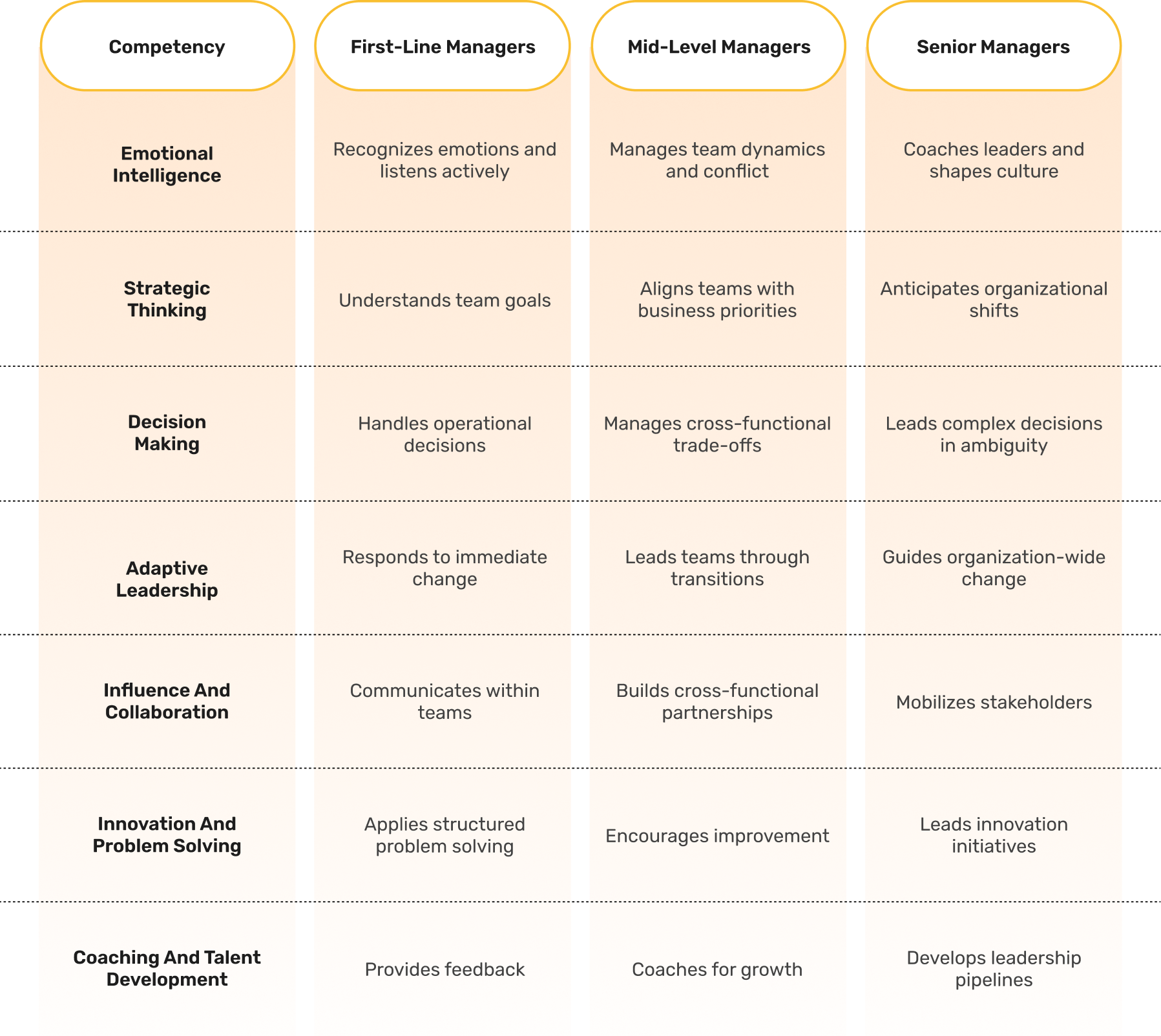
For HR and L&D leaders, this framework provides a reference point for evaluating whether leadership training supports managers as their roles expand.
Disclaimer: This framework reflects common leadership progression patterns and may differ based on organizational needs, industry, and leadership expectations.
What Sets Effective Leadership Training Apart
Most leadership training for managers fails without anyone noticing. Managers complete courses and understand the concepts, but struggle to put them into practice. Deadlines reveal weak delegation, feedback is delayed or unclear, and small conflicts grow into bigger issues. Teams develop workarounds, high performers take on extra responsibility, and HR ends up intervening more than it should. These patterns show that the training has not translated into real leadership behavior.
Effective leadership training addresses these gaps by preparing managers for real workplace decisions and challenges. A key factor is tailoring training to the experience level:
- New managers: Leadership courses for new managers should focus on foundational leadership behaviors, giving feedback, and guiding small teams. Generic programs often skip these basics or overwhelm new managers with advanced concepts.
- Mid-level managers: At this level, training emphasizes cross-team collaboration, delegation, and translating strategy into operational results. Programs that treat all managers the same leave mid-level leaders unprepared for broader responsibilities.
- Senior managers: For senior leaders, training strengthens influence, leads organizational change, and develops future leaders. Standard supervisory training courses rarely address enterprise-level challenges or leadership pipelines.
Strong management skills training also ensures consistency across the organization. Managers leave with a shared understanding of expected leadership behaviors, reducing gaps and misaligned practices.
Finally, training must align with organizational expectations and realities. Clear guidance on authority, boundaries, and responsibilities allows managers to act decisively. Programs without this alignment leave leaders uncertain and inconsistent.
Leadership training delivers real results when managers know what to do, how to do it, and how it fits their role and experience. Ineffective training leaves them knowing concepts but unable to apply them where it matters most.
Build Leadership Capability That Lasts With KnowledgeCity
Advanced leadership training for managers prepares leaders to guide teams through complexity, communicate clearly during change, and support people consistently and confidently. When organizations invest in developing these capabilities, the impact shows across multiple levels: teams perform more reliably, trust strengthens between managers and employees, and HR intervention decreases as managers handle challenges proactively.
The difference between training that works and training that fails comes down to application. Managers need more than conceptual knowledge. They need practical frameworks they can use immediately in real workplace situations.
KnowledgeCity’s leadership training for managers bridges this gap. Our programs are designed around the actual challenges managers face daily, from delivering difficult feedback to leading teams through organizational change. Our leadership skills training supports managers at every level, from first-line supervisors building foundational capabilities to senior leaders developing enterprise-wide influence.
Whether you’re building a consistent leadership approach across your organization or addressing specific skill gaps, KnowledgeCity provides leadership development training that delivers measurable results across teams and the business.
Ready to transform how your managers lead? Explore KnowledgeCity’s management courses and discover how we help organizations develop leadership capability that drives sustained performance.

 KnowledgeCity













Subscribe to Our Newsletter
Join 80,000+ Fellow HR Professionals. Get expert recruiting and training tips straight
to your inbox, and become a better HR manager.