Key Takeaways
- Gallup (2024): Only 2% of Fortune 500 CHROs strongly agree that their performance management system inspires employees to improve. Most PM systems are evaluated on criteria that have no relationship to this outcome.
- Deloitte (2025): Only 26% of organizations say their managers are very or extremely effective at enabling the performance of people on their teams. The gap lives in manager capability, not system features.
- CMI (2023): 33% of current managers and leaders have never received any formal management and leadership training. A performance management system deployed on top of undertrained managers produces better-documented underperformance, not improvement.
- The difference between a PM system that changes behavior and one that catalogs it comes down to three specific capabilities (manager enablement, development integration, and calibration quality). Most evaluation processes through 2025 and into 2026 test for none of these.
At a 3,000-person professional services firm, the HR team spent four months evaluating performance management systems in 2024. The winning platform scored highest on goal-tracking tied to OKRs, check-in scheduling, nine-box calibration, and HRIS integration. Eighteen months after go-live, manager engagement scores are where they were at implementation, and the system holds a complete record of documented conversations that did not change how anyone works.
This is the gap that standard performance management system evaluations rarely surface. The selection process measured features. The outcome it missed is the one showing up in the Gallup (2024) and Deloitte (2025) data on whether the system inspires improvement.
The research from 2023 through 2025 points to the same structural gap from three different vantage points, and the three capabilities that separate a system built for behavior change from one built for documentation are detectable before any contract is signed.
The Outcome Data Most Performance Management System Evaluations Don’t Ask For
2% of Fortune 500 CHROs Back Their PM System
“Two percent of CHROs from Fortune 500 companies Gallup recently surveyed strongly agree that their performance management system inspires their employees to improve.” — Gallup, 2024
Gallup (2024) surveyed CHROs from Fortune 500 companies and found that 2% strongly agree their performance management system inspires employees to improve. Deloitte’s 2025 Global Human Capital Trends survey of nearly 10,000 business and HR leaders across 93 countries found that only 26% of organizations report their managers are very or extremely effective at enabling the performance of people on their teams. Both figures measure the same thing from different vantage points: whether the system changes what people do at work.
The standard performance management system RFP does not ask for either metric. The typical selection scorecard ranks vendors on feature completeness, integration depth, user interface ratings, and implementation timeline. Those criteria produce an accurate picture of what the system can do, but they have no way to predict whether it will change anything.
The Gallup figure measures whether the employee performance management process, supported by the system, produces behavior change. A manager who submitted a completed annual review in December 2024 produced a data point in the system. Whether that review changed anything is the question the 2% figure is measuring, and that question is almost never in the RFP.
How Performance Management Systems Are Typically Evaluated
The Feature-Centric Checklist
Most performance management system evaluations assess vendors across a standard feature matrix covering rating scale flexibility, support for OKR or MBO goal frameworks, check-in scheduling and tracking, nine-box or calibration grid tools, reporting and analytics dashboards, HRIS and payroll integration, and mobile access. HR technology analyst coverage through 2025 consistently shows feature completeness as the primary selection criterion in enterprise PM procurement, which means the evaluation is designed to answer whether a system can run the process, not whether it can improve it.
That model produces a technically accurate picture of what each system can do, and it serves a legitimate purpose in filtering out platforms that cannot meet minimum operational requirements. The gap it leaves is the one that shows up in the Gallup and Deloitte data eighteen months after go-live.
What the Feature Checklist Cannot Predict
The feature checklist describes what a system captures. The Talent Strategy Group’s 2023 Global Performance Management Report found that only 12% of leaders are highly effective at providing coaching and feedback, a gap that no feature matrix captures because the matrix describes what the system records, not what it does to improve the quality of those conversations. The 2026 Talent Strategy Group Performance Management Report, drawing on data from more than 250 organizations, confirms that mandatory feedback training remains uncommon, with only 18% of organizations requiring it.
Check-in scheduling has been a standard feature in enterprise PM platforms since at least 2018. The Gallup (2024) and Betterworks (2023) outcome data (2% CHRO satisfaction and 64% employee dissatisfaction respectively) reflects no corresponding improvement across that period, which is the clearest evidence that the evaluation process and the outcome it is supposed to serve are not connected through the feature list.
The Manager Capability Variable Most Performance Management Systems Don’t Address
What the Training Data Shows
The Chartered Management Institute’s October 2023 Better Management report, covering data from nearly 4,500 managers and organizations across the UK, found that 33% of current managers and leaders have never received any formal management and leadership training, and 52% do not hold any management and leadership qualifications. The Talent Strategy Group’s 2026 Global Performance Management Report, drawing on data from more than 250 organizations worldwide, found that only 18% of organizations mandate feedback training and only 21% mandate goal-setting training, confirming that underinvestment in manager capability remains a global pattern. The 2023 Talent Strategy Group report found that only 12% of leaders are highly effective at providing high-quality coaching and feedback.
That combination, undertrained managers operating a system their organizations never prepared them to use effectively, is the condition under which most enterprise PM deployments run today.
The Gap That Feature Checklists Miss
The feature checklist describes what the system captures. It says nothing about whether what the system captures reflects effective management or well-rehearsed underperformance.
The Recording Problem
A performance management system records what managers do in conversations. If what managers do is ineffective, a better recording system produces a more organized catalog of the same conversations. For the one in three UK managers (per CMI, 2023) who have never received formal training, and for the comparable share in other markets where the Talent Strategy Group’s 2026 data shows mandatory training remains uncommon, the Q4 review reflects a conversation shaped by instinct rather than method. A system that records that rating without improving the quality of the judgment behind it has added administrative infrastructure without changing the outcome.
The Compliance Trap
When a performance management system is configured primarily around deadline enforcement (submit reviews by the target date, complete the required number of check-ins per quarter), managers experience it as an administrative compliance exercise. The goal of the configuration was to generate complete records. The goal of performance management is to improve what people do at work. Those two goals are not the same, and compliance-oriented configuration optimizes for the first while treating the second as secondary. Betterworks’ 2023 research found that 64% of employees view their PM process as a partial or complete waste of time. When review completion rate is the primary system metric, that is the employee experience the configuration tends to produce.
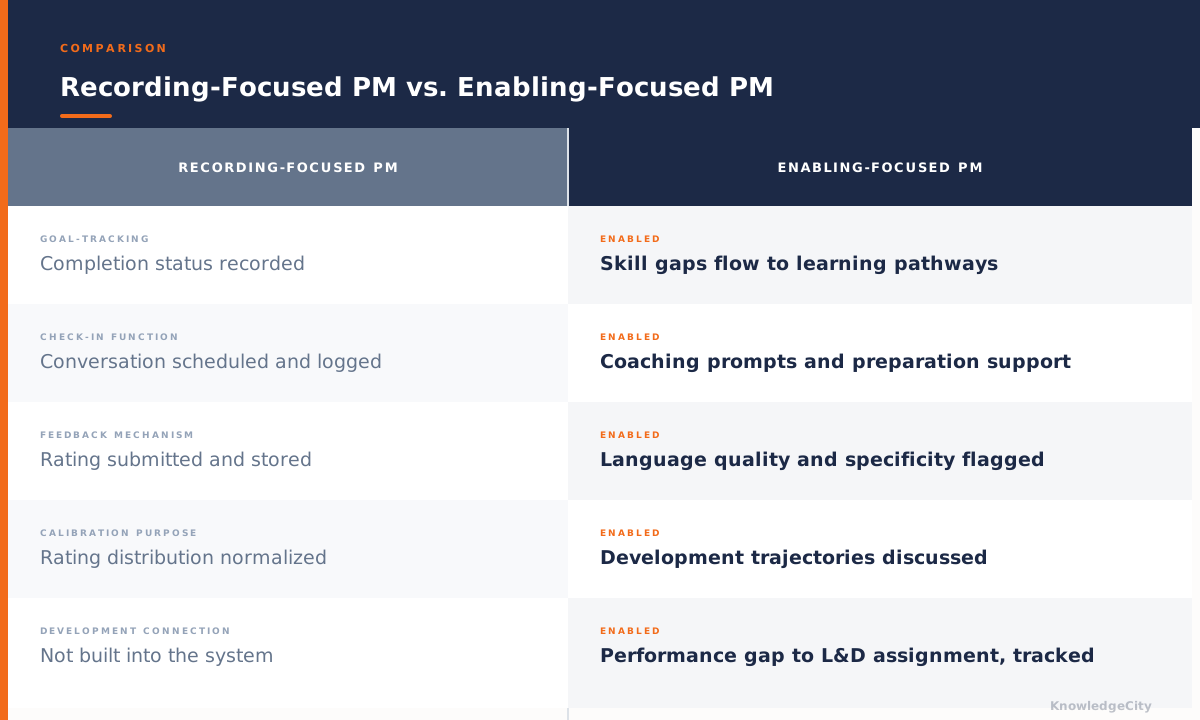
What Performance Management Systems Typically Track | What Predicts Performance Change |
|---|---|
Review completion rate | Quality of manager-employee development conversations |
Goal completion percentage | Whether identified skill gaps flow into a learning pathway |
Check-in frequency | Whether managers adapt feedback to individual growth areas |
Calibration attendance | Whether calibration produces development commitments, not just rating adjustments |
Time-to-submission | Manager effectiveness signals including coaching cadence, feedback specificity, response to low ratings |
The Three Capabilities That Separate PM Systems That Change Performance
What separates a performance management system that produces the Gallup 2% outcome from one that changes it comes down to three specific capabilities, each of which is testable before signing and absent from most current evaluation frameworks.
Manager Enablement vs. Manager Administration
Administration is what most performance management software provides, covering form routing, deadline reminders, rating scale configuration, and approval workflows. By 2026 these capabilities are present across all enterprise PM platforms, and while they are necessary for a functional system, they address the logistics of the process rather than the quality of what happens inside it.
Enablement is what separates a recording system from a developmental one. An enabling system gives managers tools to prepare for conversations, not just reminders to schedule them. It surfaces patterns when a manager’s check-in cadence has dropped below the organizational baseline and provides coaching prompts or conversation frameworks that give managers a starting point for a development discussion. For the 67% of managers who have received formal training (using the CMI 2023 figure as the baseline), these tools reinforce what they already know. For the 33% who have not, they provide structure that the manager’s experience alone cannot supply. Evaluating how well a PM system prepares managers to coach is one of the most useful questions an HR leader can bring to a vendor demo.
Development Integration vs. Review Completion
A performance management system configured for completion routes the submitted review to the manager’s manager and closes the loop there. In a recent enterprise deployment, the review is in the system, the deadline was met, and the cycle is done. A performance management process designed for development connects what was identified in the review to what happens next for the employee.
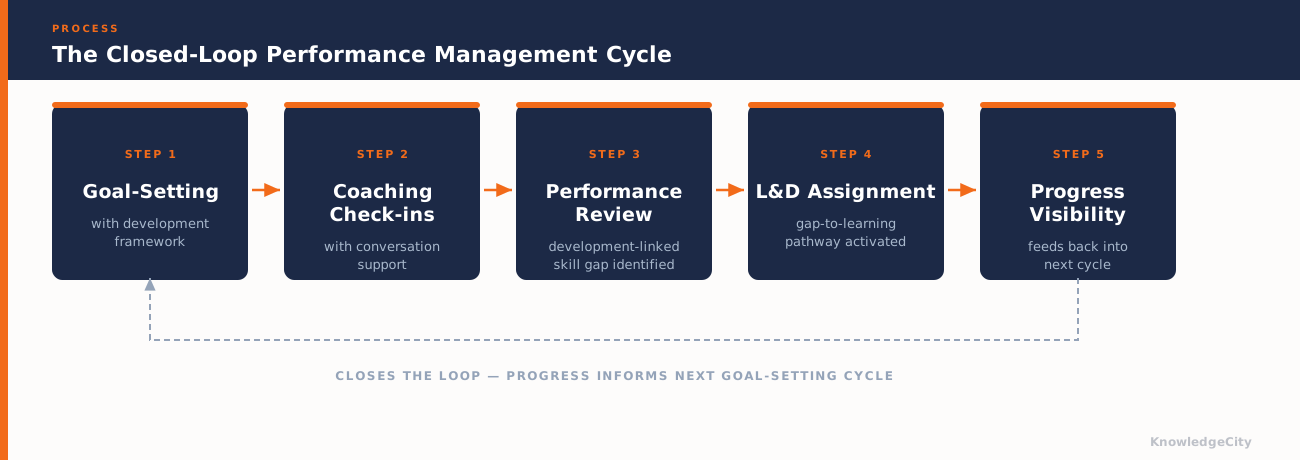
Development integration means a skill gap identified in Q2 generates a learning assignment in the LMS. It means the completion of that assignment is visible at the Q4 review so the manager and employee can assess whether the gap closed. It means the system creates a connection between the skills gap analysis and the training catalog rather than leaving the connection to individual managers to make manually. Ask vendors to demonstrate this workflow, not just confirm that their system integrates with an LMS.
Calibration Quality vs. Rating Distribution
Calibration sessions built around distribution enforcement produce a normalized rating curve and address statistical artifacts of manager leniency or severity bias. Most enterprise PM platforms released between 2018 and 2024 include calibration as a distribution tool. They do not, in their default configuration, change how managers think about their teams or how they conduct development conversations.
Calibration built around development conversations asks different questions. Who on this team is ready for the next level, and what would get them there? What pattern in this manager’s recent ratings suggests they are not seeing a dimension of their team’s performance clearly? What development commitments will this calibration session produce, and how will the PM system track them through the next review cycle? The configuration choice is visible in the calibration module during the vendor demo, and the questions a calibration session is designed to answer reveal which goal the system was built to serve.
Connect Performance Management to Learning
KnowledgeCity’s workforce development platform connects performance reviews directly to your learning library, so skill gaps identified in Q2 become L&D assignments with progress visible in the Q4 cycle.
What Employee Sentiment in Performance Management Data Reveals
The Betterworks 2023 Finding
Betterworks’ 2023 State of Performance Enablement survey, a vendor-sponsored study with an externally fielded sample, found that 64% of employees view their performance management process as a partial or complete waste of time, and fewer than one in three say the process always helps them perform better at work. This finding is consistent with the Gallup (2024) data on CHRO satisfaction and the Deloitte (2025) data on manager effectiveness, even though the three come from different sources and methodologies.
The consistency across these independent data sources points to the same structural problem from three different vantage points, each confirming the others. CHROs are not satisfied with what the system produces, the managers running it were never prepared to use it effectively, and the employees on the receiving end experience it as something that consumes time without returning anything useful.
“Fewer than one in three employees say their performance management process always helps them perform better at work.” — Betterworks, 2023 State of Performance Enablement
The Attribution Problem in System Selection
Organizations that see low engagement with their PM process tend to attribute the problem to the system’s user interface, the rating scale design, or the cadence of the review cycle. They respond by switching platforms. The manager capability gap follows them into the new system and produces the same outcome on a newer interface.
The Betterworks data is measuring manager effectiveness more than system design. An employee who finds their performance management process valuable has had conversations that felt useful, received feedback they could act on, and seen a connection between those conversations and their development. Those outcomes depend on what the manager brought to the conversation, and the CMI (2023) data suggests that for 33% of managers, that preparation was never formally developed.
What a Performance Management System Built for Outcomes Requires
Coaching and Conversation Infrastructure
A performance management system built for outcomes provides managers with preparation support before conversations, rather than reminders to schedule them. This includes conversation frameworks that give managers a structure for development discussions, flagging when a manager’s check-in pattern suggests avoidance, and feedback language suggestions that help managers be more specific about behaviors rather than traits. These features address the gap the CMI (2023) UK data and the Talent Strategy Group’s 2026 global data both describe. For managers who have never had formal training in performance conversations, a system that only schedules and records those conversations provides no support for making them better.
Closed-Loop Development Integration
The defining structural feature of an outcome-oriented performance management process is whether the loop closes between a skill gap identified in a review and a learning assignment that addresses it. When that assignment is completed, the progress needs to be visible in the next review cycle so the manager and employee can assess whether the gap closed. Without that connection built into the system, development goals sit in the LMS and performance data sits in the PM platform, and neither informs the other.
Most vendors will confirm their system integrates with popular LMS platforms. The Talent Strategy Group (2023) found that fewer than 20% of organizations configure that integration to support automated assignment generation, which means the connection exists at the data level without supporting the development workflow. The test in the demo is whether the integration is bidirectional and whether the development thread is visible within the performance workflow itself. Remote performance management adds additional complexity to this integration, making closed-loop visibility even more important when managers and employees are not in the same location.
Manager Effectiveness Signals
Beyond surfacing employee performance data, an outcome-oriented performance management system also surfaces manager effectiveness data, including patterns in rating distributions that suggest a manager is over-relying on a single performance dimension, declining check-in cadence across a team, calibration results that consistently diverge from peer-manager assessments, and review language that lacks specificity or development orientation.
The 74% of organizations whose managers are not effectively enabling performance (per Deloitte, 2025) are not currently receiving this signal from their PM system. A system that generates manager effectiveness data alongside employee performance data gives HR the ability to identify where manager development investment should go, rather than deploying training broadly across all current cohorts and hoping it reaches the managers who need it most.
Vendor evaluation questions to bring to the demo:
- What does the system do when a manager has not scheduled a check-in in 60 days?
- Can a performance gap identified in one review cycle automatically generate a development assignment in the LMS?
- What outputs does a calibration session produce beyond a finalized rating distribution?
- How does the system surface manager effectiveness patterns to HR, separate from employee performance data?
The Evaluation Questions That Expose the Gap Before You Sign
Questions About Manager Support
Standard vendor evaluation questions test for feature presence, asking whether the system supports continuous feedback, whether it has a mobile app, whether it integrates with Workday. These questions produce accurate answers about what the system can do. They do not reveal what the system does to make a manager’s preparation for a performance conversation better than it would be without the system.
HR leaders should bring more targeted questions to the 2026 demo cycle:
- What guidance does the system provide to a manager scheduling a check-in for the first time?
- If a manager’s review language is consistently vague across ten employees, does the system surface that pattern?
- If a manager’s team has a 40% lower check-in completion rate than the organizational average, who gets notified, and when?
The answers reveal whether the system was built to support the manager or only to record what the manager did.
Questions About Development Integration
The most common way to evaluate LMS integration is to ask whether the systems connect. A more useful evaluation tests whether the connection is bidirectional and whether it supports the development workflow the organization needs.
Demonstrate the following scenario in the demo. A manager conducts a Q2 review, identifies a skill gap in a specific competency area, the system generates a recommended learning pathway, the employee completes a course, and that completion is visible in the Q4 review alongside the performance rating. If the vendor cannot walk through that workflow end to end, the integration exists at the data level but not at the process level, and the closed loop the organization needs is not closed.
How to Tell Whether a Performance Management System Is Built for Performance or Documentation
The Gallup (2024) finding that 2% of Fortune 500 CHROs strongly agree their PM system inspires improvement reflects what most performance management systems were actually designed to do. They were designed to document the performance management process at scale, and in most enterprise deployments through 2025 that design goal has been met. The problem is that documentation and performance improvement require different system designs, and an evaluation process built around feature completeness will select for the first without testing for the second.
Both system types will pass a standard vendor evaluation because both check the same feature boxes. Each will demonstrate complete records, deadline enforcement, HRIS integration, and completion dashboards. What separates them only becomes visible when the evaluation asks what the system does when a manager has not had a developmental conversation with a direct report in 90 days, the situation Deloitte’s 2025 research suggests is the reality in 74% of organizations. A documentation system has no answer to that question because it was never designed to ask it.
HR leaders evaluating performance management software in 2026 should bring that scenario to every demo and watch what the vendor does with it. A system built for improvement can walk through what happens next: which signal fires, who receives it, and what the manager is prompted to do. A system built for documentation will redirect to the completion dashboard and show the review was submitted on time.
See How KnowledgeCity Closes the Performance Loop
KnowledgeCity’s workforce development platform connects performance management, development integration, and manager effectiveness signals in one system, so HR leaders can evaluate performance outcomes, not just performance records.
Frequently Asked Questions
1. What Is the Difference Between a Performance Management System and Performance Management Software?
Performance management system typically refers to the full organizational practice, including the process design, manager behaviors, calibration approach, and development integration, supported by a software platform. Performance management software refers specifically to the technology that records and facilitates that process. The distinction matters because low-performing software deployments often reflect a gap in the underlying system design rather than a deficiency in the software itself. Gallup’s 2024 data finding that 2% of Fortune 500 CHROs back their current system applies to the combined outcome, not to the software in isolation.
2. What Does Research Say About Performance Management System Effectiveness?
Gallup (2024) found that only 2% of Fortune 500 CHROs strongly agree their performance management system inspires employees to improve. Deloitte’s 2025 Global Human Capital Trends survey of nearly 10,000 leaders across 93 countries found that only 26% of organizations say their managers are very or extremely effective at enabling the performance of people on their teams. Betterworks’ 2023 State of Performance Enablement survey found that 64% of employees view their PM process as a partial or complete waste of time, and fewer than one in three say it always helps them perform better at work.
3. How Should HR Leaders Evaluate Performance Management Systems Before Buying?
Beyond the standard feature checklist, HR leaders should test three dimensions during the evaluation: manager enablement (does the system support managers in preparing for conversations, or only in scheduling and recording them?), development integration (can a skill gap identified in a review automatically generate a learning assignment that tracks through the next review cycle?), and calibration quality (does the calibration module support development conversations, or only rating normalization?). Each of these maps directly to one of the gaps identified in the Gallup (2024), Deloitte (2025), and CMI (2023) research, and each can be tested directly in a vendor demo.
4. What Is Continuous Performance Management and Does the Research Support It?
Continuous performance management replaces annual or semi-annual review cycles with ongoing check-in cadences and real-time feedback. The research case for frequency rests on the same manager-capability variable as the research on traditional reviews: more frequent conversations produce better outcomes only if those conversations are effective. The Talent Strategy Group (2023) found that only 12% of leaders are highly effective at providing coaching and feedback, which means increasing check-in frequency without improving manager capability produces more frequent ineffective conversations, not better performance outcomes.
5. How Does a Performance Management System Connect to an LMS?
Most performance management software offers LMS integration through API connections or native partnerships with major platforms. The meaningful question is not whether the integration exists but whether it supports bidirectional data flow, with performance data informing learning recommendations and learning completion data informing the next performance review. The Talent Strategy Group (2023) found that fewer than 20% of organizations configure this integration at the level that supports automated assignment generation. A one-way integration that exports performance ratings to the LMS without returning development progress data to the performance workflow does not close the loop that outcome-oriented performance management requires.
References
- Gallup. 2% of CHROs Think Their Performance Management System Works (2024).
- Deloitte. 2025 Global Human Capital Trends: Employee Performance Management Optimization.
- Betterworks. 2023 State of Performance Enablement (Global HR Research Report).
- The Talent Strategy Group. 2023 Global Performance Management Report.
- The Talent Strategy Group. 2026 Performance Management Report (February 2026).
- Chartered Management Institute. Better Management Report: Take Responsibility, Take Action (October 2023).