Key Takeaways
- An enterprise LMS in 2026 is no longer a standalone training tracker; it is the training engine of a workforce development platform that also includes the course library, compliance training, skills assessments, and performance reviews.
- The World Economic Forum’s Future of Jobs Report 2025 estimates that 39% of workers’ existing skill sets will be transformed or become outdated by 2030.
- A McKinsey survey found that 87% of executives say they are experiencing skills gaps now or expect them within a few years.
- SCORM, xAPI, and cmi5 content-interoperability standards (developed by the U.S. DoD’s ADL Initiative) define what a real corporate LMS has to support; a system that handles only one is technical debt.
- ISO/IEC 27001 and SOC 2 Type II are the security baseline that cloud-based LMS procurement teams hold vendors to before a 1,000-plus-seat rollout.
By 2027, the question is not whether an organization needs a learning management system; it is whether the organization’s LMS is the training engine of a connected workforce development platform, or a content silo the rest of the operating model has to work around. The World Economic Forum’s Future of Jobs Report 2025 estimates that 39% of workers’ existing skill sets will be transformed or become outdated by 2030. A McKinsey survey found that 87% of executives say they are experiencing skills gaps now or expect them within a few years. An LMS that does not connect role-risk mapping, audit-grade evidence, and skills data to those numbers leaves HR and L&D leaders running training as a side function instead of as the operating capability the business now needs.
This article walks an HR or L&D leader through the strategic case for a corporate LMS at scale, the five capabilities a real enterprise LMS has to deliver, the differences between a course library and a corporate LMS, the cloud-based LMS procurement question most teams get wrong, and how the LMS becomes the training engine of a workforce development platform. KnowledgeCity’s reading on the five signs your organization needs an LMS covers the diagnostic that most HR teams hit before they make the decision.
By the end, the leader has a framework that holds up under board questioning, examiner review, and the next workforce-planning cycle.
The Scale Threshold When Spreadsheet Training Breaks
Before walking through the five capabilities, the practical question is when an organization needs them. At what scale does training break on a spreadsheet? Below 500 employees, an organization can run training on shared spreadsheets, email reminders, and a folder of PDF completion certificates. Above 1,000 employees, with multiple regulators in scope and quarterly board reporting expected, the cost of not having a corporate LMS exceeds the cost of buying one. The threshold is not a headcount number alone; it is the moment the organization cannot answer a regulator’s audit question inside the audit window.
Illustrative Scenario:
A 2,500-employee regional services firm ran annual compliance and L&D training on a shared spreadsheet, email reminders, and a folder of PDF certificates. A regulatory audit asked for role-tiered completion evidence inside a 30-day window. The spreadsheet showed 91% completion. The audit asked for individual completion timestamps, version-controlled course content, and proof of remediation training for the 9% who had not completed. None of that was recoverable. The finding cost the firm a remediation plan, an LMS rollout under deadline, and a board-level apology for a control gap that scale had hidden in plain sight.
Three patterns carry the scale-threshold moment. Audit-grade evidence at the role level is the first capability the spreadsheet model cannot produce. Version control of course content is the second; a course updated in 2025 cannot be reconstructed to its 2023 form without the LMS’s content store. Remediation tracking is the third; the 9% who did not complete have to be moved through training on a defensible cadence, with documented reminders and escalations.
An HR leader who has watched a peer organization run that audit will not propose another year on spreadsheets. After that, the conversation shifts from whether to buy an LMS to which one supports the operating model the organization needs.
The Five Capabilities a Corporate LMS Has to Deliver at Scale
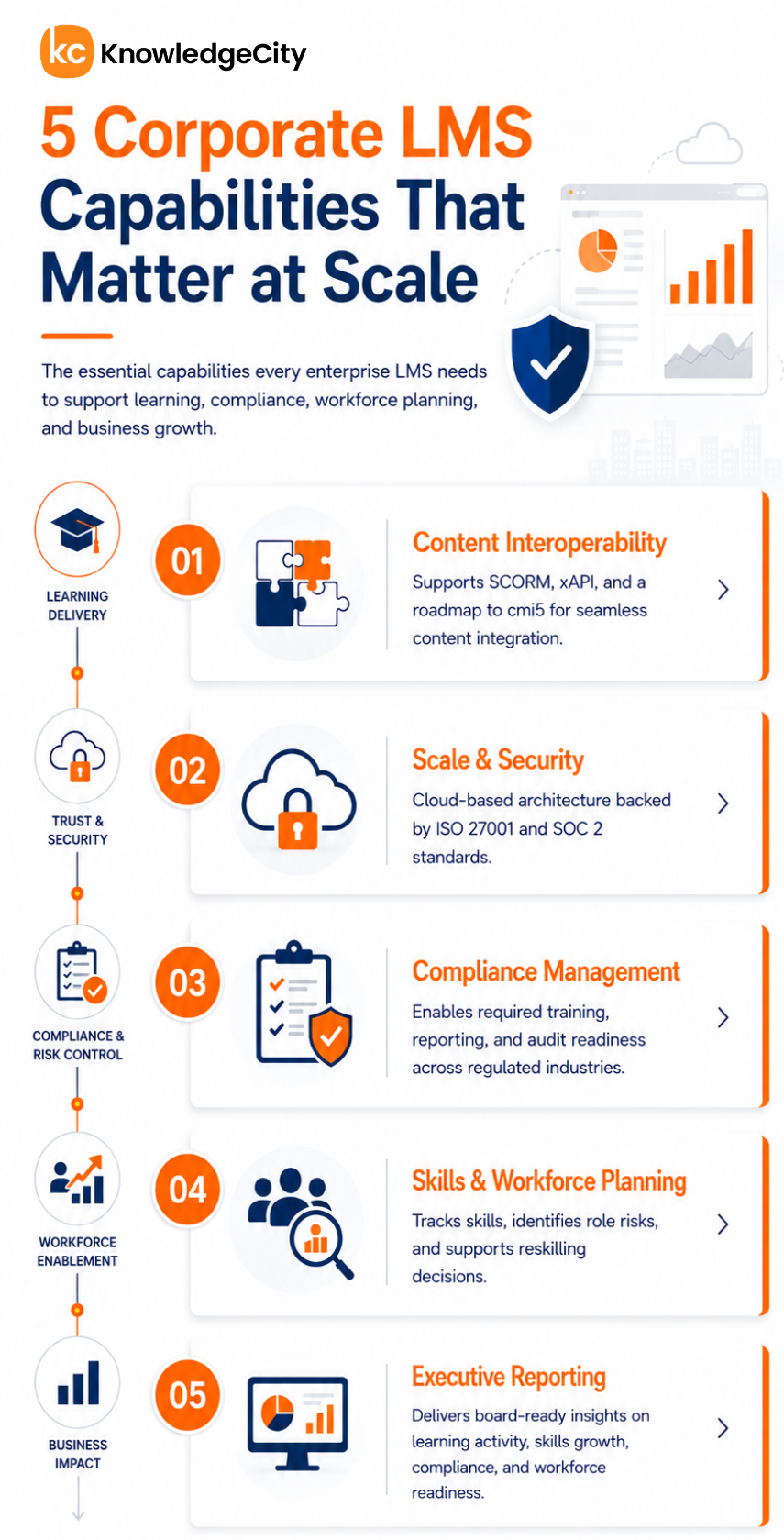
Five capabilities define what an enterprise LMS at scale has to do. Each capability is anchored in a regulatory expectation, an industry standard, or a workforce-planning requirement. KnowledgeCity outlines a comparable framework for L&D operations in its 10 must-have LMS features reading; the version below is enterprise-strategic.
Capability 1, Content Interoperability (SCORM, xAPI, cmi5)
A corporate LMS has to read content created in other systems. SCORM (Sharable Content Object Reference Model), developed by the U.S. Department of Defense’s Advanced Distributed Learning Initiative, has been the dominant interoperability standard since the early 2000s. xAPI (Experience API), released by the same ADL Initiative in 2013, captures learning activities across systems and is the standard for measuring learning that happens outside a course. cmi5, released by the ADL Initiative in 2016, builds on xAPI and adds the packaging and launch rules that SCORM defined, which makes it the specification to ask vendors about on the roadmap. A real enterprise LMS supports SCORM and xAPI today, with a stated path to cmi5. A system that handles only one standard is technical debt waiting to break on the next content vendor’s release.
Capability 2, Scale and Security (Cloud Architecture, ISO 27001)
The second capability is scale with security. ISO/IEC 27001 is the international standard for information security management systems and the procurement baseline for enterprise LMS buyers. Paired with a SOC 2 Type II report and a cloud architecture, ISO 27001 lets a 1,000-plus-seat organization roll out training without a year-long on-prem deployment cycle. The procurement section below covers how buyers test the architecture itself.
Capability 3, Compliance Pillar (BSA, OCC Appendix D, WIOA)
The third capability is operationalizing the compliance pillar. Section 5318(h) of the Bank Secrecy Act (31 USC 5318) requires financial institutions to maintain anti-money-laundering programs that include ongoing employee training. OCC Heightened Standards in 12 CFR Part 30 Appendix D require large national banks to maintain a written risk governance framework with a code of conduct overseen by the board. The Workforce Innovation and Opportunity Act (Public Law 113-128, enacted July 22, 2014) funds workforce-development programs at scale and sets reporting expectations that the LMS has to support. A course library cannot deliver any of those obligations on its own; only a corporate LMS connected to the bank or agency’s compliance management system can.
Capability 4, Skills and Workforce Planning (Skills Inventory, Role-Risk Mapping)
The fourth capability is feeding the workforce-planning layer. The Bureau of Labor Statistics Occupational Outlook Handbook publishes employment projections by occupation and is a standard reference for U.S. workforce-development program design. Inside the organization, the LMS records skills data the chief HR officer and chief learning officer use to map role-risk, plan reskilling, and prioritize training spend. KnowledgeCity’s reading on building a reskilling strategy covers the practical steps that turn skills data into a workforce-planning input.
Capability 5, L&D Leadership Reporting (CLO Dashboards, Board Minutes)
The fifth capability is board-grade reporting. LinkedIn’s 2024 Workplace Learning Report finds that 90% of organizations are concerned about employee retention and that providing learning opportunities is the top retention strategy, which puts L&D reporting directly in the board’s line of sight. The Association for Talent Development’s 2025 State of the Industry report tracks per-employee L&D spend benchmarks ($1,254 in 2024, down slightly from $1,283 in 2023) that the board uses to compare the organization’s investment to peers. A real enterprise LMS produces the quarterly dashboard that ties training completion, skills change, and incident-related remediation into the report the board signs off on.

Replace Nine Disconnected Tools with One Workforce Development Platform.
KnowledgeCity’s workforce development platform unites the LMS, learning library, AI course creation, policy and incident management, competency mapping, skills and talent assessment, and performance reviews in one operating model.
Why a Corporate LMS Is Different from a Course Library
A course library and a corporate LMS are not the same product. A course library is content; a corporate LMS is infrastructure. The difference is where the audit trail lives, how role-risk maps are built, and whether the system reports to the board on a quarterly cycle.
A course library, even a very deep one, delivers a catalog of learning content. The learner picks a course, completes it, and the system records the completion. The course library is the right product for a small organization or for a function inside a larger organization that needs depth of content but does not own enterprise reporting. KnowledgeCity covers the content side in its reading on how an AI-powered LMS simplifies compliance training, which is the layer the LMS adds on top of the content library.
A corporate LMS at scale does four things the course library does not.
- Routes content by role-risk so a bank teller and a custody operations lead see different mandatory training.
- Produces audit-grade evidence the bank can hand to an OCC, FDIC, or Federal Reserve examiner inside the exam window.
- Reports to the board on a quarterly cadence with minute-grade artifacts the risk committee can sign off on.
- Integrates with skills, performance, and workforce-planning systems so training completion is one input into the broader workforce conversation, not a standalone metric.
The course library is a feature inside the corporate LMS, which is in turn a layer inside the workforce development platform. A buyer who confuses the three procures content when the organization needs infrastructure.
Cloud-Based LMS vs On-Prem, the Procurement Question Most Teams Get Wrong
That positioning raises the next procurement question, and most teams still get it wrong. The procurement question for a corporate LMS in 2026 is no longer cloud vs on-prem. Cloud-based LMS architecture is the default; the question is which cloud-based LMS architecture supports the organization’s compliance, scale, and workforce-planning requirements.
Three criteria separate a working cloud-based LMS from a marketing-deck cloud LMS.
- Security certifications: ISO/IEC 27001 plus a SOC 2 Type II report (in scope for both security and availability) is the procurement baseline. A vendor that offers only SOC 2 Type I or that does not have ISO 27001 is a vendor enterprise buyers cut from the shortlist.
- Tenant isolation and data residency: Multi-tenant cloud architectures are the norm, but enterprise buyers in regulated industries need confirmation that learner data, completion records, and audit trails stay in the bank or agency’s tenant and within the required data-residency boundary.
- Integration depth: The cloud-based LMS has to integrate with the HRIS, the compliance management system, the performance management system, and the skills inventory. A vendor with strong content but weak integrations becomes a course library again at the procurement layer.
Buyers searching for the best LMS for corporate training in 2026 use these three criteria to cut a long shortlist down to two or three vendors. The vendor that wins is rarely the one with the prettiest demo; it is the one with the cleanest answer to the question, “what does the integration model look like with our existing HR and compliance stack?”
How the LMS Connects to Compliance, Performance, and Workforce Development
The architecture above matters at the integration layer, where the next set of capabilities lives. An LMS that stays inside the learning silo is a course library. An LMS connected to compliance, performance, and workforce development is the workforce development platform’s training engine. The connection is what turns LMS data into board-level signal.
The Compliance Connection
Training-completion evidence under BSA 31 USC 5318(h), OCC Appendix D, the WIOA reporting framework, and sector-specific regulators (FINRA, FFIEC, OCC, FDIC) flows out of the LMS and into the compliance management system. The board’s quarterly compliance report depends on this flow working at the role level, with timestamps and version-control metadata intact.
The Performance Connection
Completion data and skills-assessment results from the LMS feed the performance management system so a manager’s review reflects what the employee learned this quarter and what skills the role still requires. The connection is the difference between a performance review that points at last year’s training catalog and one that points at this quarter’s capability growth.
The Workforce-Planning Connection
Skills data from the LMS, role-risk maps from compliance, and headcount data from the HRIS feed the workforce-planning function. The WEF Reskilling Revolution goal of reaching 1 billion people by 2030 (launched at Davos in January 2020) works at enterprise scale as upstream pressure: it makes the LMS-to-workforce-planning connection a strategic requirement rather than a nice-to-have. KnowledgeCity’s reading on closing the skills gap covers the practical side of how an HR team uses skills data to plan workforce moves.
When all three connections are live, the LMS stops being a training tool and becomes the training engine of the workforce development platform, with the rest of the operating model built on top of it.
The LMS Bar by 2027
The integration model above sets the LMS bar by 2027. A standalone LMS without integration into compliance, performance, and workforce-planning is technical debt. The market signal is already moving.
Three forces raise the bar. The WEF Future of Jobs Report 2025 projects 39% of workers’ existing skill sets will be transformed or become outdated by 2030; the organizations that wait until 2028 to act on this number will be reskilling on a compressed timeline. The WEF Reskilling Revolution target of 1 billion people reskilled by 2030 is the upstream demand signal LMS vendors are designing around. The regulatory layer (BSA 5318(h), OCC Appendix D, FINRA, FFIEC) has demonstrated through the Wells Fargo asset cap (in place from February 2018 until the Federal Reserve lifted it on June 3, 2025) that the agencies will cap a bank’s growth over weak governance of risk and conduct.
The Provocation. By 2027, choosing an LMS is the easy part. The hard question is whether the LMS is connected to compliance, performance, and skills, so the board’s quarterly review of the workforce reads as one story and not five disconnected exports.
An HR or L&D leader who lands the platform decision in the next twelve months is making a decision that has to survive three exam cycles, two performance cycles, and one strategic-planning cycle. The framework above is what survives.
Conclusion
The enterprise LMS in 2026 is workforce-development infrastructure, not a training tracker. The board owns the framework, the regulators test the audit trail, and the workforce-planning function reads the skills data. An HR or L&D leader who treats the LMS decision as a content question buys a course library. An HR or L&D leader who treats it as an infrastructure question buys the training engine of a workforce development platform.
One Platform. One Record. One Story for the Board.
KnowledgeCity’s workforce development platform unites the LMS, learning library, AI course creation, policy and incident management, competency mapping, skills and talent assessment, and performance reviews in one operating model.
Frequently Asked Questions
1. What Is the Difference Between an Enterprise LMS and a Course Library?
A course library is a catalog of learning content; an enterprise LMS is the infrastructure that delivers role-risk-routed content, produces audit-grade evidence, reports to the board, and integrates with HR, compliance, performance, and workforce-planning systems. A course library can sit inside an enterprise LMS; an enterprise LMS rarely sits inside a course library. For a 1,000-plus-seat organization with multiple regulators in scope, the enterprise LMS is the procurement target, with the course library as one of its content sources.
2. What Do SCORM and xAPI Mean for Corporate LMS Procurement?
SCORM (Sharable Content Object Reference Model) and xAPI (Experience API) are content-interoperability standards developed by the U.S. Department of Defense’s Advanced Distributed Learning Initiative. SCORM has been the dominant LMS content standard since the early 2000s; xAPI was released in 2013 to capture learning activities outside the LMS. A real corporate LMS supports both. A vendor that handles only one is technical debt; the organization’s content investment is locked to a standard that the next vendor switch will not honor.
3. How Big Does an Organization Have to Be Before It Needs a Corporate LMS?
The threshold has less to do with headcount than with auditability. Spreadsheets fail at the moment the organization cannot answer a regulator’s audit question inside the audit window. Below 500 employees an organization can run training on spreadsheets and email reminders. Above 1,000 employees with multiple regulators in scope and quarterly board reporting expected, the cost of not having a corporate LMS exceeds the cost of buying one. KnowledgeCity’s reading on the five signs an organization needs an LMS covers the diagnostic in more detail.
4. Is a Cloud-Based LMS Secure Enough for a Regulated Industry?
A cloud-based LMS that holds ISO/IEC 27001 certification and provides a SOC 2 Type II report (in scope for both security and availability) clears the procurement baseline for most regulated industries, including banking, healthcare, and federal contractors. Beyond the certifications, regulated buyers also confirm tenant isolation, data-residency boundaries, and the integration model with the HRIS, compliance, and performance systems. The cloud-based LMS in 2026 is the default architecture; the question is which one meets the organization’s specific regulatory stack.
5. How Does an LMS Fit Into a Workforce Development Platform?
A workforce development platform is the operating model that integrates the LMS, course library, compliance training, skills assessments, and performance reviews on one stack. The LMS is the training engine inside that platform. By 2027 the LMS is no longer a standalone product for a 1,000-plus-seat organization; it is the engine that produces the audit-grade training evidence, the skills data, and the L&D leadership reporting the rest of the workforce development platform depends on. An LMS that does not connect to the broader platform is technical debt.
References
- World Economic Forum. “The Future of Jobs Report 2025.” weforum.org
- Association for Talent Development. “2025 State of the Industry: Talent Development Benchmarks and Trends.” td.org
- U.S. Government Publishing Office. “Workforce Innovation and Opportunity Act, Public Law 113-128,” July 22, 2014. govinfo.gov
- LinkedIn Learning. “2024 Workplace Learning Report.” learning.linkedin.com
- U.S. Bureau of Labor Statistics. “Occupational Outlook Handbook.” bls.gov
- McKinsey & Company. “Beyond Hiring: How Companies Are Reskilling to Address Talent Gaps.” mckinsey.com
- World Economic Forum. “The Reskilling Revolution: Better Skills, Better Jobs, Better Education for a Billion People by 2030,” January 2020. weforum.org
- International Organization for Standardization. “ISO/IEC 27001, Information Security Management Systems.” iso.org
- Office of the Law Revision Counsel, U.S. House of Representatives. “31 USC 5318(h), Bank Secrecy Act anti-money-laundering program requirements.” uscode.house.gov
- Office of the Comptroller of the Currency. “Heightened Standards, 12 CFR Part 30, Appendix D.” ecfr.gov
- Advanced Distributed Learning Initiative. “SCORM (Sharable Content Object Reference Model).” adlnet.gov
- Advanced Distributed Learning Initiative. “Experience API (xAPI).” adlnet.gov
- Board of Governors of the Federal Reserve System. “Federal Reserve Board terminates enforcement action against Wells Fargo & Company,” press release, June 3, 2025. federalreserve.gov