
Harassment complaints in hospitality rarely appear suddenly. They often emerge after months of unclear expectations, inconsistent enforcement, and missed warning signs. As an HR or L&D professional, you navigate these complexities every day, ensuring employees feel safe, operations remain smooth, and legal obligations are met in an industry where turnover is high, customer interaction is constant, and workplace pressure never fully disappears.
In hospitality, harassment prevention carries tangible consequences. It affects employee retention, impacts brand reputation, and exposes organizations to legal liability. Understanding what the law requires and where your teams are most vulnerable is essential before deciding how to meet those requirements across multiple locations and roles.
This blog outlines the current harassment training requirements for hospitality employers, explains why these rules matter for your teams, and highlights what compliance looks like in practice.
Why Sexual Harassment Risk Is Higher in Hospitality
Hospitality workplaces create conditions that make harassment more likely than in many other industries. Employees often work long or irregular hours, rotate between shifts, and report to multiple supervisors. They interact constantly with guests and coworkers in high-pressure situations. Many roles are customer-facing or rely on tips, which can create power imbalances and increase stress.
These structural factors make it harder for inappropriate behavior to be noticed or reported early. The fast pace of operations, combined with frequent turnover and seasonal hiring, means employees may not have time to learn policies or feel confident raising concerns.
For you, understanding these factors is essential. Certain roles, locations, or times of day carry higher exposure to risk, and being aware of these patterns allows you to prioritize training, supervision, and support effectively. Monitoring incident reports, feedback, and workplace dynamics helps identify emerging risks before they escalate.
Harassment prevention training becomes most effective when it reflects these realities. Providing clear guidance for employees, reinforcing supervisor accountability, and combining training with practical oversight help your teams navigate the unique challenges of hospitality. This approach strengthens workplace culture, reduces operational risk, and supports employee trust and retention.
Federal Harassment Training Expectations Under EEOC Guidance
At the federal level in the United States, there is no law mandating harassment training for most private employers. Title VII of the Civil Rights Act of 1964 prohibits workplace harassment but does not require specific training.
However, the Equal Employment Opportunity Commission (EEOC) strongly encourages employers to provide regular, interactive harassment prevention training. Training helps prevent misconduct, supports reporting, and is often essential to establishing a valid legal defense.
Under the Faragher/Ellerth standard, employers may assert an affirmative defense against certain supervisor harassment claims by showing: (1) they took reasonable care to prevent and correct harassment, including through training, and (2) the employee did not reasonably use available complaint procedures. Employers without consistent training may be unable to establish this defense, particularly when supervisors are involved.
This federal framework provides important context for understanding state and local requirements.
State Laws That Require Harassment Training
Many states have moved beyond encouragement and now require harassment training by law. These requirements vary widely, which creates added complexity for hospitality employers operating across multiple locations.
California Harassment Training Requirements
California requires employers with five or more employees to provide sexual harassment prevention training. Supervisors must complete two hours of interactive training every two years, and non-supervisory employees must complete one hour on the same schedule. New hires and newly promoted supervisors must be trained within six months. The law also expands protected categories beyond federal standards, increasing the scope of content that must be covered. For hospitality employers with large hourly workforces, keeping up with these timelines is a recurring compliance challenge.
Connecticut Requirements
Connecticut requires employers with three or more employees to provide sexual harassment prevention training. Supervisors must receive two hours of training, and non-supervisory employees must also receive two hours. Training must be completed within six months of hire or promotion to a supervisory position. While the law requires training at least once every ten years, the state strongly encourages refresher training every three years.
These requirements apply to all employees working in Connecticut, regardless of where the company is headquartered.
Delaware Requirements
Delaware requires employers with fifty or more employees in Delaware to provide interactive sexual harassment prevention training. Training must occur within one year of hire and be repeated every two years. Both employees and supervisors are covered. Training content must address the illegality of sexual harassment, definitions with examples, legal remedies and complaint processes available to employees, Delaware Department of Labor contact information, and the prohibition against retaliation. Supervisors must additionally receive training on their specific responsibilities for preventing and correcting harassment.
Illinois Requirements
Illinois law requires all employers with one or more employees working in the state to provide sexual harassment prevention training to all employees at least once every calendar year, with training completed by December 31. While the law does not mandate a specific deadline for new hires, employers are strongly encouraged to train new employees as soon as possible after hire, as employers are liable for harassment by new employees immediately upon their employment. The training must explain sexual harassment as defined under the Illinois Human Rights Act, include examples of prohibited conduct, summarize relevant federal and state laws and available remedies, and outline employer responsibilities for prevention, investigation, and corrective action.
Restaurants and bars have additional requirements and must provide annual, industry-specific supplemental training in English and Spanish, and must establish and distribute a written sexual harassment prevention policy to employees in both languages within the first calendar week of employment.
Maine Requirements
Maine requires employers with fifteen or more employees to provide sexual harassment training within one year of hire. Supervisors and managers must receive additional instruction focused on their role in preventing and addressing misconduct.
New York State Requirements
New York State requires all employers to provide annual interactive sexual harassment prevention training to every employee who works any portion of their time in the state, including full-time, part-time, seasonal, and temporary employees. The training must be interactive and include an explanation of sexual harassment consistent with state guidance, examples of prohibited conduct, information on employee rights and reporting options, and an overview of protections and remedies available under New York State and federal law.
New York City Requirements
In addition to New York State’s requirements, New York City law requires employers with 15 or more employees to provide annual interactive anti‑sexual harassment training to all employees, including supervisory and managerial employees, who work in the City (and to interns and independent contractors who meet the work thresholds), and employers must retain records of training completion, including signed acknowledgments, for at least three years.
NYC employers are also required to distribute required sexual harassment prevention notices and fact sheets to employees, and the training must cover city, state, and federal protections, examples of prohibited conduct, internal and external complaint processes, prohibition on retaliation, bystander intervention, and related supervisory responsibilities under the Stop Sexual Harassment in NYC Act.
Washington State Requirements
Washington State does not require harassment training for all hospitality employees. The law applies specifically to isolated workers in certain industries, including hospitality.
Covered roles include hotel housekeepers, room service attendants, janitors, and security staff who work alone or primarily alone. Employers of these isolated workers must provide training on sexual harassment, sexual assault, and discrimination prevention.
The training must cover employee rights, reporting procedures, available state and federal remedies, protections against retaliation, and resources such as the Equal Employment Opportunity Commission and the Washington State Human Rights Commission.
Employers must implement written policies and, for roles at risk, provide access to emergency tools such as panic buttons. Training completion must be documented to verify compliance.
Local Ordinances That Affect Hospitality Employers
Some cities and districts have additional rules that directly affect hospitality businesses.
Chicago, Illinois requires annual harassment prevention training, including bystander intervention. Supervisors must receive at least two hours of training, with additional content specific to management responsibilities.
Washington, D.C. mandates recurring harassment training for tipped workers and hospitality employees, including prevention, reporting, and bystander intervention components.
For you, this means compliance cannot stop at the state level. Local ordinances can apply even when state law does not, especially in major hospitality markets.
Recordkeeping and Proof of Compliance
One of the most common compliance failures in harassment prevention is not the absence of training but the absence of accurate, retrievable documentation showing that training occurred and met legal expectations. Many state and local laws now require employers to retain detailed records that demonstrate training completion, content, provider details, and participation. These records become essential when regulators audit your compliance or when a complaint arises months or years after the fact.
What Documentation Should Include
To be legally defensible and compliant in jurisdictions with mandates, employers should maintain records that typically include the following, based on applicable state and local requirements:
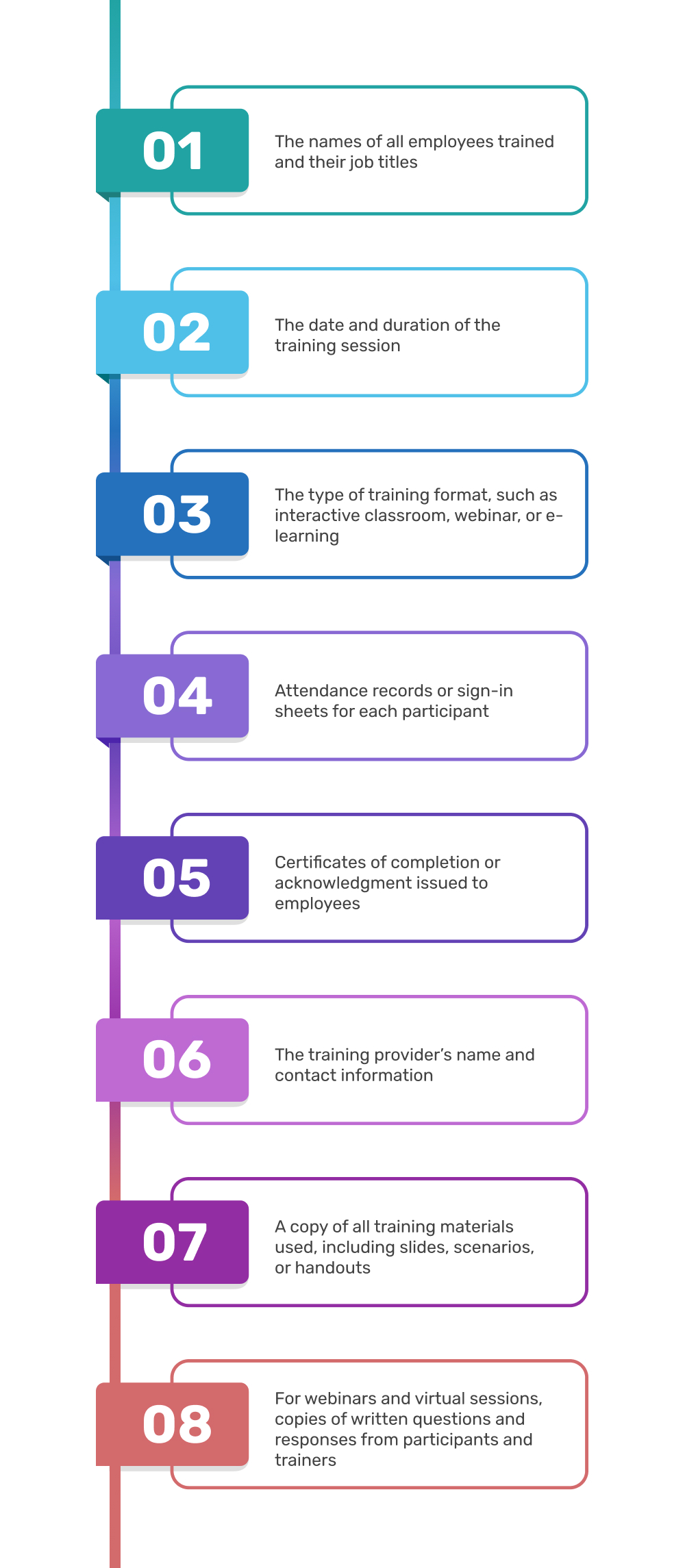
These requirements are not hypothetical. For example, California’s harassment prevention law requires employers to retain all of this information for at least two years and, for e-learning or webinars, specifically to retain participation records and trainer responses for the same period.
Jurisdiction-Specific Record Retention
Record retention timelines differ between jurisdictions and even between city and state laws. For example:
- In New York City, employers must retain training records, including signed employee acknowledgments, for at least three years and make them available for inspection if requested by local authorities
- In Chicago, employers must retain written records of policies and training sessions for at least five years or the duration of any related claim or civil action, whichever is longer
This variation is significant for hospitality employers that operate across multiple locations. Understanding and complying with each locality’s rules ensures that training documentation holds up under scrutiny when your organization most needs it.
Why Recordkeeping Is More Than a Compliance Task
In hospitality, where employees frequently transfer between roles or locations and where seasonal, part-time, and temporary hires are common, maintaining accurate training documentation can feel like an operational burden. It is also a strategic safeguard:
- Defensive Evidence: In the event of a claim, clear documentation helps demonstrate that your organization did not ignore legal obligations but instead took structured preventive action
- Audit Readiness: Regulators can request training records during routine compliance checks or in response to complaints. Having organized documentation avoids last-minute scrambling
- Trend Identification: Training records help you see where completion rates lag or where content may not resonate, enabling you to adjust delivery and messaging for better impact
- Policy Enforcement: Documentation reinforces that training is not a one-time requirement but part of consistent organizational standards that apply across shifts and locations
These records become particularly critical when someone questions whether a training session truly occurred or whether it met the interactive standards that many states require for supervisor and employee sessions.
Consequences of Non-Compliance in Hospitality
Failing to meet workplace harassment training and documentation requirements exposes hospitality employers to multiple levels of risk, and these risks often intersect in ways that directly affect your teams and operational effectiveness.
Legal and Financial Risk
When documentation is incomplete, inconsistent, or missing, courts and regulatory bodies can interpret the absence of records as a failure to meet legal obligations. This can lead to:
- Increased damages in harassment claims because the absence of training records undermines your compliance defense
- Regulatory penalties in jurisdictions with mandatory training and strict audit rights
- Lengthy litigation costs that arise from defending incomplete documentation rather than addressing policy substance
The legal analysis in these cases often hinges not only on whether employees received training but whether your organization can prove every session met legal requirements under the applicable state or local law.
Organizational and Operational Impact
Harassment that goes unaddressed or where employees feel empowered to challenge inadequate training can cause immediate operational strain in hospitality settings. Common consequences include:
- Higher turnover, especially among frontline and seasonal staff who may already feel vulnerable in customer-facing roles
- Lower morale across teams when employees believe policies are not enforced or consistently documented
- Management instability when supervisors are unclear about expectations or their accountability roles
These operational disruptions ripple across service delivery, scheduling, and team cohesion.
Brand and Reputational Exposure
Guest-facing businesses depend heavily on reputation. A harassment complaint that becomes public can affect more than the location where the incident occurred. It can affect bookings, partnerships, employee recruiting, and customer trust. In hospitality, where brand perception directly influences revenue, the reputational cost of compliance failure can be significant.
Responsibility Lands on HR and L&D
For HR and L&D professionals, these consequences do not stay abstract. They show up in your inbox, in leadership escalations, and in board-level conversations about risk and workplace culture. Robust documentation supports your position when explaining compliance efforts, training strategies, and risk mitigation outcomes to leadership.
Investing in centralized and structured recordkeeping helps protect your teams, reinforces consistent training delivery, and safeguards your organization legally, operationally, and reputationally.
4 Tips for HR and L&D Professionals: Building a Harassment-Resistant Culture Beyond Compliance
Harassment prevention in hospitality is complex. As we discussed earlier, high turnover, rotating shifts, and guest-facing roles increase risk exposure. Training and policies that are integrated with operations can help your teams prevent incidents, respond appropriately, and maintain consistent accountability.
These four tips provide practical ways to strengthen your culture while supporting HR and L&D responsibilities.
Tip 1: Identify High-Risk Scenarios and Roles
Harassment often occurs in specific contexts such as late-night shifts, high-pressure guest interactions, or areas with minimal supervision. To address these vulnerabilities:
- Analyze incident and near-miss reports to detect trends across roles, locations, and shifts.
- Prioritize training content and messaging for situations your employees encounter most often.
- Adjust staffing and supervision to ensure employees are supported in higher-risk scenarios.
Focusing on real operational risks increases the effectiveness of training and makes compliance defensible.
Tip 2: Integrate Accountability Into Daily Operations
Consistency in enforcement comes from making accountability part of routine work:
- Reinforce key policies during pre-shift briefings and team huddles.
- Incorporate completion and comprehension of harassment policies into performance tracking.
- Give supervisors visibility into reporting patterns and training completion for their teams.
Embedding accountability into everyday workflows ensures policies are understood and applied consistently across locations.
Tip 3: Tailor Training to Roles and Supervisor Responsibilities
Different positions face different exposure to harassment risks. Frontline staff, housekeeping, servers, and supervisors have distinct responsibilities:
- Customize training scenarios to match the challenges employees face in their specific roles.
- Emphasize supervisor obligations in preventing and responding to incidents.
- Use real-life examples that reflect daily operations and interactions with staff and guests.
Role-specific training clarifies expectations and supports both compliance and safe, respectful workplaces.
Tip 4: Use Data to Strengthen Culture and Compliance
Data from training and reporting provides strong insight for HR and L&D teams:
- Track completion, assessment scores, and participation to identify areas needing follow-up.
- Analyze reporting patterns to detect emerging risks or cultural gaps.
- Provide leadership with clear metrics demonstrating compliance and proactive risk management.
Leveraging data helps ensure training drives measurable improvements in behavior, awareness, and accountability.
Note: Training requirements update regularly. Verify current laws for your state and local jurisdictions.
Simplifying Compliance and Supporting Your Teams with KnowledgeCity
Managing harassment training, documentation, and culture across multiple locations can be complex. KnowledgeCity provides subject matter expert-developed courses designed specifically for hospitality, covering federal, state, and local requirements, including role-specific guidance for hotels, restaurants, and event venues.
Courses are regularly updated to reflect the latest regulations, ensuring your training remains current and defensible. Supervisors and frontline staff receive training that is relevant to their day-to-day responsibilities, helping them act confidently and consistently in real workplace scenarios.
Our Learning Management System (LMS) streamlines tracking and reporting, making it easy to monitor completion, maintain audit-ready records, and stay aligned with compliance requirements across all your locations.
With KnowledgeCity, your teams have clear guidance, accessible training, and centralized oversight, giving you confidence that your organization meets legal obligations while creating a workplace where employees understand expectations and can focus on their roles effectively.

 KnowledgeCity












Subscribe to Our Newsletter
Join 80,000+ Fellow HR Professionals. Get expert recruiting and training tips straight
to your inbox, and become a better HR manager.