Key Takeaways
- More than 90% of S&P 100 companies now include human capital oversight in their compensation committee charters (WTW, cited in What Directors Think 2026).
- Only 1 in 3 board members rates their board’s human capital governance as effective, while 66% of corporate secretaries expect CHRO board engagement to grow over the next 3 years.
- Only 29% of CHROs are confident they can deliver on strategic workforce planning goals (Gartner, cited by Deloitte).
- The SEC’s 2020 human capital disclosure rule remains in force; a broader rulemaking reached the agenda in 2023 but was later dropped.
- Boards now ask for succession readiness, skills gap coverage, and learning ROI, which activity metrics and disconnected systems cannot produce.
More than 90% of S&P 100 companies have either renamed their compensation committee or revised its charter to include human capital oversight, according to WTW, cited in Corporate Board Member’s What Directors Think 2026. The structural shift reflects a change in how boards define their oversight responsibility, shaped by skills scarcity, rapid AI adoption, and U.S. Securities and Exchange Commission (SEC) human capital disclosure requirements that placed workforce capability directly inside investor-facing reporting.
Governance quality lags well behind board engagement. Only 1 in 3 board members considers human capital governance on their board to be effective, according to a 2024 survey of more than 500 directors published in Directors and Boards in partnership with WTW. The board conversation has moved to the agenda, and the infrastructure required to make it consequential has not kept pace.
The Shift From Cost Center to Strategic Asset
How Boards Historically Positioned Workforce Spending
For most companies throughout the past decade, board engagement with workforce topics was limited to headcount approvals, executive compensation decisions, and annual reviews of voluntary turnover. Training budgets were operational expenses visible primarily during cost-reduction exercises, and the workforce was treated as a line item rather than analyzed as a variable capable of compounding or constraining strategic outcomes. That default held until a combination of competitive, regulatory, and technological forces began to reorder the governance agenda.
The 3 Forces Driving Workforce to the Board Agenda
- Skills scarcity has made talent availability a binding constraint on growth in sectors from technology to financial services to large-scale manufacturing. Companies that cannot fill technical roles, retain specialized knowledge workers, or reskill existing workforces at speed face a ceiling on their business plan that no financial tool can address directly. Boards have come to recognize that workforce capability is where strategy either compounds or stalls.
- AI and automation adoption has created a second and structurally distinct pressure. Organizations that have committed to AI deployment face a reskilling obligation at a scale that annual training calendars were not designed to manage, because the rate of role change exceeds what point-in-time training can track.
- SEC human capital disclosure, adopted in 2020 under Regulation S-K, added a third force by making human capital a required disclosure topic for public companies, bringing workforce development directly inside the documents that shareholders and analysts review. A broader, more prescriptive rulemaking reached the SEC’s regulatory agenda in 2023 but was subsequently dropped, leaving the 2020 principles-based requirement as the operative standard. The disclosure obligation and investor attention to it remain.
The Engagement-Effectiveness Gap Boards Cannot Ignore
The increase in board-level discussion has not produced a corresponding improvement in governance quality. Only 1 in 3 board members considers human capital governance on their board to be effective, and the confidence gap extends into HR leadership: only 29% of chief human resources officers (CHROs) report confidence in their ability to deliver on strategic workforce planning goals, according to Gartner research cited by Deloitte. Discussion frequency has run well ahead of the data quality and analytical frameworks that would allow those discussions to produce decisions.
The Conference Board’s April 2025 research captures the forward-looking pressure that gap creates. Surveying 55 corporate secretaries, the research found that 66% expect CHROs to become moderately or significantly more engaged with their board over the next 3 years, with only 2% anticipating any decline. That expectation lands on HR functions still building the data infrastructure required to meet it, making the distance between what boards are requesting and what most HR organizations can currently produce one of the defining challenges in workforce governance today.
What CEOs and Boards Are Now Asking CHROs About Workforce
The Questions Reshaping the CHRO Role
Boards and chief executives are now asking whether the organization has a workforce plan that forecasts talent needs 3 to 5 years into the future, what return the organization has achieved from identifying and developing internal successors for critical roles, and whether the company has current measures of workforce sentiment that can surface problems before they become attrition events. These are enterprise strategy questions that require the CHRO to operate as a board-level strategic partner who can connect workforce capability data to competitive and financial outcomes.
The Conference Board found that CHRO board engagement had increased at nearly 70% of public companies over the past 3 years. That increase in meeting frequency has not automatically translated into greater strategic influence over workforce decisions; what boards ultimately measure is not how often the CHRO presents but whether those presentations can connect workforce data to business plan execution. The capability to present workforce data in business terms has become the distinguishing factor between CHROs who shape strategy and those who report on it.
From HR Reporter to Board-Level Strategy Partner
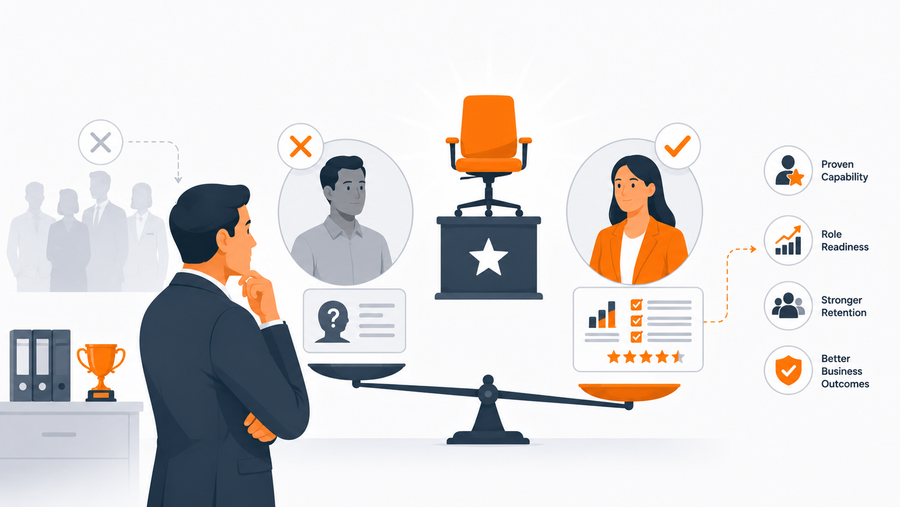
Making that transition is a data architecture question as much as a skills question. A CHRO who presents completion rates and enrollment figures is answering whether training happened. One who can present skills gap coverage by critical role, succession readiness movement quarter over quarter, and learning investment correlated to performance outcomes is answering whether the workforce is equipped to execute the plan.
KC Skills maps verified competency against role requirements, KC Performance ties reviews and 9-box succession workflows to assessed skills, and KC LMS reports it all on one data model.
The Workforce Metrics Boards Are Requesting From HR Leaders
Board data requests have shifted from headcount and completion summaries to performance and capability measures that connect the workforce directly to the business plan. The table below maps the board-level questions now appearing on governance agendas, the specific metrics each question requires, and the infrastructure HR must have in place to produce that data.
Board Question | Metric Required | HR Infrastructure Required |
|---|---|---|
Is our leadership pipeline secure? | Succession readiness ratio for critical roles | Competency data mapped to succession requirements for each key role, updated as development progresses |
Are we closing the skills gap? | % of workforce with verified competency vs. role requirements | Skills assessment linked to role-specific competency frameworks with gap visibility by function |
What return are we getting on learning investment? | Completion-to-performance correlation by role | Training records connected to performance outcome data in a unified platform, not separate systems |
Are we retaining critical talent? | Internal mobility rate plus voluntary turnover by role tier | Career pathing and assignment data at the individual employee level |
Are we building AI readiness? | % of workforce enrolled in reskilling for automation-affected roles | Course assignment informed by skills gap analysis by role, not job title alone |
Each of those infrastructure requirements depends on a learning system that records outcomes data, not just completion rates. A workforce development platform built for this delivers several capabilities that a fixed course catalog cannot support at board-level scale:
- Skills gap analysis data mapped to role requirements across the organization, updated as roles and competency frameworks evolve
- Learning completion linked to performance outcomes by role and function, producing the return-on-investment data boards are requesting
- Succession readiness measures that reflect current assessed competency, not historical training completion records
- Internal mobility data showing whether critical talent is being developed for advancement or stagnating in place
- Audit-ready records structured for board presentations and, for public companies, SEC human capital disclosure
What Strategic Workforce Planning Requires From HR Leaders Today
The board agenda shift represents a professional and organizational test for every HR leader in 2026. Those who can translate workforce capability data into business language, presenting succession readiness ratios, skills gap coverage rates, and learning investment tied to performance outcomes, gain access to the rooms where strategy is decided and funded. HR leaders who continue presenting activity metrics will find the board conversation advancing without the HR function as a substantive participant.
Strategic workforce planning at board-level resolution begins with infrastructure. An organization can employ a CHRO committed to workforce transformation and still present activity-level data at every board meeting when the underlying systems keep learning completion, competency frameworks, and succession planning in separate, unconnected records. The organizations that have built a unified architecture are managing workforce capability as a strategic variable with the same data discipline applied to revenue forecasting.
The industries where this shift is most advanced financial services, healthcare, and technology among them, share a defining characteristic. In each, workforce capability functions as a direct business constraint rather than a background HR priority, connected visibly to regulatory outcomes, customer experience, and growth capacity. For HR leaders across industries approaching a comparable inflection point, the practical implication is direct: boards are already asking about strategic workforce planning, and the finding that only 1 in 3 board members considers human capital governance effective confirms that the gap between board expectation and HR capability is real and measurable.
Turn completion records into board-ready intelligence. Skills gap coverage in KC Skills, role frameworks in KC Map, succession and review data in KC Performance, one shared data model.
Frequently Asked Questions
- What is workforce development, and why is it now a board-level priority?
Workforce development refers to the structured programs, training systems, and learning pathways organizations use to build and sustain the skills employees need to perform effectively. Traditionally managed as an operational HR function, it moved onto board agendas as 3 forces converged: skills scarcity made talent availability a binding constraint on growth, AI adoption created reskilling obligations at a scale requiring platform infrastructure, and the SEC’s 2020 human capital disclosure rule made workforce reporting an investor-facing matter for public companies. By 2026, more than 90% of S&P 100 companies had either changed their compensation committee’s name or revised its charter to include human capital oversight, according to WTW, cited in Corporate Board Member’s What Directors Think 2026.
- What workforce metrics do boards typically request from CHROs?
Boards are requesting performance and capability data that connects the workforce directly to business outcomes. The most commonly requested categories include succession readiness ratios for critical roles, skills gap progress mapped to business functions, learning investment correlated to performance outcomes, internal mobility rates as an indicator of talent development, and workforce sentiment measures that surface retention risk before it becomes attrition.
- How does a workforce development platform support board-level reporting?
A workforce development platform supports board-level reporting by creating a data architecture that connects skills assessment to competency frameworks, learning completion to performance outcomes, and workforce gap analysis to succession planning requirements. Going beyond completion records, the platform generates the outcomes data boards are requesting, including skills gap coverage by role, succession readiness by function, and learning investment correlated to capability improvement. For public companies, this infrastructure also supports SEC human capital disclosure by producing audit-ready records of workforce investment.
- What is the gap between board interest in workforce topics and actual governance quality?
Board interest in human capital has expanded substantially, with more than 90% of S&P 100 companies having broadened their compensation committee charter to include human capital oversight, according to WTW. Despite that engagement, only 1 in 3 board members considers human capital governance on their board to be effective, according to a 2024 survey of more than 500 directors published in Directors and Boards in partnership with WTW, and only 29% of CHROs report confidence in their ability to deliver on strategic workforce planning goals, per Gartner research cited by Deloitte. The gap persists because discussion frequency has outpaced the data infrastructure HR functions have built to support those discussions.
References
- Corporate Board Member and WTW. What Directors Think 2026.
- WTW and Directors and Boards. A Board Outlook on Effective Human Capital Governance, 2024.
- The Conference Board. The Evolving Role of the CHRO in the Boardroom, April 2025.
- Deloitte. Reinventing Workforce Planning, citing Gartner’s finding that 29% of CHROs are confident in delivering strategic workforce planning goals.
- U.S. Securities and Exchange Commission. Modernization of Regulation S-K Items 101, 103, and 105, adopted August 2020.