Key Takeaways
- Gallup’s 2015 State of the American Manager found that “organizations fail to choose the candidate with the right talent for the manager job a whopping 82% of the time.”
- Widely cited CEB / Gartner findings put first-time-manager failure at roughly 50-60% within 18 to 24 months, and HBR-cited research puts new-role underperformance at close to 50% during the first 18 months.
- Decades of industrial-organizational psychology research (Schmidt & Hunter meta-analyses; assessment-center longitudinal studies) show general mental ability, personality/behavioral measures, and structured interviews predict role performance substantially better than past performance alone.
- A talent management system built for promotion decisions runs the same profile against every candidate: cognitive ability, behavioral traits, leadership aptitude, and job-fit scoring produce a defensible, comparable record rather than a memory-based recommendation.
A senior account manager delivers strong quarterly results for two years. When a team lead position opens, her director recommends her based on tenure and institutional knowledge. Nine months into the role, two team members have resigned, a third has escalated a performance concern, and the director is quietly asking HR what went wrong. The account manager was excellent at individual contributor work. Managing a team with competing priorities and strong personalities required a different cognitive and behavioral profile, and that profile was never examined before the decision was made.
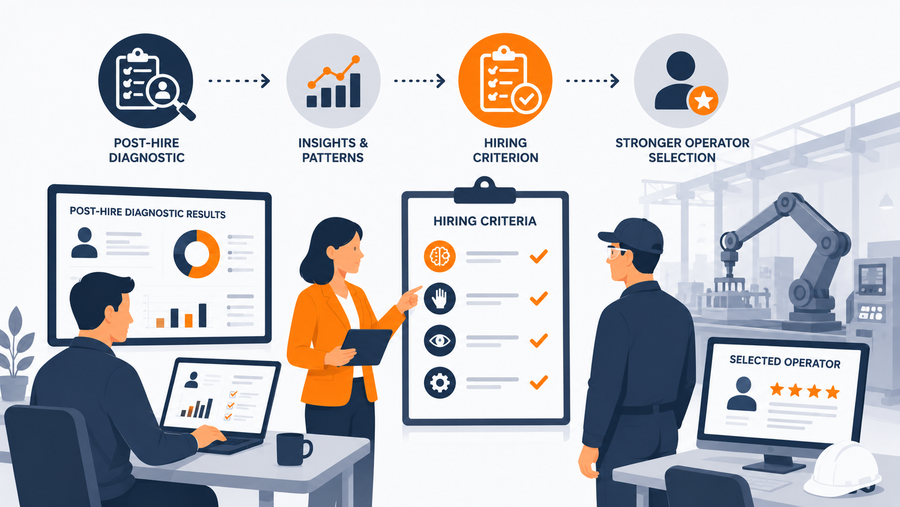
Most promotion decisions rest on performance history and manager judgment, two inputs that describe past behavior in a prior role rather than predicted fit for the next one. A structured talent assessment adds the third input by scoring a candidate’s cognitive ability, behavioral traits, and leadership aptitude against the specific demands of the target role, creating the evidentiary basis for an informed promotion choice.
The Hidden Cost of Getting a Promotion Wrong
Why the Damage Distributes Across Multiple Cost Centers
Organizations tend to undercount the cost of a misplaced promotion because the damage distributes across multiple cost centers and time periods. The promoted employee may plateau, reduce team output by a measurable margin, or generate turnover among high performers who decide the management environment is not worth staying in. None of these costs appear on a single budget line that would trigger a process change.
The core error in most promotion decisions is treating past performance as a proxy for future role fit. A skilled individual contributor who excels through technical precision and personal discipline may struggle in a role requiring sustained influence, ambiguity tolerance, and coaching capacity across a team with varied skill levels. Those are distinct constructs, and they show up in behavioral and psychometric data rather than in quarterly performance ratings.
What the Research Says About New-Manager Failure
Two independent research streams describe the size of the problem:
- Gallup, State of the American Manager (2015): “Organizations fail to choose the candidate with the right talent for the manager job a whopping 82% of the time,” selecting instead for tenure and technical performance in a prior position.
- CEB / Gartner and HBR-cited research: roughly 50-60% of first-time managers fail or underperform within 18 to 24 months of the promotion, with the misfit typically surfacing through team-level turnover or productivity decline rather than individual-level firing.
The pattern is consistent enough that talent leaders now describe management promotion as a specific decision-support problem, not a general performance-review outcome. That is why talent assessment tools help organizations make better workforce decisions across the internal mobility cycle.
What Talent Assessment Tools Reveal That Performance Records Cannot
The Three Constructs Structured Assessments Measure
Structured talent assessment tools measure the constructs that predict role success rather than the outputs of a prior job:
- Cognitive ability assessments evaluate reasoning speed and problem-solving under time pressure. Industrial-organizational psychology meta-analyses by Schmidt and Hunter identify general mental ability (GMA) as the single strongest general predictor of job performance across job levels, with validity coefficients around r ≈ .50.
- Behavioral and personality assessments map traits such as conscientiousness, openness to feedback, and interpersonal drive against a configurable role profile built for the specific position being filled. Leadership-focused personality measures show moderate but reliable validity (r ≈ .30-.45) for leadership effectiveness.
- Job-fit scoring compares a candidate’s trait profile directly against the competency model for the target role. Combined validity for structured assessment together with GMA and structured interviews runs in the .60-.70+ range, meaningfully above unstructured-interview or past-performance-only decisions.
Why the Numbers Behind the Assessments Change the Decision
A candidate who scores 91 in cognitive ability but 48 in team-direction behaviors represents a meaningful mismatch that manager judgment may never surface. A structured scored report can communicate that mismatch clearly before the offer is made or the internal announcement is finalized. That is the incremental validity the assessment layer adds to what would otherwise be a one-dimensional decision, and it matters in the same way skills assessments carry significance at every layer of the org chart.
Score Promotion Candidates Before the Offer
KC Talent runs psychometric and behavioral assessments with job-fit scoring for every candidate.
How Job Fit Assessment Guides the Internal Mobility Decision
Building the Role Profile First
The assessment-based approach to promotion begins with a role profile that defines the cognitive threshold, behavioral traits, leadership style, and key tension points the position actually demands. An organization that establishes these parameters before evaluating candidates creates an objective standard that every candidate is measured against, regardless of who advocates for their promotion.
Running the Assessment Against Every Candidate
Each candidate then completes a structured talent assessment that evaluates them across the defined dimensions. A fit scoring algorithm generates a ranked output identifying where candidates align and where gaps exist. Behavioral interview guides built from the assessment results give the hiring manager specific questions to probe the areas the data flagged as potential misfits, structuring the human judgment step with relevant, evidence-based questions.
Keeping the Decision Human, Just Better Informed
The promotion decision remains human, but it is a human decision made with a complete picture rather than a partial one built from memory and preference. Longitudinal research on assessment centers documents this incremental validity directly: assessment-center overall ratings produce a significant increment in validity for predicting promotion beyond supervisors’ performance ratings alone. Structured assessment does not replace manager judgment. It corrects for its known blind spots.
The Shift From Rating Employees to Measuring Readiness
Most organizations have performance management data available at every promotion cycle. A five-out-of-five rating tells you someone executed well in their current assignment. Whether the cognitive and behavioral profile behind that performance is matched to what the next role demands is the question that a structured talent assessment is designed to answer. The answer shapes whether the promoted person thrives or plateaus in the first year.
Adding a structured assessment step requires inserting one decision gate before the promotion is announced rather than replacing the entire performance management system. Organizations that adopt this model gain cleaner succession conversations, faster onboarding curves in promoted roles, and a documented rationale for every internal mobility decision that the broader HR team can audit and improve over time. The buyer question surfaces most clearly during the LMS vs. workforce development platform decision, because talent management systems and performance management software both live at the workforce-development layer rather than in a standalone LMS.
How KC Talent and KC Performance Structure Promotion Decisions on Evidence
The Thrive pillar of the KnowledgeCity platform is where this workflow lives. Thrive’s frame is direct: “Hire on fit. Review on data. Develop on signal.”
What KC Talent Delivers for the Promotion Decision
KC Talent delivers the psychometric and behavioral assessment framework organizations need to build promotion decisions on data rather than intuition. Three verified capabilities support the promotion workflow:
- Psychometric and behavioral assessments: cognitive ability, behavioral traits, and leadership aptitude on one report.
- Job-fit scoring + interview guides: the fit score identifies alignment and gaps; the interview guide gives the hiring manager evidence-based questions for the final round.
- Job-fit scoring for every candidate: the same profile runs against every candidate in the succession pipeline, external or internal, so the comparison is defensible.
What KC Performance Contributes to the Decision Set
KC Performance provides the performance history that serves as context for the assessment results. Three verified capabilities cover the review layer:
- Goals, 360° feedback, and 1:1s: the record the promotion decision draws on, not just the annual review.
- Tied to outcomes, not the form: review data reflects what the employee delivered, not how neatly the paperwork closed.
- Calibrated reviews across every manager: so a five-out-of-five from one manager means the same thing as a five-out-of-five from another.
What the Combination Produces at Decision Time
Together, KC Talent and KC Performance give HR leaders and talent decision-makers a consolidated view of each candidate’s documented performance in the current role alongside a scored readiness prediction for the next one. Organizations that build this process into their promotion cycle gain a defensible, repeatable standard for internal mobility that reduces derailment events and measurably improves team outcomes in the first year after promotion. The same discipline shows up in the workforce development strategy heading toward 2028 that HR teams are already planning around.
Build Every Promotion Decision on Evidence
KC Talent scores the readiness prediction. KC Performance holds the context. Both sit on the same employee record.
Frequently Asked Questions
1. What does a talent assessment measure that a performance review does not?
A talent assessment measures cognitive ability, behavioral traits, and leadership aptitude, all of which predict whether someone is ready for a new role rather than describing how well they performed in their current one. Performance reviews document output in a familiar environment. A structured assessment evaluates the underlying profile that will determine success when the scope, the reporting structure, and the expectations all change at once.
2. How does a job fit assessment reduce promotion failure rates?
A job fit assessment generates a scored comparison between a candidate’s trait profile and the competency model for the target role. It surfaces mismatches before the promotion is finalized, giving the organization an opportunity to adjust the candidate pool, provide targeted preparation, or recalibrate the role definition before the announcement is made. Assessment-center longitudinal research shows structured assessment ratings produce a significant increment in predictive validity for promotion beyond supervisors’ performance ratings alone.
3. Can talent assessment tools be used for internal promotions, not just external hires?
Yes, and internal mobility is one of the highest-value use cases for structured talent assessment tools. Internal candidates carry performance history that can create a halo effect in manager evaluations. A structured assessment provides an independent data point that separates the candidate’s track record from their readiness for a different type of work, making the internal mobility decision more defensible and more accurate.
4. How often do organizations get the manager promotion decision wrong?
Gallup’s 2015 State of the American Manager report found that organizations fail to choose the candidate with the right talent for the manager job 82% of the time. CEB / Gartner research puts new-manager failure rates at roughly 50-60% within 18 to 24 months of the promotion. The size of the gap between promotion decisions built on past performance alone and promotion decisions built on structured assessment is measurable in team-level outcomes.
5. How do KC Talent and KC Performance support the promotion decision process?
KC Talent runs psychometric and behavioral assessments, provides job-fit scoring paired with interview guides, and delivers job-fit scoring for every candidate. KC Performance covers goals, 360° feedback, and 1:1s; ties review data to outcomes rather than paperwork; and produces calibrated reviews across every manager. Together they give HR leaders a consolidated view of documented performance in the current role and a scored readiness prediction for the next one.
References
- Gallup. State of the American Manager: Analytics and Advice for Leaders (2015). “Organizations fail to choose the candidate with the right talent for the manager job a whopping 82% of the time.”
- CEB / Gartner and Harvard Business Review. New-manager failure and post-promotion underperformance research (approximately 50-60% failure or underperformance within 18-24 months).
- Schmidt, F. L., & Hunter, J. E. (1998). The validity and utility of selection methods in personnel psychology: Practical and theoretical implications of 85 years of research findings. Psychological Bulletin, 124(2), 262–274. https://doi.org/10.1037/0033-2909.124.2.262