
In the past year, conversations in executive meetings have changed.
Instead of asking only about hiring pipelines or engagement scores, leadership is asking harder questions.

For HR or L&D professionals, these are not theoretical concerns. They directly affect how you allocate budget, design programs, and define workforce priorities. Your decisions influence whether your teams stay relevant or struggle to keep pace.
Automation is accelerating. AI systems draft reports, analyze data, support customer service, assist in coding, and screen candidates. As more routine and analytical tasks shift to machines, the value of distinctly human capabilities becomes more visible, not less.
The real challenge is not whether automation will change work. It already has. The real challenge is defining what human contribution should look like inside your organization and preparing your teams for that reality.
This blog outlines the human skills that matter most today and explains why they deserve focused development inside your training strategy.
Why Human Skills Are Increasing In Value
Automation performs well when work is predictable, repetitive, and based on structured data. It struggles when context shifts, values conflict, or human dynamics influence outcomes.
Your workplace is filled with context. Your teams deal with incomplete information, competing priorities, sensitive employee concerns, and high-stakes decisions. These situations require judgment, communication, and ethical reasoning.
Most employers are redesigning roles, so automation handles routine tasks while people focus on higher-value work. That higher-value work depends on durable human capabilities.
When you look at your training roadmap, this shift should guide your priorities. Technical tool training has a shorter lifespan. Human skills compound in value over time. They strengthen performance across roles and remain relevant even as systems change.
With that foundation, the first capability to examine is learning agility.
Learning Agility And Continuous Skill Development
The most consistent finding in recent workforce reports is the growing importance of learning agility. The ability to learn quickly, unlearn outdated methods, and adapt to new expectations has become a defining trait of high performers.
Automation cycles are faster than traditional reskilling cycles. New tools are introduced before employees fully master existing ones. If your teams rely solely on formal retraining every time technology changes, they will struggle.
You need to build the skill of learning itself.
This includes teaching employees how to evaluate information, seek feedback, reflect on mistakes, and identify skill gaps independently. When people understand how to manage their own development, they are more confident and more resilient during transitions.
Learning agility also reduces fear. Employees who believe they can learn new systems are less likely to resist change. This strengthens adoption rates and protects productivity.
Once your teams are comfortable adapting, they are better positioned to apply critical thinking.
Critical Thinking And Sound Judgment In AI Supported Work
AI tools generate recommendations based on data patterns. They do not understand your organizational culture, stakeholder sensitivities, or long-term strategic trade-offs.
That responsibility remains with your teams.
A recent study highlights critical thinking and complex problem-solving as top skills in automated environments. Employees must question outputs, identify inconsistencies, and interpret results within the business context.
You should evaluate whether your current training builds this depth of reasoning.
- Are employees practicing structured decision-making?
- Are managers equipped to evaluate AI-generated insights before acting on them?
Scenario-based learning, case analysis, and peer discussions strengthen judgment. These exercises prepare employees to navigate ambiguity rather than rely passively on automation.
Strong judgment also requires awareness of human dynamics. Decisions are rarely purely technical. They affect morale, trust, and culture. That is where emotional intelligence becomes essential.
Emotional Intelligence And Interpersonal Skills In A Changing Workplace
As automation handles transactional tasks, human interaction becomes more central to performance. Coaching conversations, performance feedback, conflict resolution, and change communication require emotional awareness.
The Ready for Anything leadership development study identifies empathy and social intelligence as high-value capabilities. Employees want leaders who understand concerns around automation and address them honestly.
You see this in your own organization. When new systems are introduced, questions arise about job security, workload shifts, and evaluation criteria. Leaders with strong emotional intelligence manage these conversations effectively.
Development programs that include structured role-play, coaching practice, and feedback tools can strengthen these skills. When managers communicate with clarity and empathy, adoption improves and resistance declines.
Communication as a broader skill connects directly to this dynamic.
Communication And Collaboration In Hybrid And Automated Environments
Automation increases the speed of information flow. AI tools generate summaries, drafts, and reports. Yet clarity still depends on human communication.
Communication and collaboration are critical skills in today’s workplace. Your teams need to articulate ideas clearly, listen actively, and influence across functions to ensure smooth workflows and strong alignment.
You should consider whether communication training in your organization reflects real workplace challenges. Virtual meetings, cross-functional alignment, and data-driven presentations require advanced skills.
Clear communication reduces costly misunderstandings. In automated systems, small misinterpretations can scale quickly. When your teams communicate effectively, workflows remain smooth, and accountability remains clear.
Strong collaboration also creates space for creativity.
Creativity And Innovation In Data Driven Organizations
AI systems operate within patterns, while human creativity opens new directions. Creativity remains one of the least automatable skills. Organizations rely on people to generate ideas, redesign processes, and identify opportunities that data alone cannot reveal.
You can encourage creativity by fostering psychological safety. Employees need confidence that proposing new ideas will be taken seriously. Structured ideation sessions and cross-functional workshops help break routine thinking patterns.
Creativity also strengthens problem-solving. When your teams approach challenges from multiple angles, they are better equipped to navigate uncertainty.
In automated environments, uncertainty is constant, which makes adaptability an essential complement to creativity.
Adaptability And Resilience During Continuous Change
Automation reshapes workflows, reporting structures, and expectations. Change fatigue is a real risk.
Adaptability and resilience are core capabilities for your teams. Employees who handle change constructively maintain productivity and morale.
You can support this through change navigation training, stress management resources, and transparent communication frameworks. When employees understand why changes occur and how they can grow within them, resistance decreases.
Resilience also strengthens your culture. It allows teams to face uncertainty without disengagement and prepares leaders to guide transformation effectively.
Leadership is evolving alongside automation, and your teams’ ability to adapt is now a strategic advantage.
Leadership And Social Influence In Human AI Collaboration
Leadership in automated workplaces requires more than operational management. It means guiding teams through technological transformation while preserving trust.
Human-centered leadership is more important than ever. Strategic thinking, coaching ability, and ethical oversight are rising priorities for your teams.
You should examine whether your leadership programs reflect these expectations. Managers need guidance on integrating AI tools responsibly, setting performance standards in AI-supported roles, and maintaining fairness.
Leadership shapes culture. When leaders model responsible technology use and thoughtful decision-making, employees follow. Ethical awareness strengthens this foundation.
Ethical Awareness And Responsible Decision-Making
AI systems influence hiring, performance evaluations, and resource allocation, making ethical decision-making more important than ever. Organizations need employees who understand bias, privacy considerations, and accountability.
You can integrate ethical frameworks into both technical and leadership training. Employees should practice evaluating scenarios where automation intersects with fairness and compliance.
Responsible decision-making protects your organization’s reputation and strengthens employee trust. It reinforces that automation supports people rather than replacing accountability.
This also connects to digital fluency, ensuring your teams use technology responsibly and thoughtfully.
Digital Fluency Combined With Human Judgment
Technical familiarity alone is not enough. Your teams need digital fluency paired with judgment.
Employees should understand how AI tools function, where they add value, and where human oversight is required. This reduces overreliance and prevents misuse.
Training should combine practical instruction with scenario evaluation. When employees practice using tools within realistic business contexts, they develop balanced confidence.
Digital fluency strengthens productivity. Human judgment ensures responsibility.
Building A Human Skills Development Strategy That Lasts
Understanding these skills individually is important. Integrating them into a coherent strategy is what drives results.
First, align development priorities with business objectives. Identify which human capabilities most directly support your organization’s goals.
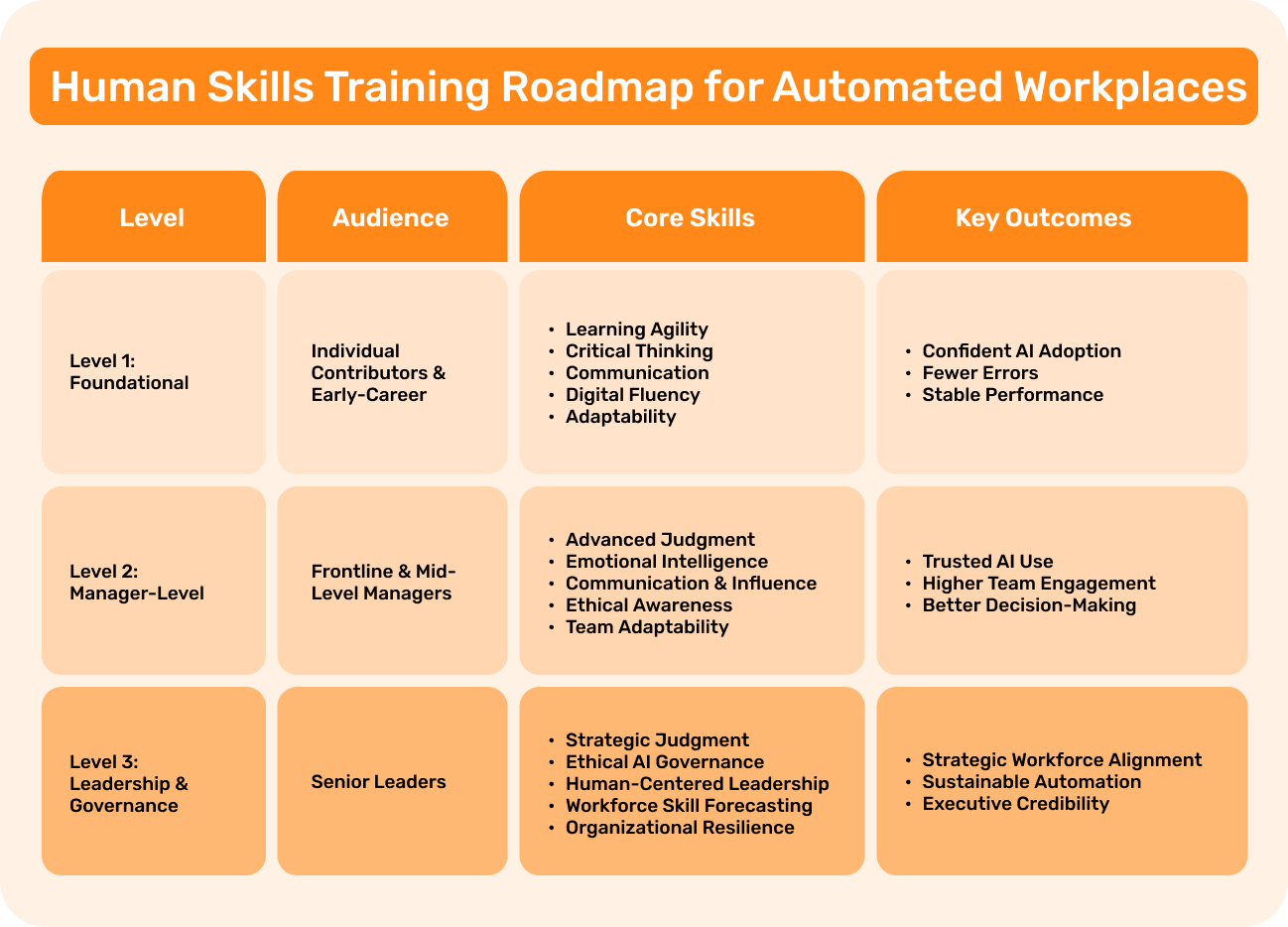
Second, embed these skills across career stages. Early-career employees need communication and learning agility. Managers need emotional intelligence and judgment. Senior leaders need strategic thinking and ethical oversight.
Third, measure outcomes thoughtfully. Use behavioral assessments, performance indicators, and feedback systems that capture skill growth rather than attendance metrics.
Finally, communicate clearly with your teams. When employees understand why these skills matter and how they protect long-term employability, engagement increases.
To help you prioritize and sequence training for your teams, here’s a concise roadmap showing how foundational, managerial, and leadership human skills build on each other.
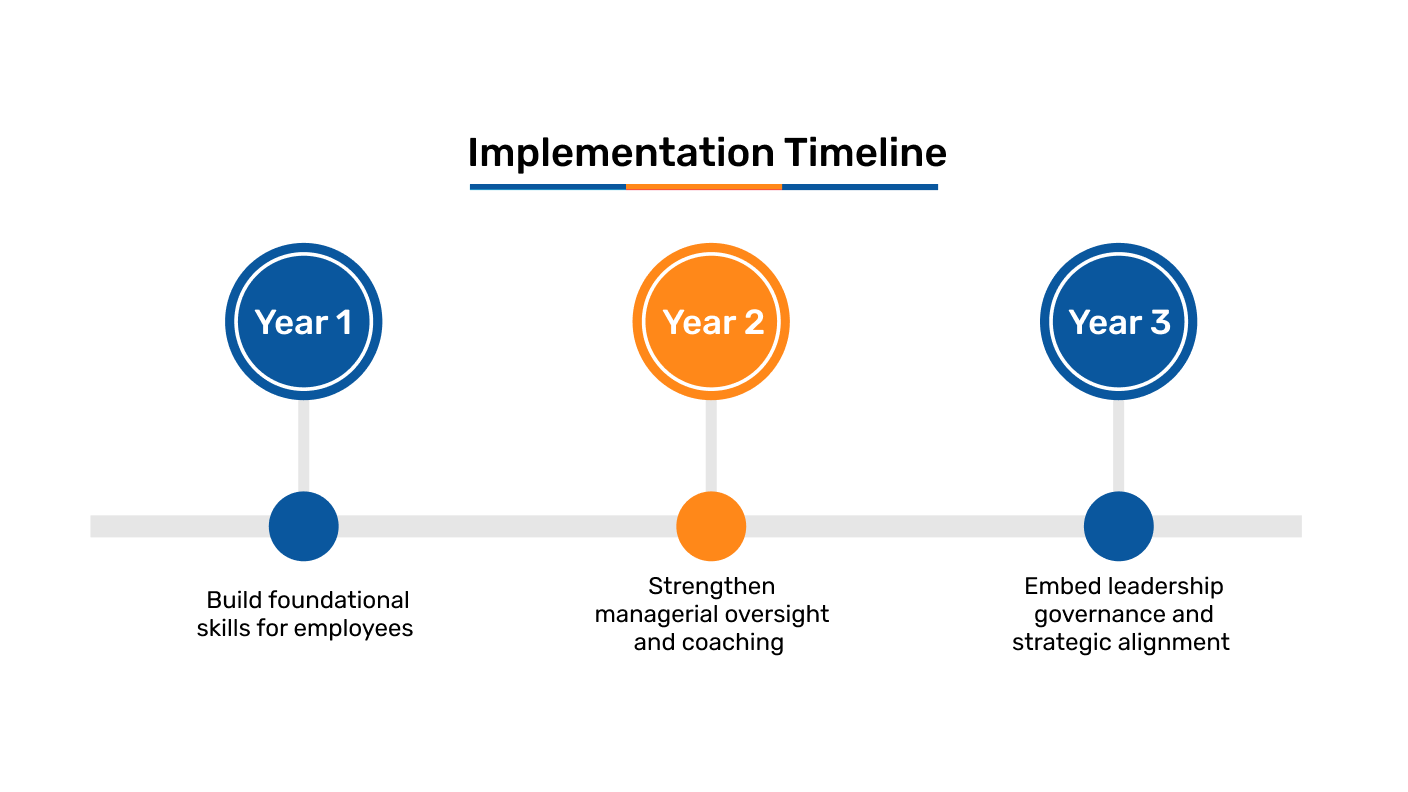
Here’s a suggested timeline to phase these development priorities over the next three years, ensuring sustainable skill growth across your organization.
Preparing Your Teams For Sustainable Value
Automation will continue to evolve. Tools will change. Job descriptions will shift.
What remains stable is the value of human capability. Learning agility allows your teams to adapt. Critical thinking ensures responsible decisions. Emotional intelligence strengthens culture. Communication drives alignment. Creativity fuels progress. Adaptability sustains momentum. Leadership guides transformation. Ethical awareness protects integrity. Digital fluency increases efficiency.
Your role is not to compete with automation. It is to define how people and technology work together effectively inside your organization.
When you invest intentionally in these human skills, you are not reacting to change. You are shaping it.
At KnowledgeCity, we help you turn human skills priorities into practical learning for your teams. With 50,000+ premium training videos, an AI-powered learning management system, and tools for training needs analysis, you can sequence learning across roles, track progress, and ensure your teams develop the capabilities they need to work confidently alongside automation. By focusing on ethical decision-making, adaptability, communication, and leadership, we help your teams stay aligned with your organizational values while navigating the challenges of an automated workplace.

 KnowledgeCity





Subscribe to Our Newsletter
Join 80,000+ Fellow HR Professionals. Get expert recruiting and training tips straight
to your inbox, and become a better HR manager.