Enjoying the preview?
This is the free first lesson. Get full access: request a demo or sign in.
Enjoying the preview?
This is the free first lesson. Get full access: request a demo or sign in.
Microsoft Access comes with over one hundred pre-written built-in functions for you to use in your database applications. Built-in functions are pre-written pieces of code you can use to enhance your queries, reports, and forms. These built-in functions cover a wide variety of uses, and are grouped into different categories based on their applications. Knowing how to use built-in functions gives you a whole new suite of resources for organizing your Microsoft Access database.
In this module, we will explore Microsoft Access 2021’s built-in functions. You will learn how to best apply these pre-written functions, and about their different categories. We’ll go over built-in text functions, which manipulate strings and other data types, and conversion functions, which you can use to convert between different data types. You’ll also learn about financial functions for working with things like statistics, as well as math functions, which range in applications from basic mathematics to trigonometry. Finally, we’ll explore Microsoft Access’s expression builder, which can assist you in building complex expressions by pointing and clicking.
It explores Microsoft Access 2021's built-in functions, including how to apply them and their different categories. It covers text functions, conversion functions, financial functions, math functions, and the expression builder.
The lessons cover Conversion Functions, Date and Time Functions, General and Financial Built-In Functions, Inspection Functions, Math Functions, Text Functions, and Aggregate Functions.
You will gain skills in Microsoft Access, Access query languages, the function module, Microsoft Data Access Components, stored functions, and user defined functions.
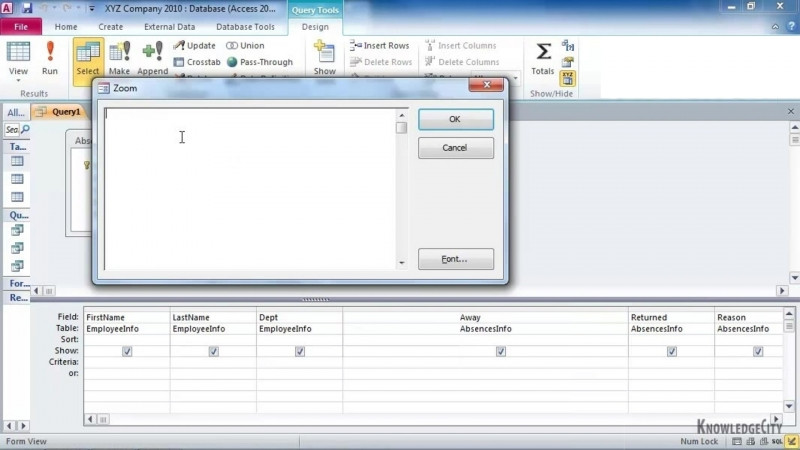
The expression builder is a Microsoft Access tool that can assist you in building complex expressions by pointing and clicking.
Knowing how to use built-in functions gives you a whole new suite of resources for organizing your Microsoft Access database and enhancing your queries, reports, and forms.