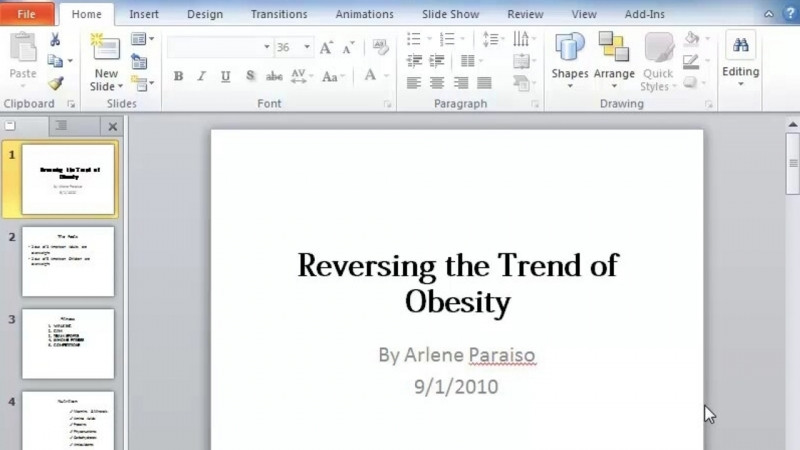
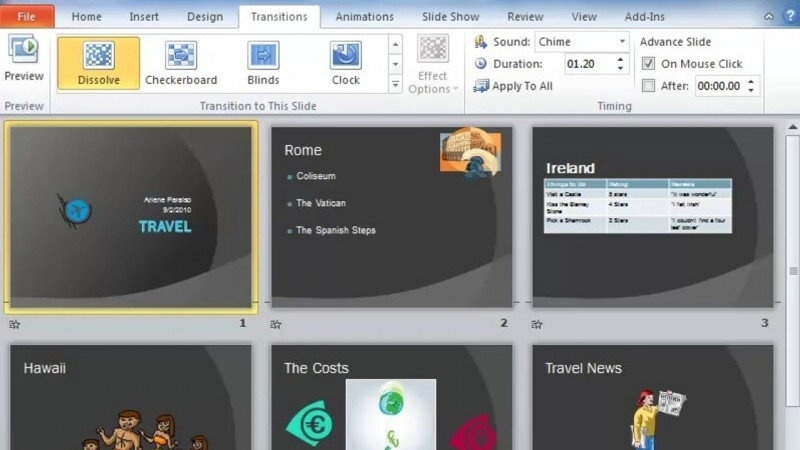
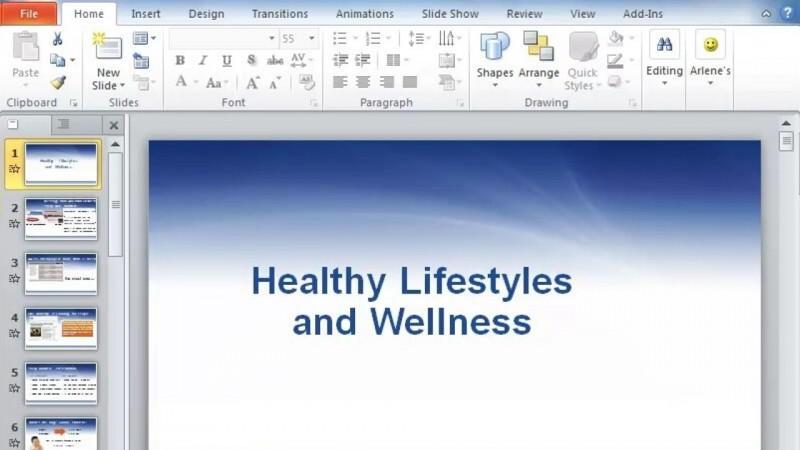
Hi, I'm Aaron Sullivan and I'm going to be showing you how to use PowerPoint to deliver a slideshow. We're going to be looking at such things as transitions and animations, various tools, features, and views that you use when delivering a slideshow. We're going to start by looking at some transition and animations in your slideshow. So after you've created a slideshow, like the one that I'm looking at, and you're going to deliver it something that helps polish the slideshow is by adding what are called transitions and animations. So when looking at your presentation, if you go to the transitions tab on the ribbon, then you have various transitions that can be added to your slides. Transitions are what are referred to as the way your slides advance from one to the next. So for example, you have a morph. It shows you a little description when you rest your mouse over it, and if I select it, it will give me a little preview of how that transition goes from one slide to the next. Fade, push. So these different options are available. Once I choose a transition for a slide, I'll know that it's been applied to my slide, because if I look in my navigation pane on the left, you can see underneath the number one is a little star, and that lets me know that there's some sort of animation applied to this slide. None of the rest of my slides have any animation or transitions applied to them at this time. Once I choose a transition that I like, I can choose to have it applied to all of the slides in my presentation with the apply to all button. Now you'll see that little star next to every single one of the slides in my presentation. Another thing that is common in PowerPoint presentations is the use of animation. Animation refers to how things on the slide change. Transitions are how you move from one slide to the next. Animations are how things on the slide change. So if I click on the second slide here, which has an agenda, I want to apply some animations to this slide on the ribbon, I click on the animations tab, and then I need to select what it is that I want to animate, because you'll notice right now, none of my animations are available choices. They're all kind of grayed out right now. So I can click on the text that says agenda, and now there are some animation options. So I can choose to have that text appear, and it just kind of shows you how that happens, happens rather quickly. I like to use what is referred to as the animation pane. So if I go to the animations tab and in the advanced animation group and I click on animation pane, this shows me everything in my slide that I have applied animation to, and the type of animation that I have applied. So I have the agenda animated right now. Maybe I want the text underneath that animated. So I select that text box, and I can choose a type of animation for that text, and you'll see how the text comes in, since there was more text, this kind of took a little bit longer than the first one. Now when we look in the animation pane, we can see first is the title, second is the content of that list underneath the agenda. We also see the little one, two, three, four, five, six, that's letting us know the order in which things are animated. So I can animate text. I can also animate images. So we'll see that over here is a little flower image of leaf and some other leaves and flowers and this whole letter A. So if I wanted to animate that letter A, for example, I'm going to choose the animation grow and turn. You see how it came in after the flowers were already there. I didn't animate the flowers, but if I decided that was actually the first thing I wanted to animate in my animation pane, I can select it. It's currently number seven, and then I can use this little up arrow and move it to the top of the list. Now it's number one. I want to see what my whole animation looks like on my slide. I can click the play from in the animation tab and see how my animation looks and works. So that is using animation and transitions in PowerPoint. You can apply as much or as little animation and transition to your presentation and make your presentation really stand out among others. Thanks for watching. In our next lesson, we'll be taking a look at some additional tools and features that you can use when delivering a slideshow.