
In higher education, policies do not sit on shelves. They live in conversations, in classrooms, in advising meetings, and in the moments when a student says, “I need to tell you something.”
If you are an Academic Program Manager, you are often the first person a student trusts when something serious happens. That trust carries real responsibility. When the issue involves sexual harassment, sexual assault, dating violence, domestic violence, stalking, or other sex discrimination, your actions matter, not only to that student but to your institution’s legal obligations under Title IX and VAWA.
This blog brings together the current federal framework and common institutional practices as they stand in 2025 and 2026. It explains what your role is, what it is not, and how you can respond in a way that protects students and protects your institution.
Understanding Title IX And VAWA In 2026
Title IX of the Education Amendments of 1972 prohibits sex discrimination in educational programs and activities that receive federal financial assistance. Over time, federal regulations and court decisions have shaped what Title IX compliance in higher education requires, including how institutions must respond to sexual harassment and sexual violence.
The Violence Against Women Act (VAWA) and Title IX are two separate federal laws that run on parallel tracks. VAWA’s requirements for higher education institutions come through its 2013 amendments to the Jeanne Clery Act, not through Title IX. Changes to one law do not alter an institution’s obligations under the other.
VAWA requires institutions to track and disclose certain crimes, including domestic violence, dating violence, sexual assault, and stalking, and to provide prevention programming and clear explanations of rights and options for those affected.
The 2024 Title IX regulations issued by the Biden administration were vacated in their entirety by a federal district court on January 9, 2025. The court found the 2024 rules exceeded the Department of Education’s statutory authority, violated the Constitution, and were arbitrary and capricious. The U.S. Department of Education’s Office for Civil Rights confirmed through a February 4, 2025, Dear Colleague Letter that the 2020 Title IX regulations are now the operative law for all institutions nationwide. All Title IX investigations, including those opened under the 2024 rules, must proceed under the 2020 framework. The 2020 regulations are the current law and the basis for OCR enforcement, though institutions should continue monitoring developments in close coordination with legal counsel.
Despite these shifts, one principle has remained consistent across every version of the regulations:
When your institution has knowledge of possible sex discrimination or sexual misconduct, it has a duty to respond. And very often, you are the one who gives the institution that knowledge.
Why You Are Central To Compliance
You may not hold the title of Title IX Coordinator. You may not conduct investigations. You may not sit in formal hearings. Yet your role is central.
In many colleges and universities, staff members who supervise students, advise them, manage academic programs, or have the authority to address misconduct may be required to report under institutional policy. The 2020 Title IX regulations use the term ‘official with authority to institute corrective measures’ as the key designation at the federal level. Many institutions use different terminology internally, such as ‘mandated reporter’ or ‘responsible employee.’ Know which category your institution places you in and what your specific policy requires.
If your institution has designated you as a reporting official, you are required to report conduct that may fall under Title IX or VAWA to the Title IX office or designated official. This duty applies whether the information comes from a direct disclosure, something you witness, or credible information shared in the course of your role. Check your institution’s policy to confirm your specific designation and obligations, as reporting requirements are set at the institutional level, not uniformly by federal law.
It does not require that you determine whether the conduct legally meets a specific definition. It requires that you pass along what you know so the institution can assess and respond.
Your role is not to be the endpoint. It is to report to the right person. Under federal law, the institution’s legal obligation to respond is only triggered when the Title IX Coordinator or a designated official receives notice. That means your prompt report is not just a formality. It is the step that puts the institution’s full response into motion.
What Your Reporting Obligations Mean For You
Reporting does not mean you are expected to solve the problem. It means you are expected to notify the right people.
Your core responsibilities in supporting Title IX compliance in higher education typically include:
- Inform students before they share sensitive details: Let them know that you are required to report certain types of misconduct to the Title IX office. This gives them the chance to make an informed decision, including choosing to speak first with a confidential resource such as a licensed counselor.
- Report promptly: If a student shares information about sexual harassment, sexual assault, dating violence, domestic violence, stalking, or related retaliation, report to your Title IX Coordinator or designated channel. You should also report if a student tells you they are experiencing retaliation for having reported such conduct. Institutional reporting deadlines vary, with some institutions requiring same-day reporting and others allowing up to 72 hours. Check your institution’s specific policy, as internal deadlines vary by school and in some states are also governed by state law.
- Share the facts you know: Include names, dates, locations, and a general description of what was reported, if provided. Do not withhold information because you think it may not qualify under a technical definition.
- Do not conduct your own investigation: You are not expected to determine credibility, gather evidence, interview witnesses, or reach conclusions. That role belongs to trained professionals in the Title IX office.
This structure exists for good reason. Centralizing investigations protects the integrity of the process and ensures sensitive matters are handled consistently and in a legally compliant way.
The Moment A Student Discloses
Policies are written in formal language. Real disclosures are not.
A student may sit across from you and hesitate.
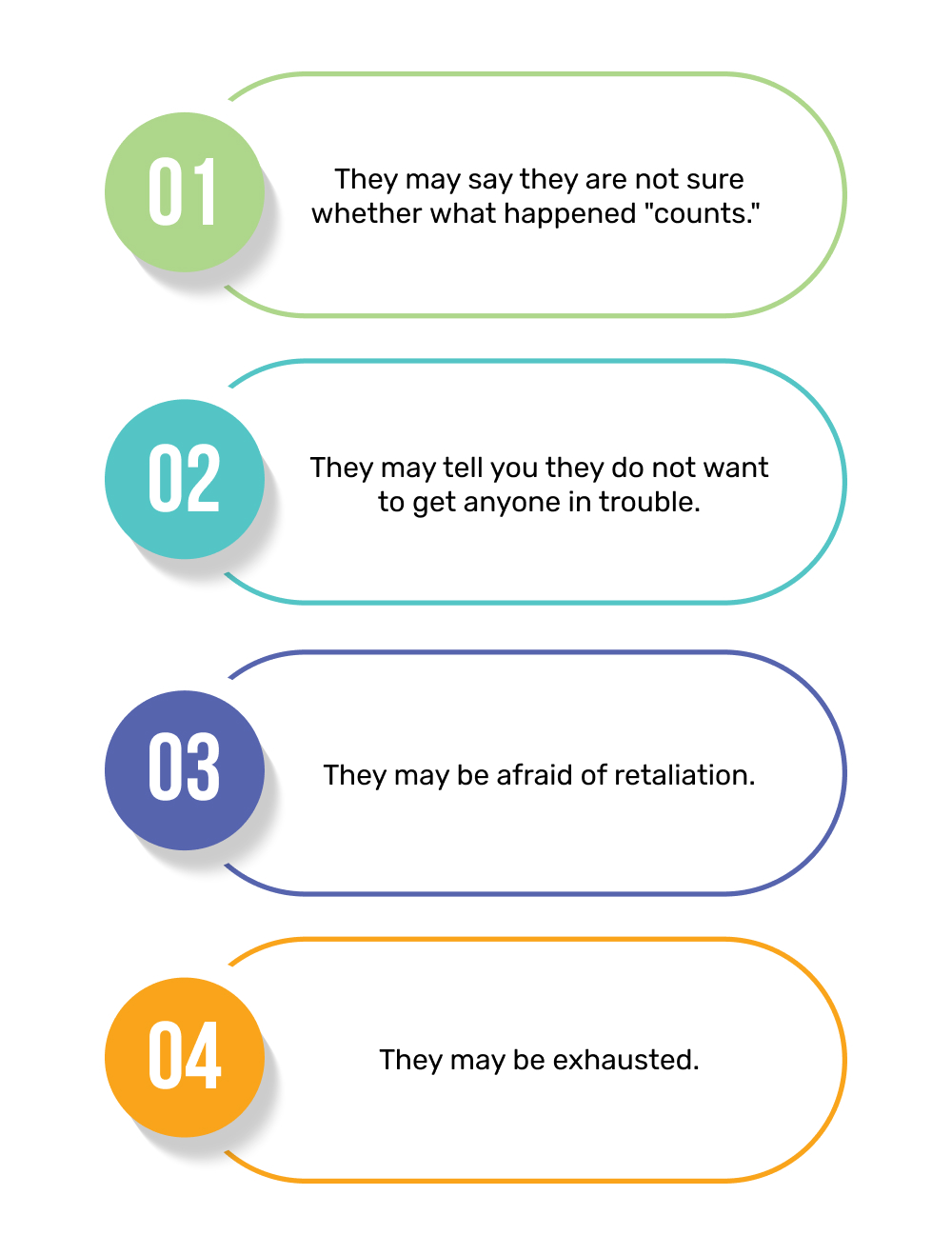
In that moment, your response shapes what happens next.
How To Respond With Care And Clarity:
- Listen first: Allow them to speak without interruption. Keep your tone calm. Avoid questions that sound investigative.
- Be transparent about your role: If you have not already done so, explain that you are required to report information about sexual misconduct to the Title IX office, and that the purpose of reporting is to connect them with support and allow the institution to review the situation.
- Provide information about options: Share information about confidential resources such as counseling services or victim advocates. Most institutions have these available.
- Reassure them about supportive measures: Explain that academic adjustments, schedule changes, extensions, housing modifications, or safety planning may be available regardless of whether they pursue a formal complaint.
- Then follow through: Submit the report promptly through your institution’s designated process.
When you handle this moment with care and clarity, you reduce confusion and increase trust in the system.
Escalation And What Happens After You Report
Once you submit a report, the Title IX office assumes responsibility for the next steps. The Title IX Coordinator or their team will typically review the report, reach out to the complainant, and explain available options, including supportive measures, filing a formal complaint, and if a formal complaint is filed, the possibility of informal resolution or a full investigation.
Your role does not end at submission. You may be asked to help implement supportive measures within your academic unit, including coordinating with faculty about extensions, adjusting program schedules, or ensuring that a student can continue progressing without unnecessary barriers.
Maintain confidentiality throughout. Share information only with those who have a legitimate need to know. Protect the privacy of everyone involved. When you report promptly and accurately, you enable Title IX compliance in higher education to work as it was designed to, meeting legal obligations while providing timely support to students.
The Connection Between Title IX And VAWA
Title IX focuses broadly on sex discrimination in education, which includes sexual harassment and sexual violence. VAWA, through Clery Act amendments, requires institutions to collect and disclose statistics about certain crimes and to provide specific information and programming related to those crimes.
When you report an incident involving sexual assault, dating violence, domestic violence, or stalking, that information may affect crime statistics, campus safety assessments, and institutional reporting obligations. Incomplete reporting can lead to federal investigations, financial penalties, and reputational harm.
More importantly, accurate reporting contributes to a clearer picture of campus safety. It informs prevention efforts and shapes how resources are allocated across your institution.
Training Requirements And Your Professional Responsibility
Federal regulations require specific training for Title IX Coordinators, investigators, and decision-makers. Title IX training for university staff is how institutions extend that foundation across the broader workforce, and many make it a formal policy requirement for all reporting officials.
Take that training seriously. Review updates each year. Regulations have evolved in recent years, and institutions adjust their policies accordingly. If your institution does not have a structured Title IX team training program, or if your current training feels unclear or outdated, raise the issue. Ask your Title IX office for clarification. Your clarity protects students and protects your institution.
Common Mistakes To Avoid
Even experienced professionals can make mistakes under pressure. These are the most common to watch for:
- Promising confidentiality you cannot keep: If you are not a designated confidential resource, do not promise secrecy. Promising to keep something private and then reporting damages to trust in ways that are difficult to repair.
- Minimizing the concern: Statements such as “I am sure it was a misunderstanding” can discourage students from seeking help. Your job is to listen, not to evaluate.
- Conducting side conversations to verify the story: Trained investigators handle fact-gathering. Do not ask colleagues or witnesses about the situation.
- Delaying because you are unsure whether it qualifies: When in doubt, report. The Title IX office determines applicability. Your job is to pass the information along.
- Documenting your own interpretations: Stick to what was said, when it was said, and any observable facts. Leave analysis to the professionals trained to do it.
These missteps often come from a genuine desire to help. Clear boundaries are what allow you to help in the right way.
Compassion Fatigue And Vicarious Trauma: Taking Care Of Yourself
This section is rarely included in compliance literature. That absence is a problem.
Academic Program Managers who regularly receive disclosures of sexual violence, harassment, and abuse carry emotional weight that accumulates over time. You listen to painful accounts. You sit with students in their most vulnerable moments. You hold that information long after the conversation ends. And in most cases, you do all of this in addition to your regular responsibilities, without a formal structure for processing what you have heard.
This is called vicarious trauma, and it is a recognized occupational risk for anyone who regularly engages with individuals who have experienced distressing events. It is not a sign of weakness. It is a predictable response to sustained exposure to others’ suffering.
You cannot show up fully for your students if you are quietly depleted. Recognizing the toll this work takes is not self-indulgent. It is professional.
Common Signs To Watch For
Vicarious trauma and compassion fatigue can appear gradually. You may notice a growing sense of dread before advising meetings. You may find yourself emotionally numb when a student discloses, where previously you would have felt present and engaged. You may replay conversations at night, or feel a persistent sense of helplessness about outcomes you cannot control. Cynicism toward the reporting process, irritability with colleagues, or difficulty separating your professional concerns from your personal life are also common indicators.
These are not character flaws. They are signals that the emotional demands of your role have exceeded your current capacity for recovery.
What You Can Do
- Debrief with appropriate colleagues or supervisors: While maintaining confidentiality, you can discuss the emotional weight of your work without sharing identifying details. You do not have to carry it entirely alone.
- Use your institution’s Employee Assistance Program (EAP): Most universities offer free, confidential counseling sessions for staff. These exist for situations exactly like yours.
- Build deliberate recovery into your schedule: Transition rituals between intense conversations and other work (a brief walk, a few minutes away from your desk) create psychological distance that prevents accumulation.
- Clarify the limits of your role: Remind yourself, regularly, that your responsibility is to report and support, not to investigate, resolve, or fix. Holding the full weight of an outcome that is not yours to control accelerates burnout.
- Raise the conversation with your institution’s Title IX office: Ask whether peer support structures, debrief opportunities, or additional training on secondary trauma are available. If they are not, your asking may prompt their creation.
The professionals who last longest in roles like yours are not those who feel nothing. They are those who have developed honest, sustainable practices for acknowledging what they feel and recovering from it.
Taking care of yourself is part of taking care of your students.
Balancing Compassion And Compliance
Some professionals worry that mandated reporting may discourage students from speaking openly. This concern is understandable, and transparency is the key to addressing it.
When you clearly explain your role before a student discloses sensitive information, you give them agency. They can choose whether to continue, to seek a confidential resource first, or to move forward with you. Compassion does not conflict with compliance. You can listen with empathy while fulfilling your reporting duty. You can validate someone’s feelings without making determinations about policy violations.
The structure exists to ensure fairness, consistency, and legal compliance. Your warmth and clarity ensure that the structure feels human.
Protecting Your Teams And Your Institution
Title IX and VAWA compliance is often framed as risk management. That is part of the reality. Institutions that fail to respond appropriately can face federal investigations, loss of funding, lawsuits, and public scrutiny.
But this work is also about culture. When students see that disclosures are taken seriously, that support is available, and that policies are followed consistently, trust grows. You set the tone within your program. If you speak about reporting procedures clearly in orientation sessions, include policy references in program materials, and model respectful behavior, your teams will understand that safety and equity are not afterthoughts.
Compliance becomes part of daily operations rather than an administrative burden.
Moving Forward With Confidence
The regulatory environment has shifted in recent years, and Title IX and VAWA compliance for universities will continue to evolve. Institutions should monitor developments in close coordination with legal counsel.
You do not carry this responsibility alone. Title IX offices, campus safety teams, counseling services, and legal counsel are part of the institutional framework. Your role is to connect students to that framework, and to sustain yourself well enough to keep doing it.
When a student chooses you as the person to confide in, they are signaling trust. By responding with clarity and professionalism, and by caring for your own well-being in the process, you honor that trust and uphold your institution’s obligations under federal law.
Title IX and VAWA compliance is not an abstract administrative task. It is a daily practice, and you are an essential part of it.
Train Your Team Before the Moment Arrives
Reading this blog is a starting point. A structured Title IX team training program is the next step. When a student sits across from a staff member and begins to share something serious, that is not the moment for your team to be figuring out what to do. That moment requires preparation, and preparation requires training that goes beyond a policy handout.
KnowledgeCity’s compliance courses are built by university professors and industry experts who understand how Title IX and VAWA obligations translate into real workplace situations. The courses are designed for people in roles exactly like yours, staff who carry compliance responsibilities as part of a broader job, not as their sole function. That means the training is practical, role-specific, and built for immediate application.
With KnowledgeCity’s Learning Management System, you can assign the right courses to the right people, track completion across your entire team, and generate audit-ready reports that demonstrate your institution is meeting its training obligations, all from one centralized platform. When federal oversight comes knocking, you will have the documentation to back up your compliance efforts.
More importantly, your team will have the confidence to handle disclosures with care, report accurately and on time, and support students through one of the most sensitive processes in higher education.
Title IX and VAWA compliance for universities starts with knowledge. Make sure your team has it.
Explore KnowledgeCity’s compliance courses today.

 KnowledgeCity











Subscribe to Our Newsletter
Join 80,000+ Fellow HR Professionals. Get expert recruiting and training tips straight
to your inbox, and become a better HR manager.