
Most workforce plans written 18 months ago did not include AI Engineer as a hiring priority, did not account for a 29% drop in entry-level postings, and did not anticipate that the skills required for roles in marketing, finance, and operations would shift this fast. That is not a planning failure. The ground moved faster than any projection suggested it would.
What HR and L&D professionals are navigating now is a labour market where the rules have changed at the role level, the skill level, and the career pathway level simultaneously. Hiring cycles that should take weeks are stretching. Training completions are climbing, but performance gaps are not closing. Roles are being posted for skills that did not exist as job requirements two years ago. The question is no longer whether to respond. It is whether the response you are building is pointed at the right things.
What follows is a clear-eyed look at what is actually happening in the market right now: which roles are growing, which skills are being hired for, why most development programs are underdelivering, and what a sharper strategy looks like in practice.
The Scale of What Is Changing
By 2030, 39% of workers’ core skills will need to change. That estimate is not a projection built on speculation. It comes from surveying over 1,000 employers across 55 economies, and the consistent finding across nearly every industry and region is the same: the skills gap is the single largest barrier to business transformation, not capital, not technology, not market access. Skills.
AI has already added 1.3 million new roles to the global labour market, including AI Engineers, Forward-Deployed Engineers, and Data Annotators, alongside 600,000+ new data centre jobs tied directly to AI infrastructure. These are not roles being planned for. They exist now, and they are being filled now, often from talent pools that organizations did not think to map two years ago.
At the same time, entry-level hiring has dropped 29% globally since early 2024. AI is absorbing the lower-complexity work that used to be the starting point for most career paths. That compresses the pipeline that feeds mid-level capability. Organizations that used to grow their own talent through volume entry-level hiring are now dependent on mid-level capability they have to either develop at speed or compete fiercely to attract externally. Both options are expensive. Neither is fast. The organizations that will be in a better position by 2027 are the ones building internal development infrastructure now, before the mid-level gap becomes acute.
The Roles That Are Actually Growing in 2026
Three of the five fastest-growing job titles in the US right now are AI-specific, based on real job transitions made by millions of professionals over the past two years. Here is what the market is actually showing.
AI Engineer is the single fastest-growing role overall. These professionals build and deploy AI models for complex decision-making tasks, from prediction and pattern recognition to language processing. The median experience level among people moving into AI Engineering is 3.7 years, and most are transitioning from Software Engineering, Data Science, or Full Stack Development. For talent acquisition, this matters: you are not hiring from a fresh pool. You are competing for professionals who are mid-career, have options, and know their market value.
AI Consultant and AI Strategist is the second fastest-growing role. These professionals bridge business objectives and AI implementation, working across technical teams and executive stakeholders. What is notable here is that MLOps capabilities, specifically model versioning, cost optimization, and governance, are now baseline expectations for this role, not differentiators. Organizations hiring AI Consultants without accounting for MLOps maturity are setting themselves up for delivery gaps.
Data Annotator has emerged as one of the more accessible high-growth roles and is worth paying specific attention to for reskilling strategy. These professionals label and review datasets that train AI models, often on a project basis. The majority of people in this role today have come from content management, editorial, and data analyst backgrounds. For L&D teams mapping internal reskilling pathways, this is a concrete and achievable transition for a wide portion of an existing workforce.
Outside of AI-specific titles, one pattern signals a broader workforce shift: the number of professionals adding Founder to their career profile grew 60% year-over-year. Strategic advisors, independent consultants, and fractional roles are rising alongside permanent employment. A workforce and succession plan that accounts only for full-time headcount is already working with an incomplete picture of where talent is flowing.
The Specific Skills Being Hired for Right Now
There is a meaningful difference between skills that are trending on learning platforms and skills that are resulting in successful hires. The ones that are doing both right now are worth building programs around.
On the technical side, the skills with the strongest hiring outcomes are: LangChain, Retrieval-Augmented Generation, model training and fine-tuning, vector databases, FastAPI, OpenAI API integration, PySpark, and PyTorch. These are production skills. The difference between knowing what a large language model is and being able to build, deploy, and maintain a system that uses one reliably at scale. Organizations posting AI roles and not seeing qualified applicants are often discovering that their job descriptions are written for literacy-level skills while the actual work requires production-level ones.
Python is approaching universal baseline status, appearing in nearly 18% of job postings. Algorithmic thinking went from under 0.5% of postings to over 2% in a single year. CI/CD skills, which support AI deployment and maintenance pipelines, moved from under 7% to over 9% of postings in the same period. These shifts are happening faster than most annual skills framework reviews can track, which is itself an argument for reviewing role skill requirements on a shorter cycle than most HR functions currently operate.
Beyond technical skills, the roles growing fastest also share a consistent demand for AI business strategy skills, including data governance and responsible AI, alongside executive communication and cross-functional leadership. The presence of those capabilities on the same list as LangChain and vector databases is a direct signal: the organizations hiring most aggressively are looking for people who can both build and steer, or who can work credibly alongside those who do either. Pure technical depth without organizational fluency is becoming a harder sell at the senior level.
One more finding worth noting: across enterprise learner data covering millions of professionals, the fastest-growing skill among people actively building AI capability is Content Creation. AI skill demand runs across every function. The assumption that AI upskilling is an IT or engineering priority leaves the majority of your workforce behind.
Four Workforce Lanes Every L&D Strategy Needs to Address
One of the clearest ways to map AI skill development across a workforce is to think in four lanes. Most organizations are currently investing in one or two of them and leaving the others largely unaddressed.
- Builders are the machine learning engineers, computer vision specialists, NLP engineers, and custom LLM developers who design AI systems from scratch. These roles require deep technical foundations and long development timelines. Unless building proprietary AI products is core to the business model, this lane should not absorb the majority of L&D investment.
- Integrators are the data engineers, RAG specialists, MLOps engineers, and cloud AI professionals who connect AI models to working business systems. AWS, Azure, Snowflake, BigQuery, and CI/CD pipelines are the core tools. This is the most underdeveloped lane in organizations that have committed to an AI strategy but have not yet built the infrastructure to execute it. The distance between deciding to use AI and having people who can make it run reliably is where most implementations slow down or stall entirely.
- Governors are the professionals responsible for AI ethics, responsible AI frameworks, data governance, and AI risk and compliance. This is the most undersupplied lane globally. By 2028, half of all content risk roles are expected to migrate from legal and cybersecurity into AI engineering, specifically to address governance gaps. The talent to fill these roles does not yet exist at scale, which makes early investment here a genuine competitive advantage rather than a compliance obligation.
- Translators are every employee in every function who needs to work with AI tools competently in their daily role. HR, marketing, finance, operations, sales. Prompt engineering, AI-augmented workflows, and the judgment to evaluate AI output critically are the relevant skills. In non-technical roles, AI literacy alone is now driving measurable salary differentiation in the market. The Translator lane is your largest population and the one where a well-designed program produces results fastest.
Mapping your workforce against these four lanes gives you a gap analysis with budget implications, not just a list of skills to develop. It also surfaces where internal reskilling pathways make the most sense, which matters given that developing existing employees consistently costs less and moves faster than hiring externally for mid-level roles.
Why Human Skills Are Growing in Importance Alongside AI
Analytical thinking is the most sought-after core skill globally right now, with 70% of employers calling it essential. Resilience, adaptability, and leadership and social influence follow. These are not placeholders for roles that AI cannot yet automate. They are the competencies that determine whether AI adoption produces better outcomes or just faster ones.
Teams redesigning workflows with AI are twice as likely to exceed revenue goals, according to Gartner. The variable is whether employees can reason clearly about which processes should change and how. That reasoning capability is not developed by training people to use tools. It is developed by building judgment, and that takes a different kind of program.
There is also a risk forming inside organizations that have moved fast on AI adoption without attending to this. Gartner named it: workslop. Employees producing output faster with AI, but without the time or autonomy to evaluate whether the result is accurate, complete, or fit for its purpose. Volume increases. Quality of judgment does not keep pace. For L&D, this is a direct prompt to build critical evaluation as a deliberate parallel track alongside AI tool training, not as an afterthought once problems surface.
The market is registering this shift from the employee side, too. Critical thinking enrollments are rising across every learner cohort, driven by employees choosing it rather than mandated programs. The recognition that tool proficiency without judgment is insufficient is spreading through the workforce organically. Your programs should be ahead of that curve, not catching up to it.
Why Most L&D Programs Are Not Producing the Results Organizations Need
More than half of organizations say upskilling and reskilling is their primary strategic response to the skills gap. Only around one in five believes they are doing it effectively. That distance between intent and outcome has causes that are worth naming directly.
Employees say training is often disconnected from their specific role. Sessions conflict with actual work schedules. There is not enough time to participate meaningfully even when the content is relevant. These are execution problems, and they compound as the pace of required skill change accelerates beyond what annual program cycles can address.
The behavioral layer is equally important. In studies of AI tool rollouts, nine in ten employees said formal training would be useful. Seven in ten ignored onboarding content entirely and learned through direct experimentation and peer observation instead. That is not an engagement problem. That is a design problem. Training that lives outside of real work will always lose to the work itself. Programs need to run alongside actual tasks, give employees a reason to apply a skill in the same week they encounter it, and create space for peer learning rather than relying solely on instructor-led delivery.
Most organizational investment in AI upskilling currently stops at the literacy level: awareness programs, tool introductions, general overviews. Literacy is the most visible and easiest to report on. It is also the level with the lowest direct connection to performance improvement. The next level, embedding AI into actual roles and daily workflows, is where behavior change happens. The level beyond that, building domain-specific AI capability tied to specific business outcomes, is where competitive advantage is built. Most organizations are spending heavily on the first level and lightly on the other two.
Soft skills training has grown meaningfully, from 38% of organizations running it in 2024 to 47% in 2025. Leadership development remains the top training priority for the third consecutive year. And the economics of internal development are clear: developing existing employees is more cost-effective than external hiring for the vast majority of organizations. The case for investment is well established. What needs to improve is what gets built and how it gets delivered.
What CHROs Are Being Told to Prioritize Differently in 2026
The four priorities surfacing most consistently in CHRO research this year are:
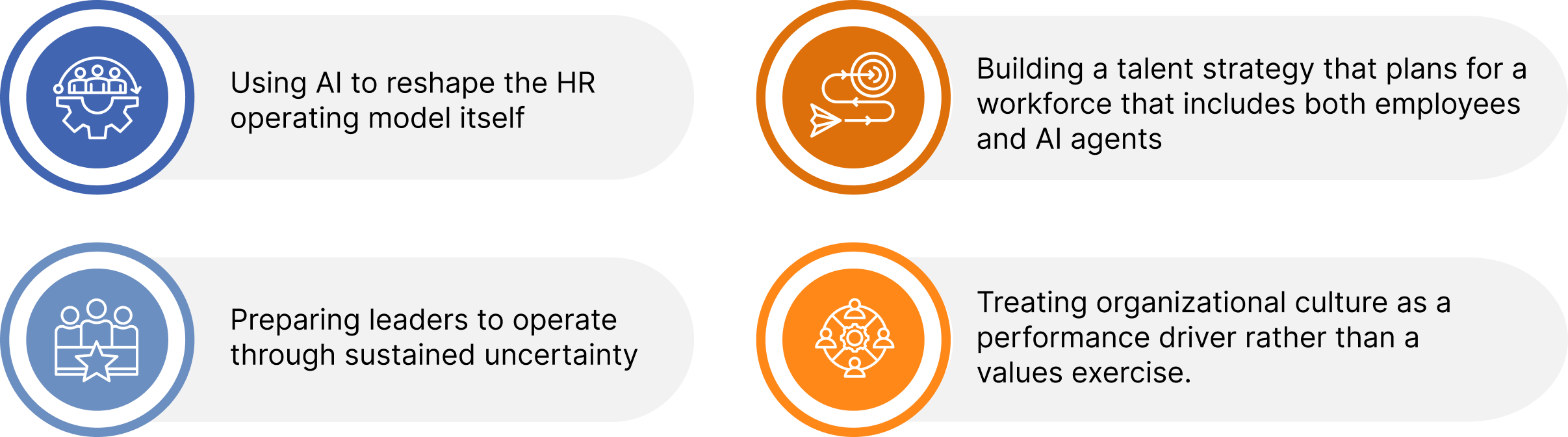
Two of those deserve specific attention from an L&D standpoint. The internal mobility problem is well-documented and largely unsolved. One in five employees will need to be redeployed by 2030, and internal mobility rates have remained flat despite increased investment in the programs meant to support it. The bottleneck is rarely willingness. It is visibility and manager behaviour. Employees cannot move toward roles they cannot see a path to. Managers will not sponsor transitions if the system rewards them for protecting headcount. Fixing internal mobility is a process and incentive problem as much as a learning one.
The early-career pipeline problem is the second. As AI absorbs entry-level work, the natural feeder system for mid-level capability weakens. Organizations that do not redesign how they build early-career talent will find themselves with a growing mid-level gap that is slow and expensive to address through external hiring. This needs to be on the workforce planning agenda now, not when the gap becomes visible in performance data two years from now.
On credentialing: by 2027, three in four hiring processes globally are expected to include formal AI proficiency assessments. If your employees cannot demonstrate their AI capability in a verifiable way, they will look for organizations that allow them to. Internal credentialing for AI skills is a retention mechanism as much as a development one, and building it before external hiring forces it on you puts your organization in a stronger position on both fronts.
Skills-Based Hiring: Where the Gap Between Policy and Practice Lives
The shift away from degree requirements in hiring is real and accelerating across industries. Several of the world’s largest employers have removed four-year degree requirements from a significant portion of their roles, and nearly a third of employers now recognize digital badges and micro-credentials as valid signals during hiring. The direction is consistent.
What is also consistent is the gap between policy and what happens at the hiring decision level. At some large organizations, fewer than one in 700 hires are non-degree graduates, even after degree requirements were formally removed from job descriptions. Removing a requirement from a posting does not change how applicant tracking systems rank candidates, how recruiters build shortlists, or how hiring managers make decisions without structured guidance to override existing defaults.
Skills-based hiring works when it is backed by real process change: structured assessments that test for demonstrated capability, manager education on what skill evidence looks like in practice, and internal career frameworks that reward verified proficiency over tenure and credentials. Without those, the policy commitment stays at the surface level and produces almost no change in who actually gets hired or promoted.
Skill currency matters as much as skill presence. A competency certified two years ago may already be outdated for the role it was earned for. The organizations making skills-based hiring work are reviewing role skill requirements on a quarterly cadence using data from actual work, technology adoption patterns, and performance outcomes, rather than waiting for annual competency framework updates that consistently describe where the organization was, not where it is.
Where to Focus Your Strategy Right Now
Start with the four lanes. Map your current roles against Builders, Integrators, Governors, and Translators, not as a theoretical exercise but as a gap analysis with budget implications. Most organizations have spent their AI training budget on awareness and literacy because it is visible and reportable. Integrators and Governors are where the acute shortage lives, and they are where investment has the most direct connection to whether AI deployments actually work in practice.
Then look honestly at how your training is designed. If it sits outside of real work, disconnected from actual tasks, it will not change behavior at the speed required. Programs need to be embedded in the workflow. Employees need a reason to apply the skill the same week they encounter it. Peer learning needs to be designed in, not left to chance.
On internal mobility: the talent you need for Integrator and Governor roles is almost certainly already inside your organization. The bottleneck is not availability. It is that the pathways are not visible and managers are not incentivized to sponsor transitions. That is a process and incentive problem, and it is solvable before you spend another budget cycle on external hiring for roles your own people could grow into.
Build internal credentialing before external hiring forces it on you. If your employees cannot demonstrate their AI capability in a verifiable way, they will look for organizations that let them. That is a retention risk that sits entirely within your control to address.
The window to build this proactively is now. The roles exist. The skill requirements are documented. The internal talent is there. What closes the gap is a workforce strategy built around where the market is today, not where it was when your last competency framework was written.
KnowledgeCity: Built for the Workforce Moment You Are In Right Now
The skills gap will not close through awareness programs and annual training calendars. It closes when learning is precise, current, and built into how work actually happens. KnowledgeCity is designed for exactly that.
Our 50,000+ premium training videos are developed in-house by US-based industry experts and university professionals, which means your employees are learning from people who understand the work, not generalists packaging content at volume. Our AI-powered LMS adapts to your workforce and delivers learning where and when it is relevant. Our AI-powered Training Needs Analysis tells you where the gaps actually are before they surface in hiring costs or missed performance targets. For HR and L&D teams who need to move from knowing what is needed to building it, KnowledgeCity is where that work gets done.

 KnowledgeCity








Subscribe to Our Newsletter
Join 80,000+ Fellow HR Professionals. Get expert recruiting and training tips straight
to your inbox, and become a better HR manager.