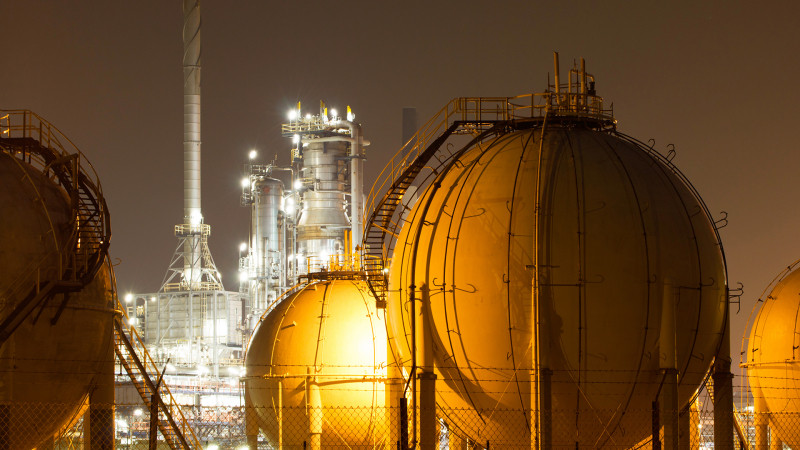
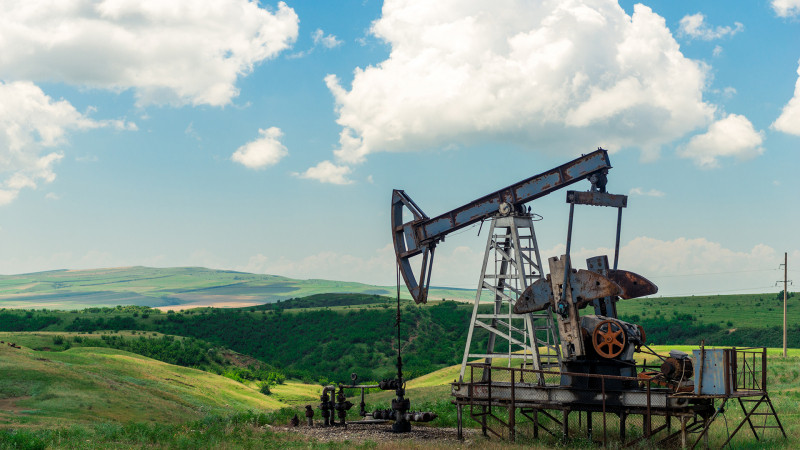
(soft music) After the oil extraction process, the adventure continues and now, it's directed to surface operations. There's a variety of equipment available that is used, depending on the need but the most common are: multiple or input collectors, flow lines, oil and gas separators, and tanks. Multiple or Input Collectors. These are mechanical arrangements of pipes and valves that generally consist of several pipes placed horizontally, parallel to each other, and connected to each of the flow lines. Its function is to collect the production of the wells that arrive at the flow stations and distribute it to the different processes of the system. However, the arrangements of valves, connections, and pipes must be such that when required, the flow of each individual well can be isolated for well-testing purposes. This is so that the flow of each well can be taken to a test separator, to segregate and measure oil or distillation products, gas production, and in some cases water production. Flow Lines. The flow line is the pipe that connects the head of a well to the production manifold of its corresponding flow station. Flow lines are those management systems that transport the flow in two-phase form, from the wells to a point of convergence called multiple. Each manifold is made up of tubular sections whose capacity and size depend on the number of tubular sections. They're manufactured in different diameters, series, and working ranges and are selected according to the production potential and flow pressures of the system. The following parameters are mainly calculated in the design of the flow lines. The pressure drop along the flow line, which is calculated using multiphase models. The optimum thickness of the type of material to be used considering the working pressures, cleaning and maintenance systems, protection systems, anchorage systems. Oil and Gas Separator. The separator is a cylindrical or spherical container that is used to separate oil, gas, and water from the total flow of fluid produced by a well. The separators can be horizontal or vertical. They can be classified at a two-phase and three phase separators, commonly called free water separators. The two-phase type only treats oil and gas, while the three-phase type treats oil, water, and gas. In addition, the separators can be classified according to their operating pressure. The low pressure units handle pressures from 10 to 180 PSI. The medium pressure separators operate from 230 to 700 PSI. The medium pressure separators operate from 230 to 700 PSI. High pressure units handle pressures from 975 to 1,500 PSI. High pressure units handle pressures from 975 to 1,500 PSI. Gravitational segregation is the most important that occurs during separation, which means that the heaviest fluid is decanted at the bottom and the lighter fluid rises to the surface. Also within the container, the degree of separation between the gas and the liquid will depend on the operating pressure of the separator, the residence time of the fluid mixture, and the type of fluid flow. Turbulent flow allows more bubbles to escape than laminar flow. Tanks and Fluid Meters. Storage tanks are structures of various materials, usually cylindrical in shape, that are used to store and/or preserve liquids or gases at ambient pressure, so that in certain technical means, they're given the qualification of atmospheric storage tanks. Storage tanks are usually used to store liquids and as volume meters, and are widely used in the oil industry. Mainly, their most notable use is in refineries for their requirements of the storage process whether temporary or prolonged and for the products and byproducts obtained from their activities. There are different types of storage tanks that adapt to different types of crude. Fixed roof atmospheric tanks can have a self-supporting roof or columns, and the roof surface can be shaped like a dome or cone. Floating roof atmospheric tanks. These tanks have great acceptance because they reduce the losses due to emptying and filling. This is achieved either by eliminating or maintaining constant the space destined for vapors above the liquid level. Pressure tanks. Used for liquids with vapor pressure greater than or equal to 0.914 kilograms per centimeter squared at sea level. 0.914 kilograms per centimeter squared at sea level. The main types of pressure tanks are cylindrical vessels and spheres. Low pressure tanks. Storage designed to maintain an internal pressure greater than 0.035 kilograms per centimeter squared but less than 1.055 kilograms per centimeter squared but less than 1.055 kilograms per centimeter squared measured at the top of the tank. These low pressure tanks must be constructed in accordance with recognized design standards. Low pressure tanks can be built with API 620. Refrigerated tanks. Refrigerated storage tanks are used to store liquified gases in ranges from ethylene to butane, which have a boiling point between -126.6 degrees Celsius to -1.1 degrees Celsius. between -126.6 degrees Celsius to -1.1 degrees Celsius. The main types of refrigerated tanks are pressure vessels, pressure spheres, and vertical cylindrical tanks.