
Unclear workplace roles cost organizations an estimated 25% of productive work time through duplicated efforts, unnecessary meetings, and stalled projects. This lack of clarity creates confusion for employees, who often pause because they are unsure which decisions they are allowed to make. Managers get pulled into routine approvals, leaving less time to guide and develop their teams. Training programs are completed, but employees struggle to apply what they learn.
For you, as an HR or L&D professional, these challenges are familiar and costly. Projects take longer, employees lose confidence, and learning initiatives fail to produce results. Defining decision boundaries clearly, embedding that clarity into onboarding and training, and reinforcing it in day-to-day operations can remove bottlenecks, improve team efficiency, and make development programs truly effective.
In this blog, we will explore why unclear decision authority slows work and what you can do to make teams more confident, efficient, and productive. Let’s start by examining exactly how this confusion shows up in day-to-day operations and why it persists across teams.
Why Unclear Decision Authority Blocks Teams
When employees do not know which decisions they are allowed to make, hesitation becomes the default behavior. Teams stop moving because:
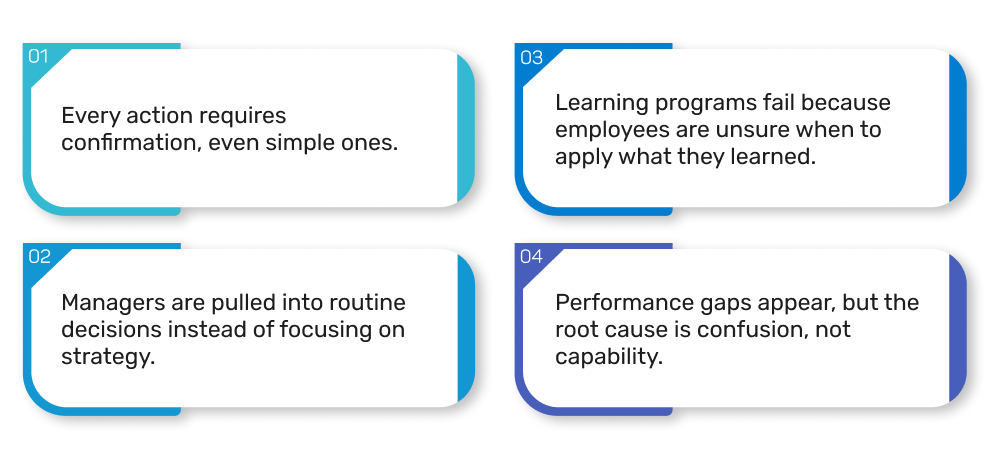
The impact of unclear decision authority is noticeable in every team. Deadlines are delayed, projects take longer than necessary, and high-performing employees often hesitate instead of acting. Managers spend significant time approving routine decisions rather than focusing on coaching and developing their teams.
You see these effects in day-to-day operations, but not every slowdown stems from unclear authority. Before investing time in solutions, it’s worth confirming whether decision ambiguity is actually the root cause in your organization.
Is Decision Ambiguity Slowing Your Teams? A Quick Diagnostic
Not every delay stems from unclear authority. Sometimes it’s genuinely a skills gap, resource constraint, or process issue. Before investing time in the solutions below, assess whether decision ambiguity is the root cause in your organization. These diagnostic questions might help:
1. Do managers frequently complain they’re “stuck in approvals”?
What to look for: Leaders spending >30% of time approving routine decisions (budget requests under $X, client email responses, minor process changes). If managers say, “I can’t get to strategic work,” this is a red flag.
2. Do employees ask for permission on decisions they’ve been trained to handle?
What to look for: Someone completes compliance training but still escalates basic compliance decisions. A team member attends a negotiation workshop but waits for approval before making client concessions within guidelines. Training isn’t translating to action.
3. Do projects stall waiting for “someone” to decide?
What to look for: Phrases like “We’re waiting to hear back” or “Not sure who owns this decision.” Stand-ups where multiple people thought someone else would decide. Work stops not because of blocked dependencies, but because no one knows who can green-light the next step.
4. Do new hires take 60+ days to make independent decisions?
What to look for: Onboarding feedback shows confusion about “what I can decide vs. what I need to ask about.” New employees mirror hesitant behavior from peers rather than acting confidently. Managers wish new hires would “just take ownership faster.”
5. Do performance reviews reveal “lack of initiative” as a pattern across multiple team members?
What to look for: If several employees across different teams are marked down for “not taking initiative” or “waiting to be told what to do,” the issue isn’t individual motivation. There’s systemic ambiguity about what they’re empowered to decide.
6. Do reorganizations or role changes cause immediate slowdowns?
What to look for: After a reorg, team velocity drops for 4-8 weeks while people “figure out who does what now.” Employees revert to asking permission for things they previously owned. Authority boundaries weren’t redrawn when roles shifted.
If you answered ‘yes’ to three or more questions, you’re facing an authority problem, not just a performance or training issue. The good news: this is fixable without restructuring your entire organization. The six interventions below directly address the gaps you’ve just identified, and you can start implementing them immediately.
How You Can Reduce Delays Caused by Unclear Decision Authority
You can stop hesitation from becoming a habit. By taking six practical steps, you can create clarity where it matters most and remove the confusion that slows teams.
1. Define Decision Authority Clearly in Roles
Employees hesitate when job descriptions list responsibilities but not the decisions they are trusted to make. Work with managers to map the exact decisions each role handles daily, from approving budgets to client interactions.
When decision ownership is clear, employees act without waiting for permission, and managers are freed from minor approvals, giving them time for higher-level leadership.
2. Embed Decision Guidance in Onboarding
New hires quickly learn what is safe by observing others. If they see hesitation, they mirror it.
Include practical decision examples during onboarding, showing which decisions can be made independently and which require consultation. Clear expectations from day one prevent hesitation from becoming a habit.
3. Train Managers to Communicate Authority
Delegating tasks is not the same as giving decision authority. Managers often slow teams without realizing it because authority is never explicitly communicated.
Coach managers to state clearly who decides what and when to escalate. Simple phrases like, “You approve these requests directly. Only escalate exceptions,” give employees confidence to act and free managers to focus on coaching and strategy.
4. Connect Training to Real Decisions
Leadership, compliance, and skill development programs often fail because employees cannot link learning to daily work.
Training should answer: “After this program, which decisions can I now make without waiting?” By tying learning to specific choices, employees begin applying their skills immediately, reducing hesitation and creating real behavior change.
5. Include Authority in Performance Conversations
Delays and mistakes often appear to be performance gaps, but are usually caused by unclear authority.
Guide managers to ask: “Was it clear who should decide this?” Addressing authority gaps during performance discussions prevents repeated slowdowns, ensures accountability is fair, and reinforces clarity across the team.
6. Maintain Authority Clarity During Change
Roles, priorities, and teams evolve. Without revisiting decision boundaries, employees revert to waiting, and managers resume micromanaging.
Schedule short check-ins whenever responsibilities shift to confirm decision ownership. These small interventions keep teams moving confidently through transitions.
These six interventions might seem straightforward, but their cumulative impact is significant. Here’s what changes when you implement them consistently.
How Clear Decision Authority Helps Teams Move Faster
These interventions do not create extra work. They remove the hidden hurdles that slow teams every day. When decision authority is clear:
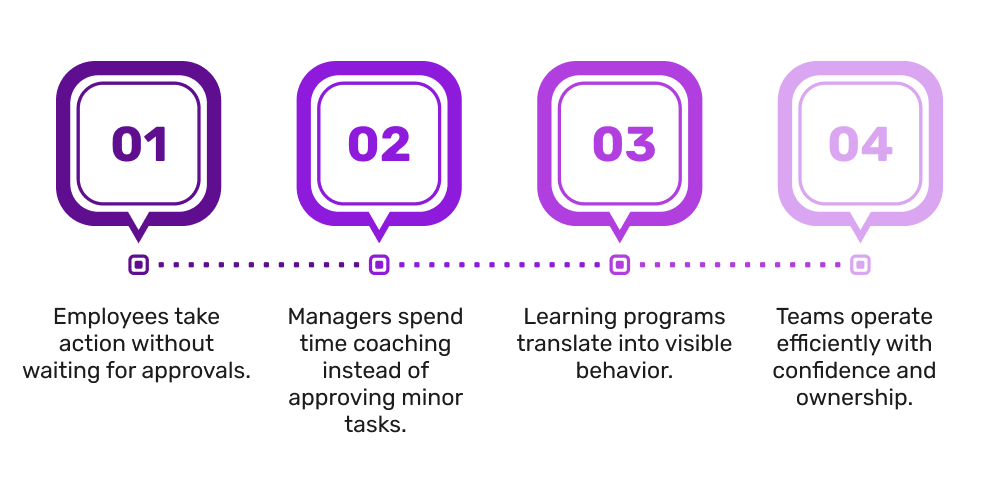
You can shape the way work happens. By embedding clarity into roles, training, onboarding, performance conversations, and ongoing development, you remove hesitation, speed up decisions, and make every program you run more effective.
Clarity in Decision-Making Drives Results
Decision authority shapes how organizations function day to day. It determines whether work advances smoothly or slows at every handoff. When authority is clearly understood, employees act with confidence, managers focus on direction instead of approvals, and learning translates into consistent execution.
For HR and L&D leaders, strengthening decision clarity reinforces ownership, improves judgment, and creates dependable outcomes across teams. Over time, this clarity becomes a defining factor in how effectively an organization performs.

 KnowledgeCity














Subscribe to Our Newsletter
Join 80,000+ Fellow HR Professionals. Get expert recruiting and training tips straight
to your inbox, and become a better HR manager.