
Your teams use social media for professional connections, networking, and staying informed. They also share opinions, comment on news, and interact in ways that feel personal. Most employees do this naturally, often without considering their official roles.
In government workplaces, these actions are visible in ways your teams might not anticipate.
Certain posts, comments, or shares can cross compliance lines under the Hatch Act, ethics standards, agency policies, and other government employee social media rules. Even well-intentioned activity can create legal or reputational risks for the organization.
As HR, Compliance, or L&D professionals, you are responsible for ensuring employees understand these boundaries. Your role is to translate rules into everyday behavior so employees can participate online safely while protecting the agency and themselves.
This blog explains the current guidance that government employees must follow, highlights where compliance issues most often occur, and shows why clear training and communication matter for your teams. Understanding the landscape of social media risk is the first step toward keeping your organization compliant and credible.
Why Social Media Creates Unique Risk in Government Workplaces
Unlike private organizations, government agencies operate under heightened expectations of neutrality, transparency, and accountability. Employees are not just representatives of an employer; in many cases, they are perceived as representatives of the government itself.
This creates three structural risks:
First, visibility: Employees’ affiliations are often public. Even when someone posts from a personal account, their role may be easy to identify, and audiences may interpret their views as informed by official authority.
Second, regulatory overlap: A single post can touch multiple rules at once. Ethics standards, political activity restrictions, records requirements, and agency-specific policies can all apply to the same action.
Third, public amplification: Content that would be inconsequential in another context can quickly gain attention when tied to a government agency. Public reaction does not wait for internal context or clarification.
These risks create situations where you are often pulled in after the fact, even when the issue began with unclear guidance or outdated training. Recognizing these structural risks helps frame the specific compliance areas your teams need to manage.
The Social Media Compliance Risks HR, Compliance, or L&D Teams Are Accountable For
When a social media issue arises in a government workplace, it is rarely evaluated in isolation. Most cases involve overlapping compliance concerns. You are often asked to explain how employees were guided, trained, and supervised.
To manage this risk effectively, training and internal guidance, including compliance training for public sector communications, must reflect the full set of compliance obligations employees operate under, not just the most well-known ones. The following compliance areas are where risk most often surfaces and where your leadership in guidance and training is critical.
Federal Ethics Standards and Online Conduct
Ethics rules govern how employees present themselves, use their position, and handle information, regardless of the platform. Social media activity that references an employee’s role, expertise, or agency can raise concerns about implied endorsement, impartiality, or misuse of authority.
From your perspective, this is a frequent risk area because employees often do not see ethics rules as relevant to casual online interactions. Training must help employees recognize when their official role changes how their speech is interpreted, even when posting on personal accounts.
Understanding ethical obligations sets the foundation for managing political activity, which is another frequent source of risk in digital communication.
Political Activity Restrictions Under the Hatch Act
Political content continues to create some of the most visible compliance issues. Employees may understand they cannot campaign at work, yet struggle to apply restrictions to digital behavior, such as reacting to posts, sharing content, or commenting on current events. These government employee social media rules often create confusion when applied to online activity outside traditional workplace settings.
Risk increases when:
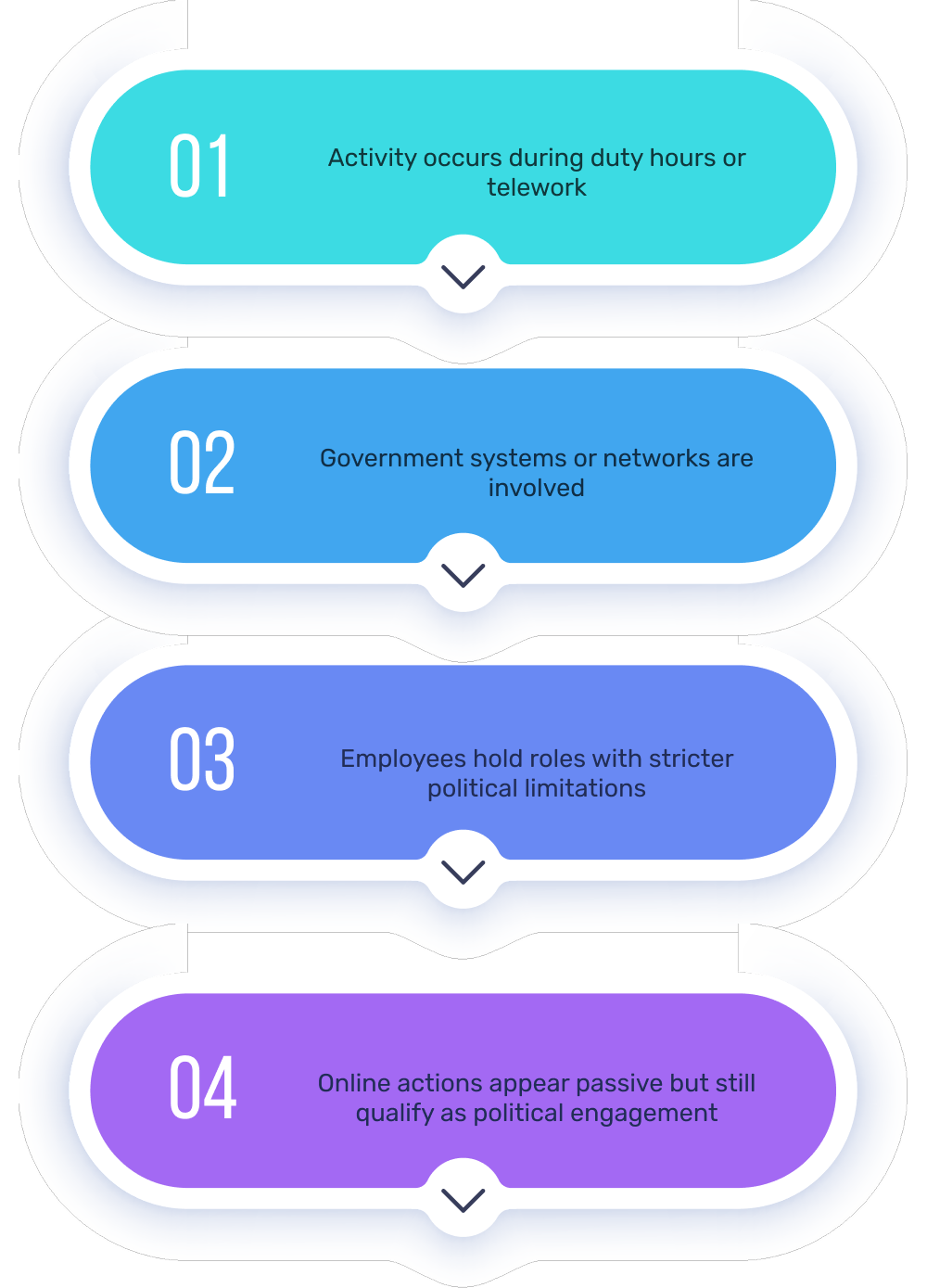
You are expected to reduce confusion by translating these rules into clear, everyday guidance employees can apply without second-guessing. Once political restrictions are addressed, attention shifts to agency-specific policies, which provide additional rules for employee conduct.
Government Social Media Policies and Internal Directives
Beyond government-wide rules, each agency establishes its own government social media policy outlining expectations for employee use. These policies often define approval requirements, content boundaries, use of disclaimers, and supervisor responsibilities.
Compliance issues emerge when employees are unaware of these internal rules or apply them inconsistently. From a training standpoint, it is not enough for policies to exist. Employees must understand how those policies apply to their specific roles and responsibilities.
Alongside agency policies, records, privacy, and accessibility obligations must also be considered to fully guide employee behavior.
Records Management and Retention Obligations
Social media interactions tied to agency business can qualify as official records. This includes posts, comments, responses, and messages made through official channels or in connection with official duties.
Records compliance failures often surface long after the original activity, during audits, investigations, or public records requests. You play a critical role in ensuring employees understand when online communication creates records and why proper handling matters.
Once records management responsibilities are clear, you and your teams also need to address privacy and confidentiality concerns to reduce organizational risk.
Privacy, Confidentiality, and Information Protection
Employees may share workplace experiences online without realizing they are disclosing protected or sensitive information. This can involve personal data, internal processes, or details connected to ongoing matters.
These situations tend to escalate quickly. They involve legal, security, and employee relations risks simultaneously. Training must help employees recognize how easily privacy and confidentiality boundaries can be crossed in informal digital spaces.
Understanding privacy concerns is also essential when employees manage official accounts, which brings accessibility requirements into focus.
Accessibility Requirements for Official Digital Communication
When employees manage or contribute to official social media channels, accessibility standards apply. Public-facing content must be usable by individuals with disabilities.
This obligation is often overlooked in social media training, yet it remains a compliance requirement. You are increasingly expected to account for accessibility as part of digital communications governance.
Along with accessibility, agency-specific restrictions may also apply and need to be updated regularly.
Agency-Specific Restrictions and Evolving Guidance
Some agencies impose additional limits based on their mission, enforcement authority, or public visibility. Recent policy updates in certain departments place tighter boundaries on online commentary that could affect neutrality, efficiency, or public trust.
These requirements can change over time. You are expected to keep training aligned with current agency direction, not outdated assumptions. Establishing a structured approach to evaluate social media activity helps your teams respond consistently when questions arise.
This is where the right training infrastructure reduces the burden on HR, Compliance, and L&D teams. KnowledgeCity supports government organizations by providing compliance-focused courses designed by industry experts and aligned with current regulations and enforcement trends. Content is reviewed and updated regularly, so your training reflects evolving guidance rather than static policy interpretations.
Beyond course content, KnowledgeCity’s AI-powered learning management system removes the manual work that often falls on your team. Automated assignment, completion tracking, and audit-ready reporting ensure employees complete required training on time, while built-in refresher reminders reinforce critical guidance before risk escalates. Instead of reacting to issues after they surface, you gain a scalable way to reinforce expectations, document compliance efforts, and demonstrate due diligence across the organization.
How HR, Compliance, and L&D Should Evaluate Social Media Risk Before Issues Escalate
When a social media concern lands on your desk, the first question is rarely about policy language. It is about judgment. Leaders want to know whether the situation could have been prevented and whether the response will hold up if reviewed later.
For you, having a consistent way to evaluate social media activity matters more than memorizing every rule. A practical decision framework helps you respond calmly, align with legal and compliance partners, and guide employees without overcorrecting. This framework should reflect your agency’s government social media policy so decisions match documented expectations.
When reviewing a situation, start with these core questions:
- Does the activity reference the employee’s role, expertise, or agency in any way?
Even indirect references can change how content is perceived. An employee does not need to speak on behalf of the agency for the public to connect their views to official authority. - Did the activity occur during duty hours, telework, or while using government systems?
Timing and tools matter. Activity that may be permissible off duty can raise issues when it occurs during work time or through government networks. - Could a reasonable member of the public interpret the content as official or endorsed?
This is not about employee intent. It is about external perception. If the answer is unclear, risk is already present. - Does the activity touch political content, agency business, or ongoing matters?
Posts that seem casual can still trigger Hatch Act concerns, ethics issues, or records obligations. - Would this content need to be retained or produced if requested?
If the activity could qualify as an official record, records management rules apply regardless of where it was posted.
This framework does not replace legal review. It gives you a shared language for early assessment and helps reduce inconsistent responses across departments and supervisors, which often create more risk than the original post.
Understanding why these evaluation questions matter requires recognizing what is actually at stake when violations occur. The consequences extend far beyond a simple policy reminder.
Understanding the Real Consequences of Non-Compliance
You are responsible for communicating not just what the government social media rules are, but what happens when they are violated. The consequences of social media violations are serious and often permanent, extending well beyond internal discipline.
Your training strategy must make these stakes clear. Employees need to understand that social media violations can end careers, create criminal liability, and cause lasting reputational harm to both themselves and the agency.
What Violations Cost Employees
Hatch Act violations result in penalties administered through the Merit Systems Protection Board, including removal from federal service, reduction in grade, debarment from federal employment for up to five years, suspension, reprimand, or civil fines up to $1,365. In fiscal year 2025, the Office of Special Counsel received 694 Hatch Act complaints, a 51% increase from the prior year, reflecting heightened enforcement during election periods.
Information disclosure violations carry criminal penalties under federal law. Disclosure of classified information can result in up to 10 years imprisonment and substantial fines. Even when violations do not meet criminal thresholds, security clearance suspension or revocation effectively ends careers in national security, intelligence, and law enforcement roles.
Ethics violations result in disciplinary action ranging from a written reprimand to removal from federal service. Misuse of position, misuse of government resources, or unauthorized disclosure can trigger these penalties. For professionals with state licenses, violations may also lead to separate bar or licensing board proceedings.
Beyond formal penalties, violations create permanent employment records that appear in background checks, affect promotion eligibility, and influence clearance renewals. Employees cannot move to another agency and start fresh. Professional reputation damage in specialized fields persists long after any disciplinary action concludes.
What Violations Cost the Agency
Individual violations create organizational consequences you must manage. Public confidence erodes when employees violate policies, leading to questions about agency oversight and judgment. Media scrutiny intensifies, often resulting in congressional inquiries and Inspector General investigations that consume resources and distract from mission work.
Agencies face operational impacts, including increased legal and ethics office workload, agency-wide training requirements, and potential implementation of more restrictive policies. Budget implications can be substantial, with costs for legal defense, settlements, enhanced monitoring systems, and additional compliance personnel.
Recent cases demonstrate these risks. Starting September 30, 2025, partisan messaging appeared on official government websites, social media posts, and employee email systems across multiple federal agencies, including HUD, SBA, DOJ, USDA, DOL, DOE, and VA. On November 9, 2025, Senate Democrats requested a GAO investigation into whether the messages violated federal appropriations law.
A federal judge ruled on November 7, 2025, that the Education Department’s alteration of employees’ out-of-office messages without their consent violated their First Amendment rights. Employees across multiple agencies were directed to use partisan language in their communications or, in the case of Education Department staff, had their email autoreplies changed without their knowledge or consent.
Why This Matters for Your Training Strategy
Employees cannot make informed decisions without understanding actual consequences. Your training must communicate that violations are not minor infractions. They are serious matters affecting employment, reputation, security clearances, and, in severe cases, personal freedom.
This is not about creating fear. It is about ensuring employees understand the stakes before posting, not after. When employees know violations can end careers, they pause before posting and consult guidance when uncertain. Your role is to make consequences real through clear language and concrete examples, so employees finish training knowing exactly what they risk.
Once evaluation criteria are in place and consequences are clear, attention shifts to bridging the gap between policy and practice through training.
Why Policies Alone Do Not Reduce Social Media Risk
Most government agencies already have a formal government social media policy in place. The challenge is not the absence of rules. It is the gap between written policy and daily behavior.
From your perspective, social media risk increases when employees believe policies apply only to extreme situations or official accounts. In practice, many compliance issues come from ordinary actions that employees do not associate with formal rules.
Common gaps include:
- Policies explain restrictions but not judgment: Employees know what is prohibited in theory, yet struggle to apply rules to real situations, such as reacting to a post, joining a discussion, or sharing content during breaking news.
- Training is too general to guide daily decisions: Annual compliance modules often mention social media without addressing the platforms, roles, or scenarios employees actually encounter.
- Supervisors interpret guidance differently: Without consistent training, managers give conflicting advice, leaving employees unsure which direction to follow.
- Policy updates do not reach behavior quickly enough: Rules change, platforms evolve, and public expectations shift. Static policies cannot keep pace without reinforcement through training.
This is where L&D plays a critical role. Effective compliance training for public sector communications translates written standards into practical guidance employees can apply daily.
High-impact training focuses on:
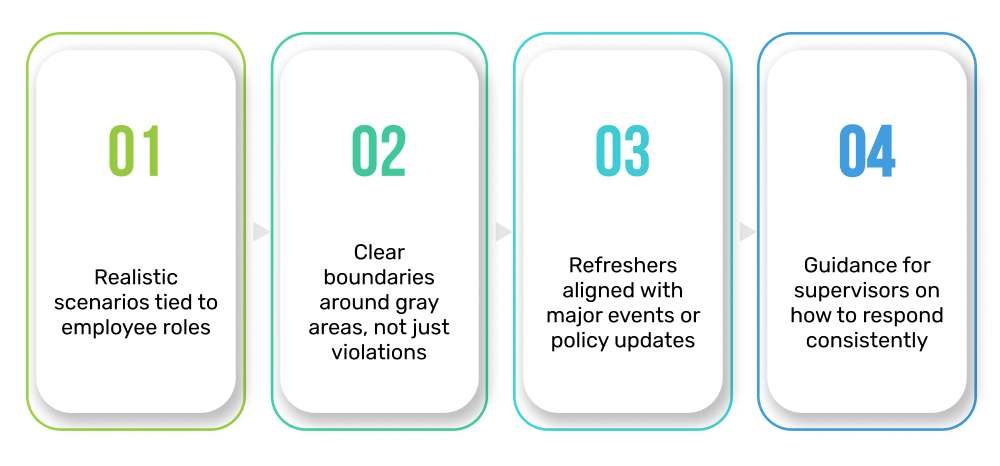
When training fills the gap between policy and practice, employees are less likely to rely on assumptions. HR spends less time managing avoidable incidents, and leadership gains confidence that the organization is taking reasonable, proactive steps to manage risk.
In government workplaces, social media compliance is shaped by behavior more than documents. Policies set the standard. Training makes the standard usable. Government social media compliance training online through platforms like KnowledgeCity helps government teams make compliance standards workable in daily practice.

 KnowledgeCity











Subscribe to Our Newsletter
Join 80,000+ Fellow HR Professionals. Get expert recruiting and training tips straight
to your inbox, and become a better HR manager.