
HR and L&D teams are being asked to explain why performance varies so widely when employees are using the same AI tools, the same data, and often the same workflows.
Two employees complete similar work with AI support. One produces output that is clear, defensible, and ready to use. The other produces something fast, confident, and ultimately unusable. Managers struggle to coach the difference. Performance reviews lack shared standards. Learning teams are tasked with improving capability; however, no one has defined what capability actually looks like in an AI-enabled workplace.
This is the reality your team faces in 2026. AI is embedded in daily work, but traditional training and performance measures are not equipped to ensure consistent, accountable results. The question becomes urgent: Should your focus be on AI skills or AI fluency, and what does that mean for designing learning that actually improves performance?
In this blog, we answer that question decisively. You will see why AI fluency must be prioritized first, how it interacts with skills and human judgment, and what L&D teams must do to stabilize performance in AI-supported work.
Why Fluency Should Come Before Skills
Many organizations started with AI skills training, teaching employees how to generate outputs, use prompts, or automate tasks. Completion rates were high, dashboards looked positive, and teams felt capable.
However, outputs did not consistently meet expectations. Managers found it difficult to evaluate work because employees applied skills differently, depending on their own understanding of the task.
Skills alone improve execution speed, but they do not align thinking or decision-making. When fluency is not established, employees may use AI correctly from a technical perspective but still produce work that is inconsistent with business expectations. Here, this means skills are most effective when they are applied within the boundaries defined by fluency. Let’s discuss what AI fluency is.
Defining AI Fluency
AI fluency focuses on how employees understand, evaluate, and act on AI outputs in context. It ensures that work is reliable, consistent, and aligned with organizational expectations.
Key elements of AI fluency include:
- Interpretation: Employees can assess whether AI outputs are relevant, accurate, and aligned with context.
- Decision Ownership: Employees understand which decisions are their responsibility and when AI is advisory.
- Validation and Escalation: There are defined steps for reviewing outputs before acting, maintaining quality and consistency.
- Transparency: Employees can clearly explain decisions and reasoning to managers, peers, and auditors.
For your team, AI fluency creates a shared standard, ensuring that skills are applied effectively and outcomes remain accountable.
But how do you know if your team has developed AI fluency? Here’s a practical framework for assessment:
The AI Fluency Assessment Rubric
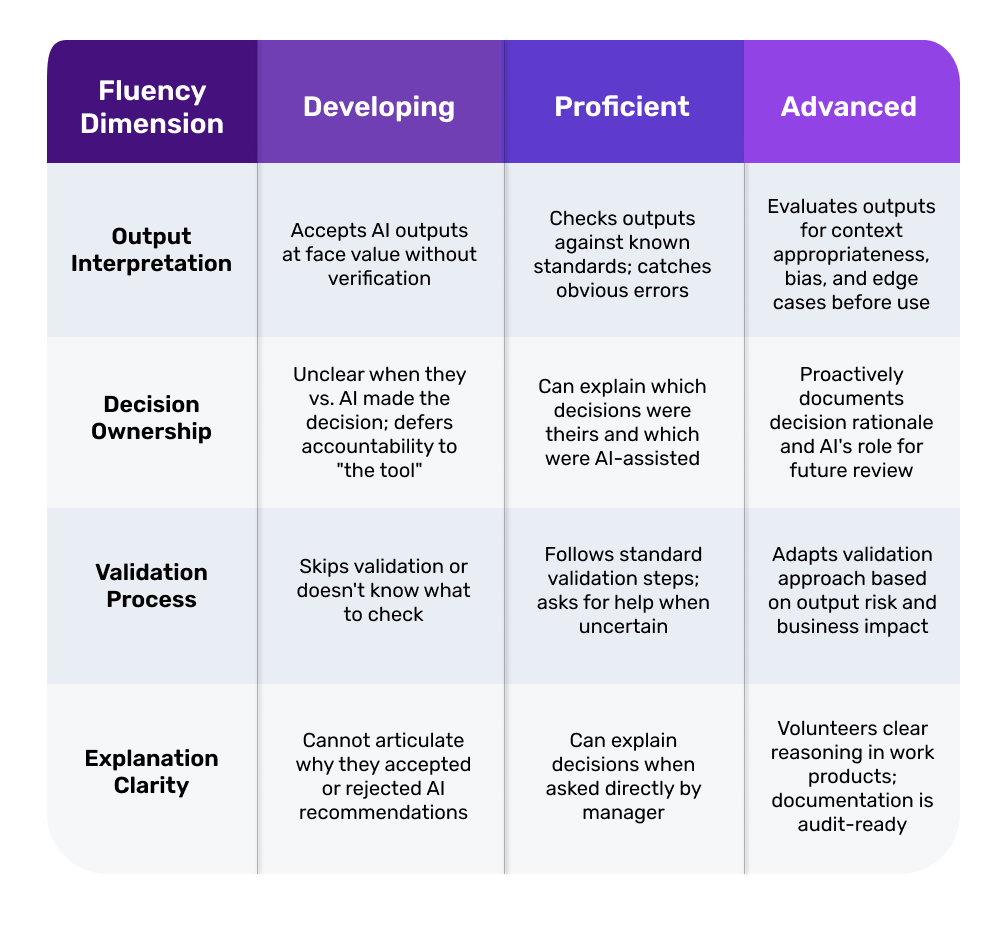
How to Use This Rubric:
- For Managers: Evaluate 3-5 recent AI-supported work samples per employee using this framework. Where you see “Developing” ratings, that’s where coaching should focus.
- For L&D Teams: Use this as a pre/post training assessment. Track the percentage of employees moving from “Developing” to “Proficient” as your success metric.
- For Self-Assessment: Employees can review their own recent work against these criteria to identify personal development areas.
- Red Flag: If more than 40% of your team scores “Developing” on Decision Ownership or Explanation Clarity, pause skills training and prioritize fluency development immediately.
Once you can assess fluency, the next step is embedding it where work actually happens, in daily workflows and manager conversations.
Embedding AI Fluency in Daily Work
Fluency becomes meaningful when it is integrated into everyday workflows and performance management:
- Manager Coaching: Managers focus on reasoning and decision logic rather than simply checking tool usage.
- Decision Checkpoints: AI outputs are reviewed at appropriate points to ensure alignment with business standards.
- Role-Specific Fluency: For example, recruiters evaluate candidate recommendations beyond automated scoring, and L&D specialists verify training impact beyond platform metrics.
- Performance Metrics: Indicators such as consistency, fewer errors requiring follow-up, and clarity in explanations reflect how fluency is applied.
Embedding fluency ensures your team produces consistent, high-quality outputs and sets the foundation for skills to enhance performance.
Where AI Skills Fit in a Fluency-First Model
Once fluency is established, AI skills become targeted and role-specific accelerators:
- Role-Based: Skills are aligned with responsibilities, ensuring relevance for each position.
- Outcome-Focused: Evaluation emphasizes quality, accuracy, and relevance rather than speed alone.
- Workflow-Integrated: Skills are practiced in real work scenarios, making them immediately applicable.
In this approach, skills expand capacity while maintaining the quality standards established by fluency.
Human Judgment as the Control Layer
AI can accelerate work, but cannot replace accountability. Critical thinking, ethical reasoning, and communication are essential controls that maintain reliable outcomes:
- Critical Thinking: Employees assess whether AI outputs make sense in context.
- Ethical Reasoning: Employees evaluate potential bias, compliance, or fairness issues.
- Communication: Employees articulate decisions clearly for managers, peers, and stakeholders.
Integrating human judgment with fluency and skills ensures that AI accelerates performance without introducing hidden risks.
Redesigning Competency Frameworks and Performance Systems
To make fluency effective, you must align organizational systems with AI-supported work:
- Competency Frameworks: Update expectations to include AI-supported decision-making and fluency behaviors.
- Performance Evaluation: Assess reasoning and decision quality, not only output metrics.
- Manager Readiness: Equip managers to coach and evaluate fluency and judgment consistently across teams.
This structural alignment ensures that learning programs support actual performance requirements.
Measuring Progress Effectively
Traditional metrics like course completion or platform usage do not measure capability. Focus on indicators that reflect applied fluency and skills.
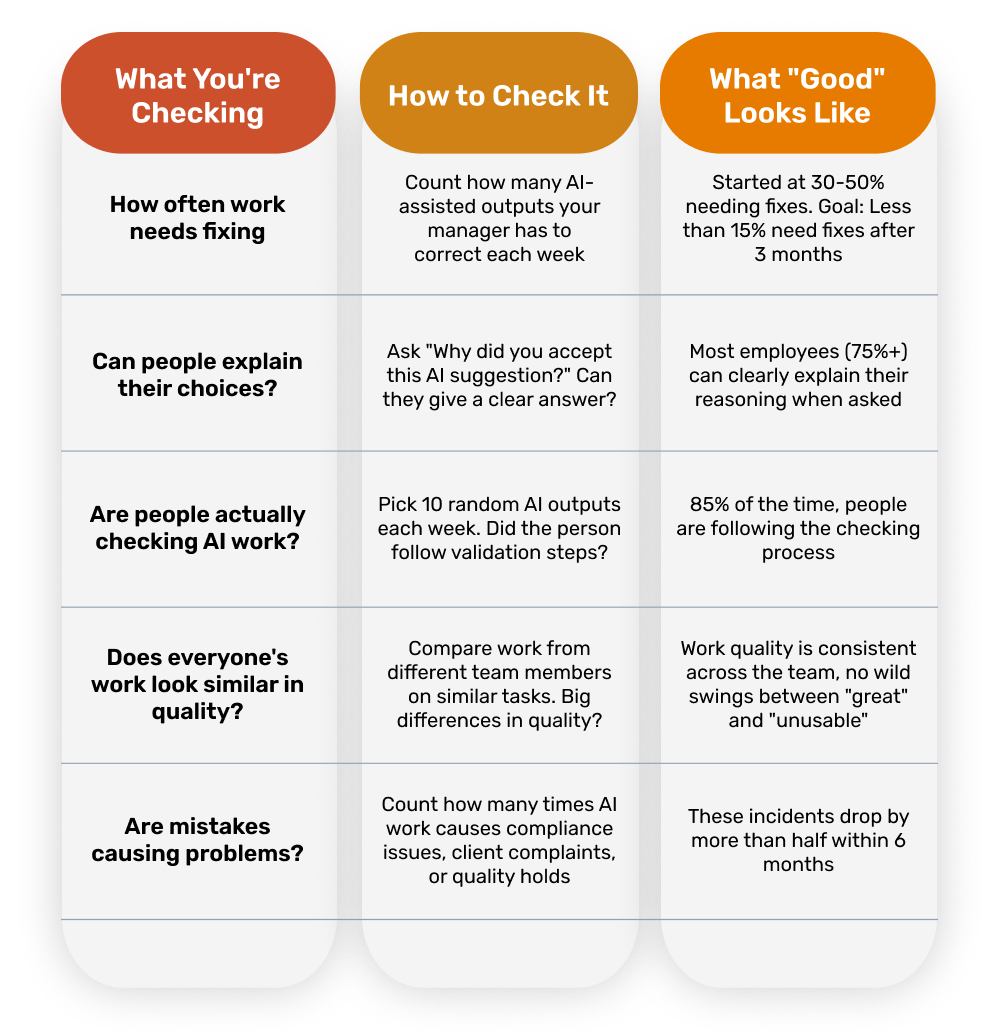
Reality Check
Expect metrics to briefly worsen (weeks 2-4) as employees slow down to validate properly. This is normal. Improvement should appear by week 6-8.
Avoid vanity metrics: Number of prompts used, training completions, output volume, or generation speed tell you nothing about capability.
These measures show whether fluency, skills, and judgment are integrated and working as intended.
Quick Actionable Roadmap for L&D Teams in 2026
- Establish fluency as the baseline expectation for all roles where AI is applied.
- Integrate fluency into workflows, coaching, and performance systems before expanding skills.
- Introduce role-specific AI skills aligned with fluency, emphasizing real-world application.
- Reinforce human judgment continuously as a safeguard for decision quality.
- Use outcome-based metrics to measure impact rather than relying on activity or completion alone.
This approach stabilizes performance, ensures accountability, and allows AI to work effectively. So, the priority for 2026 is clear: AI fluency first, AI skills second, and human judgment integrated throughout.
Build AI fluency, AI Skills, and Human Judgment in Your Teams with KnowledgeCity
As we’ve discussed, the true measure of capability today is how employees combine understanding, skill, and judgment in AI-supported work. Fluency ensures employees can interpret AI outputs accurately. Skills allow them to act effectively in context. Judgment ensures decisions align with business goals, ethical standards, and quality expectations.
KnowledgeCity helps your teams develop all three together. Our learning library of 50,000+ premium videos covers AI tool usage, prompt creation, and AI integration into workflows, alongside critical skills such as decision-making, ethical reasoning, and practical judgment. Employees engage with real-world scenarios that reinforce learning and build measurable capability.
By integrating fluency, skills, and judgment, teams maintain consistent performance and make decisions confidently. KnowledgeCity, the best employee training platform in the USA, enables HR and L&D professionals to translate learning into clear, observable improvements, ensuring their teams are prepared to meet the demands of AI in everyday work.

 KnowledgeCity





Subscribe to Our Newsletter
Join 80,000+ Fellow HR Professionals. Get expert recruiting and training tips straight
to your inbox, and become a better HR manager.