Key Takeaways
- Fleet safety, driver performance, and training systems capture accurate records in isolation, and the gap between them surfaces when an audit request spans all 3.
- The Compliance, Safety, Accountability (CSA) program scores carriers across 7 BASICs on a 24-month rolling window, so every documented safety response matters for 2 years.
- Title 49 retention obligations differ by record type: driver qualification files, drug and alcohol records, hours-of-service logs, and entry-level training records each run on their own clock.
- Records that lack a shared driver identifier require manual reconciliation, and every manual merge is a chance to create a documentation gap the auditor reads as inaction.
- The audit-ready chain is 1 exportable record: the safety event, the training assigned in response, and the timestamped completion, linked from the moment each record is created.
Fleet safety programs, driver performance monitoring systems, and training management platforms often operate as independent data stores within the same carrier organization. Each system captures accurate information in isolation. The problem surfaces at audit time, when a Federal Motor Carrier Safety Administration (FMCSA) investigator requests documentation that spans all 3: a safety event, the driver’s performance record at the time of that event, and the training assignment that followed it; the test fleet audit readiness has to pass. When those records live in separate systems with no shared identifier, reconstructing the chain manually introduces the documentation gap that surfaces in compliance reviews.
What Fleet Safety Records Capture and Where the Chain Breaks
The CSA Scoring Frame
The FMCSA’s Compliance, Safety, Accountability program organizes carrier safety performance across 7 Behavior Analysis and Safety Improvement Categories, known as BASICs. Each BASIC draws from roadside inspection results, crash reports, and violation records accumulated over a 24-month rolling window, and a carrier’s score in any BASIC reflects the aggregate of recorded events during that period. FMCSA has approved an Enhanced SMS methodology (Federal Register notice of November 20, 2024) that will rename the BASICs as compliance categories, though FMCSA’s Prioritization Preview site states the updated system is not yet in effect as of mid-2026, and carriers should continue monitoring the current SMS.
Where Internal Data Precedes the Roadside Record
Safety event data enters the SMS through roadside inspection reports and crash records uploaded by state partners, with the DataQs system serving as the channel for challenging data a carrier believes is incorrect. Fleet safety managers who monitor telematics also collect internal event data, including hard-braking incidents, speeding violations, hours-of-service flags, and pre-trip inspection failures. This internal data is valuable precisely because it precedes the roadside record.
A carrier that documents a hard-braking event and assigns corrective defensive driving training within 30 days of the event has created a record of responsive action. A carrier that cannot link the internal event to a training completion has no documentation of that response at the time of the audit.
The structural problem is that the telematics platform, the CSA portal, and the training management system typically have no shared driver identifier. Each uses its own driver ID schema. Reconciling them requires manual export and cross-referencing, a process that works when the documentation request is anticipated and breaks when it arrives as part of a compliance review with a short response window.
The Title 49 Retention Windows That Define FMCSA Audit Scope
FMCSA recordkeeping obligations are defined across multiple parts of Title 49 of the Code of Federal Regulations, and each carries its own clock:
- Driver qualification (DQ) files under 49 CFR Part 391 must be retained for the entire period of employment plus 3 years.
- Drug and alcohol testing records under 49 CFR Part 382 carry retention windows ranging from 1 year for negative test results to 5 years for records of violations.
- Hours-of-service records of duty status under 49 CFR Part 395 must be retained for 6 months.
- Entry-level driver training records split by era: for drivers trained under the pre-2022 entry-level rules, employers keep the training certificate for the duration of employment plus 1 year, while for drivers covered by the current entry-level driver training (ELDT) rule under 49 CFR Part 380 (effective February 7, 2022), completion is recorded in FMCSA’s Training Provider Registry and the carrier’s obligation is verifying the record before the driver operates.
The combined scope of these requirements means that an FMCSA compliance review can examine records spanning multiple years, multiple regulatory parts, and multiple internal systems simultaneously. A carrier that maintains each record type in a separate, unintegrated system is not in violation of any retention rule. That carrier will nonetheless spend substantially more time responding to audit requests than a carrier that links records through a shared driver identifier from the point of record creation.
Regulatory scope in 1 sentence: 4 record types, 4 retention clocks, and no single-system export that satisfies a comprehensive audit request unless a shared driver identifier links each record at the moment of creation.
Where Driver Performance Data and Training Records Diverge
The Event That Closes in One System
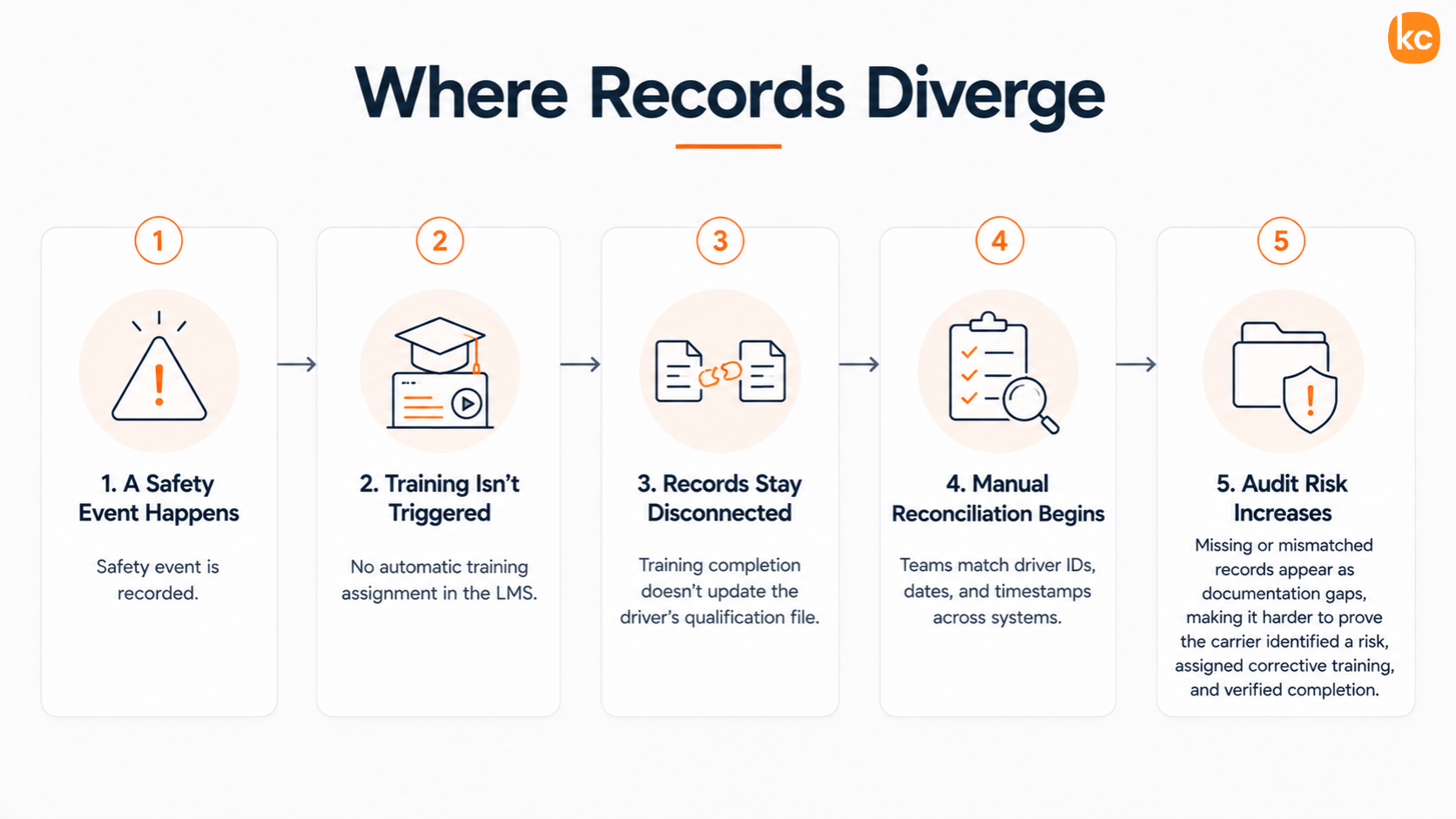
Driver performance records and training records diverge when a safety event closes in one system but does not trigger a record in the other. A CSA BASIC percentile that rises due to accumulated inspection violations does not automatically generate a training assignment in the carrier’s learning management system (LMS), which is the gap that effective driver performance tracking is supposed to close. A training completion logged in the LMS does not automatically update the driver’s qualification file.
This gap is costly because a compliance review evaluating safety management controls looks for documented evidence of a response to identified risk. When a driver’s motor vehicle record shows multiple moving violations and no training record exists for the subsequent period, the documentation creates the appearance of inaction, regardless of any informal training that may have occurred. An investigator will look for documented evidence of a response, not an oral account of one.
The Reconciliation Error Risk
Carriers that rely on manual reconciliation to produce this documentation face an additional risk: the reconciliation itself introduces error. Driver IDs that differ by a suffix, date formats that differ by locale, and completion timestamps that differ by time zone are each sufficient to misalign a record in a manual merge. Each misalignment is a documentation gap from the auditor’s perspective.
Close the loop the auditor checks. KC Safety assigns corrective training automatically after an incident, and the completion lands on the same driver record, timestamped and exportable.
Building an Integrated Audit Trail Across Safety, Performance, and Training
An integrated audit trail requires that safety events, performance flags, and training records share a common driver identifier from the point of record creation:
- A safety event record carries a driver ID that the LMS recognizes
- Training assigned in response to that event references the original event
- The completion record includes the assignment date, the completion date, the triggering event, and the elapsed time from event to completion
This structure produces a single exportable record that answers the auditor’s core question: did this carrier identify a risk, assign corrective training, and confirm that the training was completed? That kind of fleet training and performance integration is what closes the reporting gap for good.
How KnowledgeCity Connects Fleet Compliance Records
KnowledgeCity’s workforce development platform connects fleet training to the safety event records that auditors cross-reference within a single shared data model. KC Library carries defensive driving and hazmat handling courses as part of a complete DOT compliance training path available out of the box, delivered through KC LMS with offline mobile completion for drivers on the road. Each completion generates a timestamped record linked to the assigned driver, with driver qualification documentation unified on the same platform.
KC Safety handles the event side: incidents and near-misses are reported, investigated, and root-caused in one place, and corrective training is automatically assigned to close the loop and protect the CSA score. The assignment ties back to the incident, and the completion ties back to the driver, so the full chain exports for audit review without manual cross-referencing across systems. For the specific hours-of-service and drug-and-alcohol program course coverage your operation needs, ask the KnowledgeCity team during a working session which titles map to your requirements.
Demonstrate responsive safety management at your next audit. The safety event, the corrective training, and the timestamped completion, on one driver record.
Frequently Asked Questions
- What does an FMCSA compliance review examine regarding driver training records?
An FMCSA compliance review examines whether a carrier has adequate safety management controls in place. This includes driver qualification files under 49 CFR Part 391, drug and alcohol testing records under 49 CFR Part 382, hours-of-service documentation under 49 CFR Part 395, and entry-level driver training verification under 49 CFR Part 380. Reviewers look for evidence that training was assigned and completed in response to identified safety risks, not just confirmation that training occurred at some point during the driver’s tenure.
- How long must carriers retain FMCSA compliance records?
Driver qualification files under Part 391 must be retained for the period of employment plus 3 years. Drug and alcohol testing records under Part 382 carry retention windows from 1 year for negative results to 5 years for records of violations. Hours-of-service records of duty status under Part 395 must be retained for 6 months. For entry-level driver training, certificates for drivers trained under the pre-2022 rules stay on file for employment plus 1 year, while completions under the current ELDT rule are recorded in FMCSA’s Training Provider Registry, which the carrier verifies before the driver operates.
- What is the CSA program, and how does it affect fleet training obligations?
The FMCSA’s Compliance, Safety, Accountability program measures carrier safety performance across 7 Behavior Analysis and Safety Improvement Categories, known as BASICs. Each BASIC draws on roadside inspection results, crash reports, and violation records over a 24-month rolling window. A carrier’s BASIC percentile scores influence the likelihood of an FMCSA intervention or compliance review. Carriers with elevated BASIC scores related to driver fitness, hours-of-service compliance, or controlled substances are more likely to be selected for review, making documented, event-responsive training a direct risk-management tool.
- Does FMCSA require defensive driving training for commercial drivers?
No FMCSA rule prescribes defensive driving training or a completion deadline for experienced drivers; the federal training mandate at Part 380 covers entry-level drivers. What a compliance review evaluates is whether the carrier’s safety management controls respond to identified risks. Defensive driving training assigned in response to a specific, documented safety event, completed promptly and recorded with a timestamp linked to the driver’s record, constitutes documented evidence of that response. A course completed without a documented connection to an identified event still has training value, but it does not demonstrate the responsive safety management a reviewer is evaluating.
References
- Federal Motor Carrier Safety Administration. Compliance, Safety, Accountability (CSA).
- Federal Register. Enhanced Carrier Safety Measurement System (SMS), notice of approved changes, November 20, 2024.
- Federal Motor Carrier Safety Administration. 49 CFR Part 380, Special Training Requirements, including entry-level driver training.
- Federal Motor Carrier Safety Administration. 49 CFR Part 382, Controlled Substances and Alcohol Use and Testing, including §382.401 retention requirements.
- Federal Motor Carrier Safety Administration. 49 CFR Part 391, Qualifications of Drivers, including §391.51 driver qualification files.
- Federal Motor Carrier Safety Administration. 49 CFR Part 395, Hours of Service of Drivers, including §395.8 records of duty status.