
If you are reading this, you are likely responsible for training outcomes that have fallen short of real performance impact. As an HR or L&D professional, you know the effort it takes to plan programs, select content, and encourage your team to participate. Your team attends, completes the courses, and the feedback is positive. Managers say the sessions went well. Yet when you check the results, nothing has changed. KPIs remain flat, errors continue, and progress feels slow.
The problem is rarely your team or the training content. Most often, it is that the true performance problem has not been identified and addressed first. Without tackling this root issue, even the best training programs fail to produce measurable results.
In this blog, we will learn exactly what to fix first, how to uncover the real performance gap, and advanced strategies to ensure training leads to measurable performance improvement.
Understand Why Training Often Fails
Before we explore what to fix first, it is important to understand why training often falls short of improving performance. Most programs are designed as isolated learning events rather than performance improvement initiatives. Your team may learn new skills in a session, but without your support and reinforcement, they rarely transfer those skills to the workplace.
Research shows that only about 10-20% of what your team learns in training is applied on the job without deliberate support. They forget quickly, managers may not reinforce new behaviors, and organizational systems often work against the application of new skills. Recognizing these realities is essential because it frames why the first fix must go beyond content and delivery.
Understanding the root of training failure naturally leads you to the first and most critical fix: diagnosing the performance problem clearly.
Diagnose the Real Performance Problem
The first step is to identify exactly what performance gap training is meant to address. Too often, programs launch with vague goals like “improve leadership skills” or “enhance customer service.” These are aspirational, but they do not provide a measurable problem that your team can correct through training alone.
A robust diagnosis answers the questions:
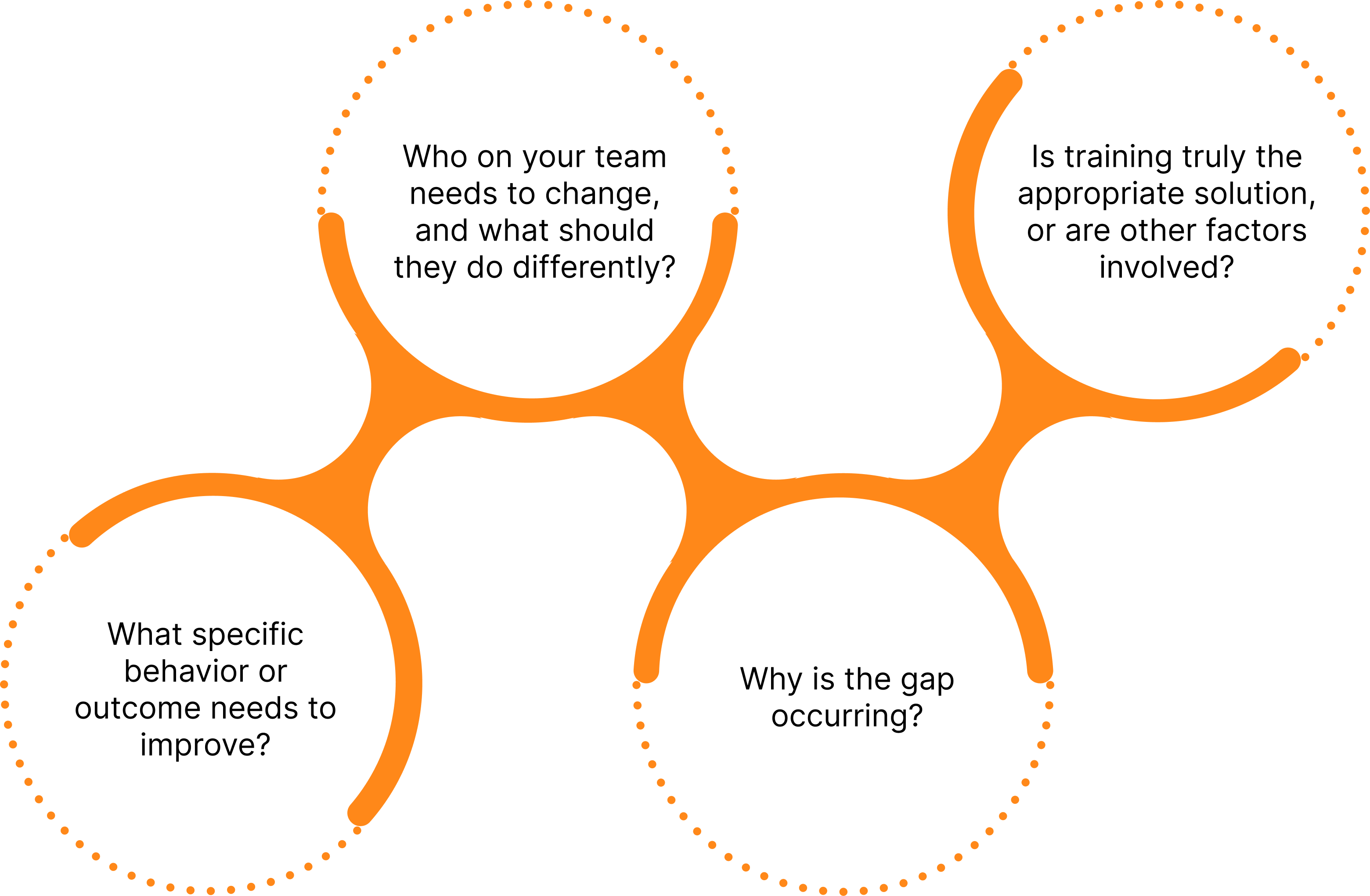
By starting with a clear diagnosis, you ensure that training targets the true performance barriers for your team rather than assumed ones. This clarity also helps set measurable objectives and prevents wasted effort on programs that cannot deliver real impact.
With a diagnosed performance gap, the next step is to define specific outcomes in business terms, so your training is aligned with measurable results.
Define Performance-Focused Outcomes
Once the performance gap is identified, it is essential to translate it into measurable outcomes. Vague learning objectives are insufficient. Leaders need to see the impact of training in terms they care about: business performance.
Examples include:
- Reducing onboarding ramp-up time for your team by two weeks
- Improving first-contact resolution in service calls by 18%
- Decreasing quality defects by 22%
By defining outcomes this way, you create a clear target for your team and managers. Training is no longer an isolated activity; it becomes a tool to achieve real business results.
When outcomes are clearly defined, it naturally leads you to design training for actual application in the workplace, ensuring that learning translates into action.
Design Training for Transfer to the Workplace
Designing for transfer is critical because knowledge alone does not improve performance. Transfer happens when your team actively applies what they have learned in their work environment.
Effective strategies include:
- Realistic Practice and Feedback: Use scenarios and simulations that mirror your team’s tasks, with immediate feedback to correct errors and reinforce learning.
- Spaced Reinforcement: Deliver learning in short, repeated intervals, rather than one-time sessions, to strengthen retention.
- Integration With Workflow: Embed job aids, checklists, and prompts within daily work tools to facilitate application.
Training designed this way increases the likelihood that your team uses new skills effectively, bridging the gap between learning and performance. Even the best-designed programs require your active involvement and support to ensure learning is applied consistently.
Engage Managers as Performance Enablers
Managers are the most powerful factor in ensuring training translates into improved performance. They set expectations, coach behaviors, provide feedback, and reinforce learning.
To maximize impact, you can:
- Prepare managers before training so they understand the skills your team is developing
- Give them tools to coach and support your team after training
- Align performance expectations with new behaviors
- Recognize and reward the application of skills
When managers are engaged, training stops being an isolated event and becomes part of your team’s ongoing workflow, making skill application more consistent and measurable.
Manager involvement also highlights the importance of organizational conditions in supporting or blocking performance change.
Align Organizational Conditions With Desired Performance
Training cannot succeed in isolation. Even when your team develops skills and managers are engaged, the workplace must support the new behaviors.
Key organizational enablers include:
- Workflows and processes that allow your team to apply new skills
- Tools and resources that enable performance
- Incentives aligned with desired behaviors
- A culture that encourages continuous learning
Without these conditions, your team may revert to old habits despite having learned new skills. Aligning organizational systems ensures that training translates into sustainable performance improvement.
With organizational conditions in place, the next critical step is to measure training impact accurately.
Measure Training Outcomes With Purpose
Measuring training impact is more than checking completion rates or satisfaction surveys. Focus on metrics that reflect real performance change for your team:
- Behavior change on the job
- Performance metrics tied to defined outcomes
- Manager assessments of skill application
- Longitudinal tracking over 30, 60, and 90 days
This type of evaluation not only demonstrates impact but also provides insights to refine your training programs continuously. Measuring outcomes effectively reinforces the connection between training and performance, guiding you toward sustained improvement.
Make Learning Ongoing and Integrated With Work
Finally, training must be ongoing, not a one-off event. Your team will forget skills if they are not reinforced. To make learning stick:
- Use follow-up microlearning sessions
- Provide job aids accessible at the point of need
- Conduct coaching sessions and reflection checkpoints
- Embed performance support tools into workflows
This approach turns learning into a continuous improvement process, ensuring that training drives lasting performance change for your team.
Taking Action Starts With the Right Fix
If training is not improving performance, continuing as before wastes time, resources, and opportunities. The first step is very important: identify the real performance problem. Everything else depends on it.
When you focus on the root cause, you stop guessing and start solving. You ensure your team learns what truly matters, applies it consistently, and achieves results that leaders notice. Training stops being a checkbox activity and becomes a powerful tool to drive real business outcomes.
This approach changes the way your team works, the results your organization sees, and the influence you have as a professional. By addressing the true performance gap first, you create lasting impact, build credibility, and demonstrate the measurable value of learning and development.
The opportunity is yours to seize: diagnose first, act decisively, and make training a driver of real performance change.

 KnowledgeCity











Subscribe to Our Newsletter
Join 80,000+ Fellow HR Professionals. Get expert recruiting and training tips straight
to your inbox, and become a better HR manager.