
Over the past year, many organizations have quietly noticed a shift in how work gets completed. Tasks that once required focused blocks of time are now handled more quickly, often with the help of AI-powered solutions embedded into everyday workflows. Employees are drafting emails, preparing presentations, and reviewing information at a pace that would have been difficult to imagine not long ago.
For HR and L&D professionals, this shift initially looks promising. When routine work takes less time, learning should become easier to fit into the workday. Upskilling should feel more realistic, and development efforts should finally have room to catch up with the speed of change.
In practice, that is not what many organizations are experiencing.
Despite clear efficiency gains from AI, learning activity has not increased in a meaningful way. Skill gaps remain visible, and in some cases feel even more pronounced. Employees often report feeling just as busy as before, while L&D teams struggle to turn productivity gains into capability growth.
This has led many HR and L&D professionals to reflect on a difficult question. If AI is giving people time back, why is so little of that time being used to build skills?
Understanding The AI Efficiency Gap In The Workplace
The AI efficiency gap describes the difference between the time saved through AI and the skills actually developed through learning. Studies consistently show that employees are saving time by using AI tools for administrative work, content preparation, and information processing. At the same time, a significant number of employees still report that they do not have enough time to learn.
From an L&D perspective, this gap creates frustration. Productivity appears to improve, but capability does not rise at the same rate. Learning programs remain underused, and the pressure to deliver impact continues to grow.
The issue is not that employees are unwilling to learn. It is that the systems surrounding their work have not changed in ways that support learning.
Measuring the AI Efficiency Gap
To make this gap visible and actionable, HR and L&D teams can track key metrics that connect saved time to real skill growth. These metrics reveal whether efficiency gains are actually being invested in:
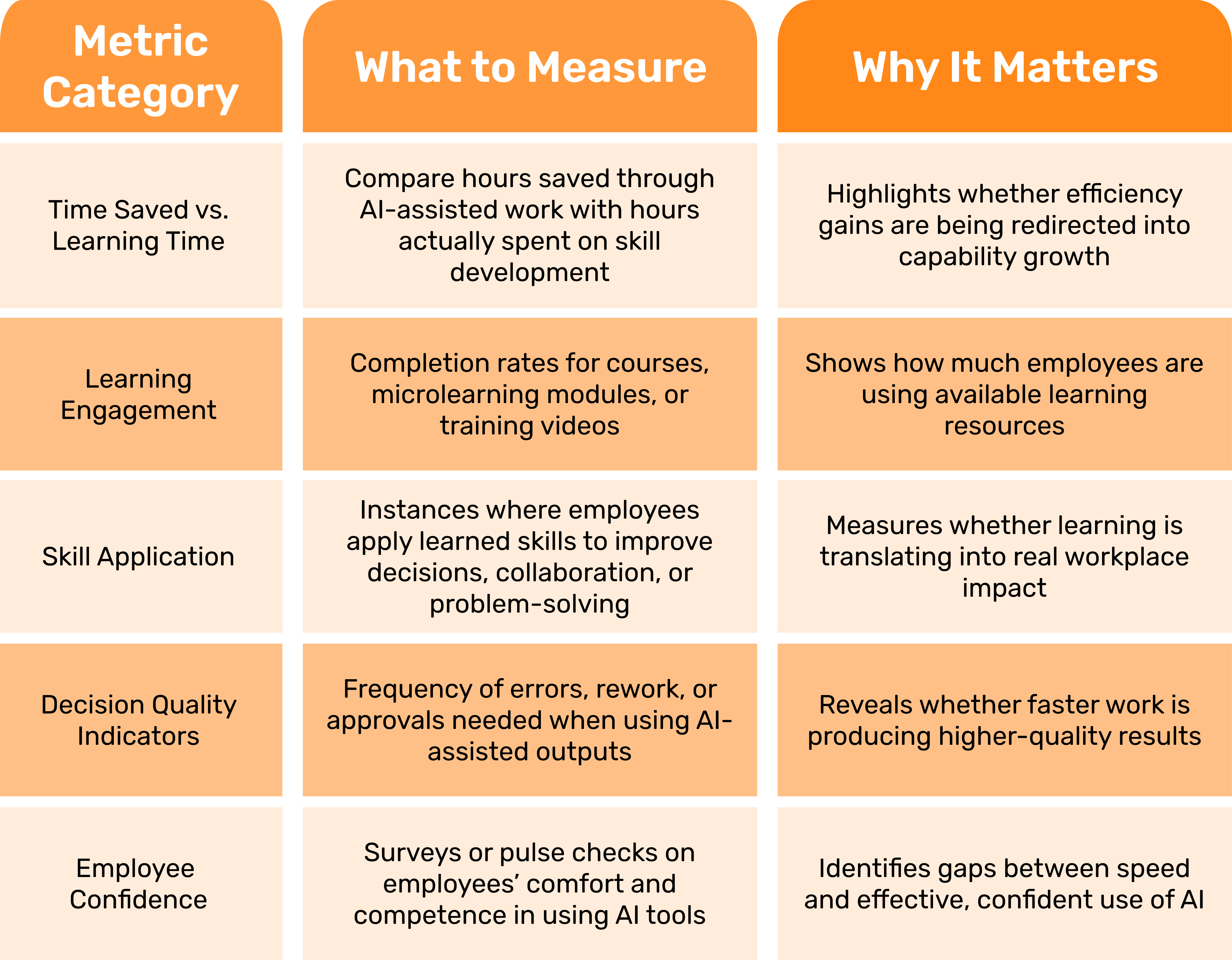
Bridging these metrics is key: time saved is valuable only if it leads to stronger skills, better decisions, and more confident use of AI in daily work.
Why Saved Time Rarely Becomes Learning Time
It is easy to assume that when time becomes available, employees will naturally invest it in development. Inside organizations, that assumption breaks down quickly. Here’s why:
-
Learning Still Feels Like A Risk
Even when employees finish tasks faster, many hesitate to use that time for learning. In environments where productivity is closely monitored, learning can feel invisible or even risky. Employees worry about how it will be perceived, especially when managers have not clearly communicated that learning during work hours is supported.
When expectations are unclear, people default to what feels safest. They take on more work, respond faster, or stay available, rather than stepping away to learn.
-
Faster Work Does Not Mean Clearer Thinking
AI speeds up execution, but it does not automatically improve judgment. Employees still need to decide what information to trust, how to apply it, and when to question it. For many, this creates mental strain rather than relief. Instead of feeling freed up, employees often feel pressure to deliver more, faster. In that state, learning feels demanding rather than helpful, even when time technically exists.
-
Learning Still Sits Outside Daily Work
Most learning experiences still require a clear break from work. Logging into a separate platform, choosing a course, and committing focused time can feel disconnected from the flow of the day. AI tools, by contrast, live inside the work itself. They support tasks in real time. When learning remains separate, it struggles to compete, regardless of how much time is saved elsewhere.
-
Upskilling Often Feels Too Abstract
Employees are practical. They want to know what to learn and why it matters now. When learning goals feel vague or long-term, they are easily postponed. AI-powered solutions provide immediate results. Learning often promises future benefit. Without a clear connection to today’s work, learning becomes optional.
Why This Is A Learning Design Problem, Not A Motivation Issue
Many organizations quietly frame low learning engagement as an employee issue. People are described as distracted, resistant, or uninterested in development.
This framing misses the point. Employees respond to the structure of work around them. They prioritize what is rewarded, visible, and supported by leadership. When learning is not clearly connected to performance or decision making, it falls behind urgent tasks.
For HR and L&D professionals, this is an important shift in perspective. The challenge is not convincing people to care about learning. It is designing learning that fits how work actually happens today.
How AI Is Changing What Skills Matter Most
As more routine work is handled by AI, what people contribute at work is changing. Speed still matters, but it is no longer what sets strong performers apart. Clear judgment, thoughtful communication, and sound decision-making are becoming the real differentiators.
There is a growing confidence among employees who use AI tools, even when their core skills have not actually improved. The work looks polished on the surface, but the thinking behind it is not always stronger. That gap is easy to miss and easy to underestimate.
For organizations, the cost of this gap shows up in decisions made too quickly and with too little scrutiny. Faster is not better if the judgment is weak. Learning now has a different role to play: helping people slow down their thinking, question what AI produces, and make decisions they can stand behind when the pressure is on.
What HR And L&D Can Do To Close The AI Efficiency Gap
Closing the AI efficiency gap does not require more content or louder messaging. It requires thoughtful changes in how learning is positioned and delivered.
-
Redefine What Learning Time Looks Like
Learning does not have to mean long sessions or formal programs. Short, focused learning that fits naturally into reclaimed time is far more realistic. When learning respects the pace of work, employees are more likely to engage without feeling overwhelmed.
-
Focus On Thinking And Judgment Skills
Training employees on how to use tools is only part of the solution. Learning must also strengthen skills such as evaluating information, asking better questions, and knowing when human judgment matters most. These skills help employees work more confidently with AI and reduce the risk of overreliance.
-
Make Learning Immediately Useful
Learning should help employees solve real problems they face today. Clearer communication, better decision-making, fewer mistakes, and stronger collaboration all create immediate value. When learning improves daily work, employees do not need to be persuaded to engage.
-
Involve Managers In Supporting Learning
Managers shape how time is used more than policies do. When leaders explicitly support learning, protect time for it, and reference it in conversations, employees feel safer investing in development. L&D cannot close the gap alone. Manager involvement is essential.
How Learning Platforms Must Support Modern Work
Traditional learning platforms were built for a different pace of work. Today, learning must be fast, practical, and designed to strengthen thinking rather than just task completion.
At KnowledgeCity, we provide 50,000+ premium training videos through our comprehensive learning library. Our content fits into real workdays and develops the skills modern roles rely on most. In addition, our AI-powered learning management system allows organizations to deliver, track, and personalize learning at scale, ensuring teams get the right training at the right time.
Why This Moment Matters For HR And L&D Leaders
The AI efficiency gap will not close on its own. Without intentional learning design, organizations risk moving faster without becoming stronger. Speed without judgment increases risk, and automation without understanding weakens accountability. Learning is the bridge between efficiency and real capability.
HR and L&D leaders can shape that bridge. By aligning learning with how work actually happens, protecting time for development, and focusing on skills that strengthen thinking, organizations can turn AI-driven efficiency into meaningful growth.
The true value of AI is not in the time it saves. It is what organizations choose to create with that time.

 KnowledgeCity







Subscribe to Our Newsletter
Join 80,000+ Fellow HR Professionals. Get expert recruiting and training tips straight
to your inbox, and become a better HR manager.