KnowledgeCity

Dreamweaver CS3 Intermediate

Explore new layout techniques in this intermediate course on Adobe Dreamweaver CS3.

Explore new layout techniques in this intermediate course on Adobe Dreamweaver CS3. Learn how to insert tables into your webpage design and gain new control over where items appear on the page. Discover how to customize tables and insert interactive buttons for more advanced webpages.

Author: جون ويفير

Duration: 2h 41m · 18 lessons
Level: Intermediate
Language: English

Skills you’ll gain

Adobe DreamweaverAdobe PageMakerHTML TablesInteractive Web DesignInteractive Web PagesAdobe Dreamweaver Certification

What You'll Learn

  • Insert tables into your webpage design and add table content
  • Customize tables by coloring them and adding rows and columns
  • Use tables for page layout, including width settings in percent versus pixels
  • Apply tiling background images and combine multiple tables on a page
  • Insert interactive Flash buttons and create rounded corners
  • Build named anchors and create linking rollover images

Key Takeaways

  • This intermediate Adobe Dreamweaver CS3 course focuses on new layout techniques for more advanced webpages.
  • Tables can be created, filled with content, customized, colored, and expanded with additional rows and columns.
  • Tables can be used to control where items appear on the page and to lay out designs, with options for width in percent or pixels.
  • The course covers interactive elements such as Flash buttons, named anchors, and rollover images.
  • Practical projects in the course include starting a calendar and creating rounded corners.

Frequently Asked Questions

Who is this course for?

It is an intermediate course on Adobe Dreamweaver CS3 for learners who want to explore new layout techniques, including inserting and customizing tables and adding interactive buttons.

What will I learn to do with tables?

You will learn how to insert tables into your webpage design, insert table content, color tables, add rows and columns, set width in percent versus pixels, use tables for layout, and use multiple tables.

What interactive features does the course cover?

The course covers inserting Flash buttons, creating named anchors, and creating and linking rollover images.

What skills does this course build?

It builds skills in Adobe Dreamweaver, Adobe PageMaker, HTML Tables, Interactive Web Design, Interactive Web Pages, and Adobe Dreamweaver Certification.
Transcript

Show transcript (free preview lesson)

Transcript of the free preview lesson. Remaining lessons unlock with the full course.

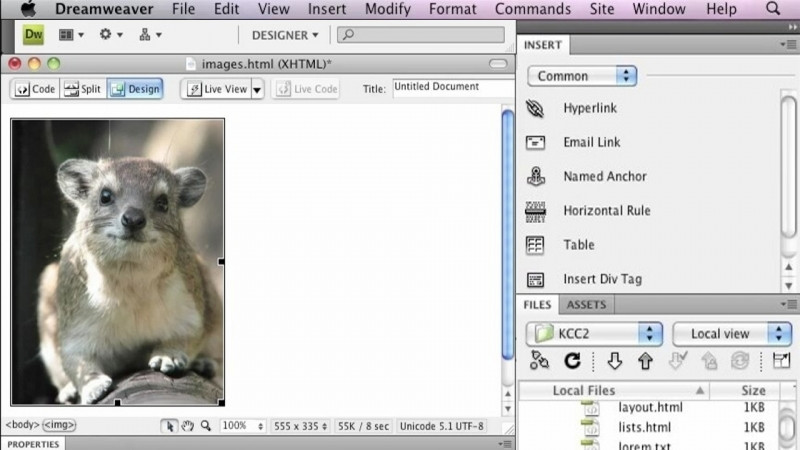
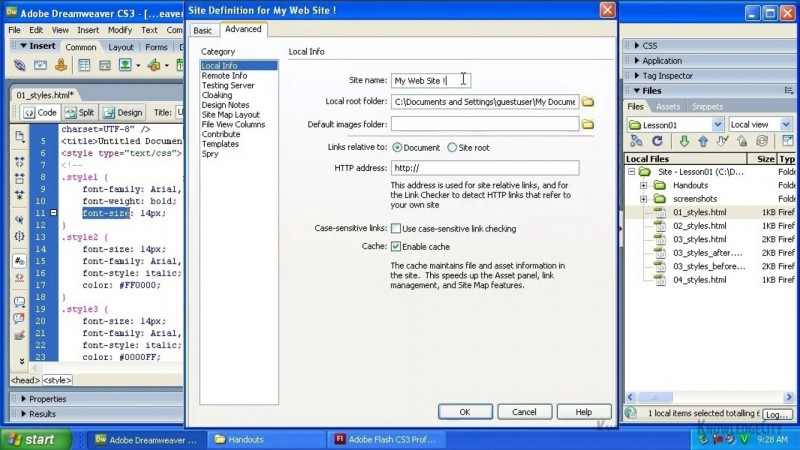
Welcome to Dreamweaver Intermediate. My name is John Wedel, and this lesson will be working with tables. Okay, to get started, what I'd like you to do is go ahead and follow what I'm going to do. I'm going to create a new site by defining a folder. We're going to pick up from where we left off. In Dreamweaver Beginning, we had my website defined. Remember to do this, we need the Files tab open. If that's not open, you can go to Windows and choose Files, F8 on your keyboard for the shortcut. We're going to tell Dreamweaver what folder we're going to use as our new root folder. Remember, the root folder is the folder that contains all of the files for your website. And to redefine that, we click on this dropdown, and we go to Manage Sites. We're going to create a new site, and I'm going to call this Lesson 01 Tables. And I'm going to specify the local root folder by clicking on the folder icon here, and you'll navigate to your resources. In my case, it's actually located here, but we're looking for the Lesson 01 Tables folder. Go ahead and click Open, and then click Select. And after that, we're done. Click OK. And then we're done with this Manage Sites dialog. And there's only one file, one HTML file in this folder, and we're going to open that up and take a look at it. So go ahead and double click. And what we're looking at is a calendar that has actually been created using Tables. Tables are HTML specific tags that go way, way, way back in the world of HTML. And Tables are used primarily for two things, and that is for tabular style data, such as the calendar, or perhaps an Excel spreadsheet. And they are also used for layout, for laying out the graphical elements of your website. Now, Tables have largely been superseded by CSS and divs for creating modern websites, but Tables were pretty much the only game in town for years. And as such, you will still find that you come across websites that you're going to work with or elements that were actually designed using Tables, and therefore you'll still need to be able to work with them. So while they are not used from scratch to create a website very much anymore, you definitely will want to know all the ins and outs of utilizing Tables. So let's go ahead and let's take a look at what this actually looks like when we view it in a browser. Right now you're seeing a lot of dashed lines and different color highlights. So I'm going to preview this in Firefox, and this is what we get in Firefox. I'll go ahead and close this, and I'll preview it in Internet Explorer. So there's a little bit of a difference there between the way that it looks between Internet Explorer and Firefox, and that's based on the differences between the two browsers. Remember that's part of the inherent variability of the web, is that browsers oftentimes do things differently, and we're seeing this in the display differences between these two browsers. So let's close that.

Learn on the Go

Take your learning anywhere — the KnowledgeCity mobile app lets you watch lessons on the go.