Key Takeaways
- Compliance costs at mid-size banks have grown faster than revenue for three consecutive years, and increasing training hours has not reversed the trend.
- Compliance training software that tracks capability outcomes gives examiners the evidence they now look for, beyond training completion logs.
- The shift from training volume to capability assessment changes compliance cost from a fixed escalation to a manageable operating variable.
- Regulatory compliance training aligned to identified skill gaps reduces examination preparation time and remediation costs compared to completion-based programs.
- KC’s workforce development platform and Skills Assessment give banking organizations a training delivery and capability verification infrastructure that produces examiner-ready documentation.
Mid-size banks have increased training hours, expanded regulatory compliance training programs, and extended mandatory completion requirements across more staff categories. Compliance costs have risen anyway. The variable that determines whether a compliance training software investment translates into lower examination risk isn’t how many hours staff complete, but what those hours build in terms of demonstrated capability.
The distinction matters at the board level because compliance cost is a competitive variable. A bank that exits an examination cycle without a Matter of Supervisory Concern finding has capital available for deployment that a bank entering remediation does not. The difference between those two outcomes is rarely the volume of training completed. It is the depth of capability the compliance program built and the quality of documentation that verified it.
This article covers the strategic case for capability-based compliance at mid-size banks, what regulators are starting to credit beyond training logs, and how compliance training software and skills assessment infrastructure support it.
The Compliance Spend Trajectory at Mid-Size Banks Is Not Slowing Down
How compliance costs have grown relative to revenue
Mid-size banks have seen compliance operating costs grow at a rate that consistently outpaces revenue growth. Regulatory scope expansion under AML requirements, fair lending obligations, and BSA compliance training mandates has added staff hours, documentation requirements, and third-party vendor costs to budgets that were already stretched. The result is that compliance cost as a percentage of non-interest expense has risen at the institutions least positioned to absorb it.
The structural driver is not inefficiency in how training is delivered. It is that more compliance requirements have been added without a corresponding reduction in previous requirements, so volume-based programs respond by adding more training, which adds more cost.
Where the cost pressure concentrates
The highest-cost compliance outcome is not the annual regulatory compliance training budget. It is the remediation expense that follows an examination finding. Banks that receive Matters Requiring Attention or Matters of Supervisory Concern face direct costs in additional reporting, third-party validation, and staff redeployment, plus restricted capital deployment during the remediation window. The annual training budget is a manageable fixed cost; the examination-triggered remediation cycle is not.
Why Compliance Training Software Completion Logs Stopped Lowering Examination Risk
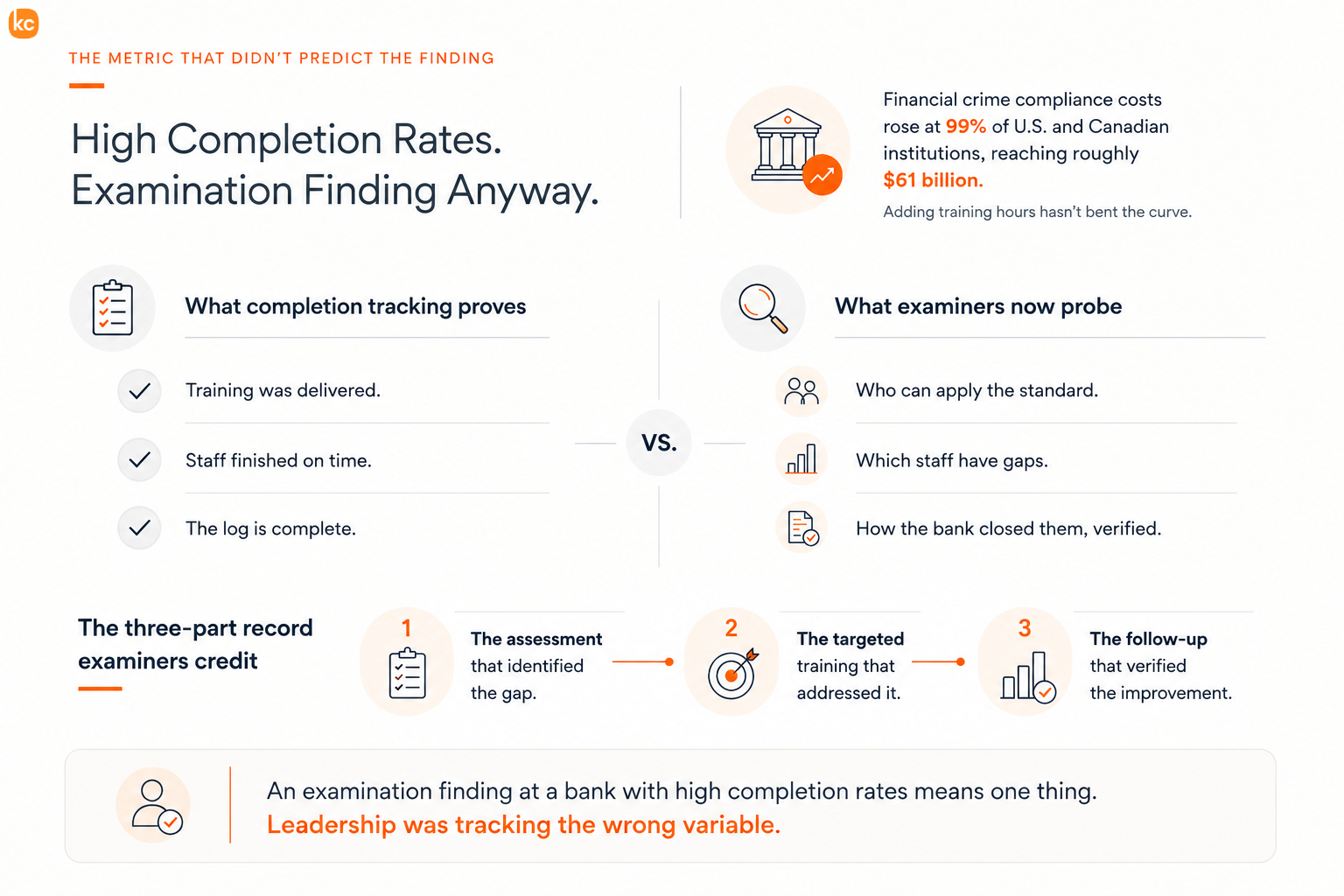
LexisNexis Risk Solutions’ True Cost of Financial Crime Compliance Study found that financial crime compliance costs increased for 99% of financial institutions in the U.S. and Canada, with total compliance spend reaching approximately $61 billion, and 70% of institutions naming cost reduction a top priority for the year ahead even as costs kept climbing. That combination, rising costs alongside a priority to cut them, is the pressure pushing mid-size banks to look for a variable other than training volume to manage. Source: LexisNexis Risk Solutions, True Cost of Financial Crime Compliance Study.
The training-volume assumption and where it breaks down
Banks have been approving compliance budgets structured around an input model: staff count, training hours, completion rates. The investment thesis behind that model is that more training hours reduce examination risk. Examiners have changed what they measure, but the budget approval process at most mid-size institutions has not. The compliance training software investment that boards authorize still gets evaluated on completion metrics, not on whether those completions translate to capability the bank can demonstrate under examination.
The consequence at the board level is that the information coming up from the compliance function does not match the information examiners use when they assess risk. OCC and Federal Reserve examination guidance has shifted toward capability verification; board-level compliance dashboards are still running on the old input metrics. That gap between what leadership tracks and what examiners measure is where the cost of the next examination finding accumulates.

What examination evidence shows about the gap
Every examination finding at an institution with high completion rates is a board-level management information failure. It means the compliance program produced a metric that leadership used to assess risk, and that metric did not predict the examination outcome. The finding isn’t evidence of insufficient training hours, but evidence that the board was tracking the wrong variable. The cost, in remediation expense and restricted capital deployment, is the price of using input metrics to manage an outcome risk.
Capability-Based Compliance: The Operating Lever That Bends the Cost Curve
How capability differs from completion as a compliance metric
Capability-based compliance replaces the input metric with an outcome metric. The compliance training software platform and integrated skills assessment together produce a capability map showing which staff members can apply the regulatory standard and which have gaps requiring targeted remediation. That map is what examiners are beginning to ask for, and it is what separates a satisfactory compliance management system rating from one that triggers additional scrutiny.
The cost implication is that targeted remediation is materially cheaper than broad re-training. When a skills assessment identifies an AML compliance training gap at a specific branch, the compliance automation workflow assigns targeted content to that staff member rather than rerunning the full compliance training program for all locations.
What the shift means for the compliance cost structure
Banks that have moved from completion tracking to capability verification report lower remediation costs after examinations, reduced preparation time going into examination cycles, and more efficient allocation of the compliance training budget. The reallocation is the most significant change at the P&L level. Compliance training software budget that was spent on volume shifts toward capability gaps, which are smaller in scope and less expensive to close than full program re-runs.
See how KC’s workforce development platform builds a capability-based training and verification infrastructure for banking.
What Regulatory Examiners Are Starting to Credit Beyond Training Completion
How examiner expectations have shifted
A satisfactory compliance management system rating is a capital event. Banks that exit examination cycles rated satisfactory or better retain the full use of their capital while peers in remediation windows face restricted deployment, additional supervisory requirements, and the management bandwidth cost of addressing findings. Federal banking regulators have updated their CMS evaluation criteria to include the bank’s process for identifying and remediating knowledge gaps, which means the gap between satisfactory and unsatisfactory ratings is increasingly a capability-management question, not a training-volume question.
The competitive implication is direct: banks that demonstrate a capability-to-examination-readiness workflow give examiners the evidence that current guidance asks for and accumulate a regulatory relationship advantage over examination cycles. The institutions examiners view as well-managed are those that can show how they identify gaps, close them, and verify the result. That demonstrated management quality earns more predictable examination outcomes than volume without the capability trail.
The audit documentation that supports examiner confidence
The audit trail that examiners now credit is a management information signal as much as a documentation requirement. It tells the examiner that leadership built an organization with visibility into what its workforce can and cannot do, and that the bank closes gaps rather than recording them. The three components are: the skills assessment record identifying the gap, the compliance training software record showing how it was addressed, and the post-training record verifying capability improvement. Compliance automation that generates this trail continuously converts what most banks treat as examination preparation work into a standing management information system.
How KC’s Compliance Training Software and Skills Assessment Power Banking Compliance Strategy
The compliance training software layer
KC’s workforce development platform provides the compliance training software infrastructure that mid-size banks use to deliver, track, and document compliance training at scale. The Learning Library includes pre-built courses covering AML compliance training, BSA compliance training, fair lending, and FDIC compliance requirements, with audit-ready exports designed to meet examination documentation standards.
Automated workflows handle assignment, deadline management, and completion reporting across branch networks, reducing the administrative overhead that compliance officers currently absorb in manual coordination.
The skills assessment layer
KC’s Skills Assessment completes the investment thesis that compliance training software starts. The board approves a compliance training investment; without capability verification, that investment purchases hours delivered. The Skills Assessment converts it into an outcome purchase: the bank knows which staff members meet the standard, which have gaps, and what targeted follow-up the compliance automation workflow assigns. That is the difference between a compliance training budget that buys documented inputs and one that buys examiner confidence.
The Board-Level Case for Treating Compliance Cost as a Workforce Capability Problem
Mid-size banks that measure compliance program effectiveness by training completion rates are measuring the wrong variable. Completion rates confirm that training was delivered; they do not confirm whether the workforce can perform to the regulatory standard examiners are now probing. That distinction is a cost variable that shows up in examination outcomes, remediation budgets, and capital deployment constraints over the examination cycle.
The strategic case is straightforward: compliance training software and skills assessment infrastructure costs less to operate than the remediation cycle triggered by an examination finding, and it produces the examiner-ready documentation that current regulatory guidance requires. Banks making this shift are reallocating what they already spend toward the inputs that do bend the cost curve, rather than adding volume that produces diminishing returns.
Workforce capability is the lever. The organizations that treat it as such, with a platform that connects training delivery to demonstrated competency and compliance automation that generates the audit trail examiners credit, are the ones that exit examination cycles with capital intact and compliance cost under strategic control.
See how KC bends the compliance cost curve for banking.
Frequently Asked Questions
1. What is the difference between compliance training completion and compliance capability at a bank?
Completion measures whether a staff member finished a training module. Capability measures whether they can apply the regulatory standard the training was designed to build. Compliance training software that records only completion gives examiners a training log; software that integrates skills assessment gives examiners a capability verification record, which is what examination guidance increasingly asks for.
2. How does compliance automation reduce compliance costs at mid-size banks?
Compliance automation handles training assignment, deadline management, and audit documentation as continuous workflows rather than manual processes. The cost reduction comes from two sources: lower administrative overhead in managing compliance training programs, and more targeted remediation that addresses specific capability gaps rather than rerunning full programs for all staff.
3. What do OCC and Federal Reserve examiners look for beyond training completion logs?
Federal banking regulators, including the OCC, have updated examination guidance to include the bank’s process for identifying and remediating compliance knowledge gaps as part of the compliance management system evaluation. Examiners look for evidence that the bank identifies which staff have knowledge gaps, that it addresses those gaps through targeted regulatory compliance training, and that it verifies capability improvement after remediation.
4. How does KC’s compliance training software support banking examination preparation?
KC’s workforce development platform delivers compliance training through a pre-built banking course library covering AML, BSA, fair lending, and FDIC requirements, with audit-ready completion exports. KC’s Skills Assessment connects that delivery to demonstrated capability, generating the three-part record examiners now credit: gap identification, targeted training delivery, and capability verification.
References
- LexisNexis Risk Solutions. True Cost of Financial Crime Compliance Study.
- Office of the Comptroller of the Currency. Compliance Management Systems, Comptroller’s Handbook.
- Federal Reserve, Conference of State Bank Supervisors, and FDIC. Community Banking Research Conference.
- Financial Crimes Enforcement Network. BSA Requirements and Guidance.
- Consumer Financial Protection Bureau. Fair Lending Supervisory Guidance.