Key Takeaways
- The Family Educational Rights and Privacy Act (FERPA) is codified at 20 U.S.C. §1232g; the implementing regulations sit in 34 CFR Part 99.
- 34 CFR §99.7 requires each institution to annually notify parents and eligible students of FERPA rights, and §99.7(a)(3)(iii) requires the institution to publish its own criteria for who counts as a “school official” with a “legitimate educational interest.”
- FERPA enforcement under 34 CFR §99.67 and 20 U.S.C. §1232g(b)(2) is the withholding or termination of federal funding; the U.S. Supreme Court confirmed in Gonzaga University v. Doe, 536 U.S. 273 (2002), that FERPA does not create a private right of action.
- Strong FERPA training is scenario-anchored, role-tiered across faculty, staff, and student workers, refreshed annually with new fact patterns, and produces an audit-ready record per learner.
- A workforce development platform that holds the catalog, role tiers, refresh cadence, and audit-ready record is the simpler shape to maintain against the §99.67 enforcement floor.
Citation | What it covers |
|---|---|
§1232g | FERPA statute (20 U.S.C.) |
Part 99 | FERPA implementing regulations (34 CFR) |
§99.7 | Annual notification + institution’s own criteria |
§99.67 | Enforcement floor: withholding or termination of federal funds |
Why the 90-Minute Annual Video Is the Wrong Instrument
The 90-minute annual FERPA compliance video is the wrong instrument for higher-ed faculty and staff. Almost every institution can show an OIG, an accreditor, or the U.S. Department of Education’s Student Privacy Policy Office that it conducted FERPA training in the prior year. The form has drifted toward compliance theater. The training plays the regulation back at the audience instead of teaching the audience how to apply it.
The substance of the rule says otherwise. 34 CFR §99.7 requires each institution to annually notify parents and eligible students of FERPA rights, and §99.7(a)(3)(iii) requires that notification to include a specification of criteria for determining who constitutes a school official and what constitutes a legitimate educational interest. The institution has to publish its own criteria. Training that reads the policy aloud does not teach faculty or staff how those criteria apply when a parent calls about a grade, when a dean asks for a roster, or when a researcher requests data under §99.31(a)(6).
The five sections below cover what strong FERPA training looks like in practice, against the rules the U.S. Department of Education enforces, and how the structure maps to a corporate LMS that holds the catalog and the record in one place.
Why Most FERPA Training Fails to Stick
Total enrollment in all degree-granting postsecondary institutions stood at approximately 19 million students in fall 2020, distributed across thousands of Title IV institutions participating in federal financial aid programs. Each institution that receives federal funds is subject to FERPA under 20 U.S.C. §1232g and the implementing regulations at 34 CFR Part 99. That is hundreds of thousands of faculty, staff, contractors, and student workers handling education records, each one a potential disclosure point.
Training scaled to that audience tends to develop four failure modes.
- The first is passive content. A 90-minute video that narrates §99.3 definitions and §99.31 disclosure exceptions back at the viewer produces a completion record without producing competence.
- The second is uniform content. The same module gets assigned to a faculty member teaching one course, a registrar handling thousands of transcripts a year, and a peer tutor working ten hours a week. The disclosure questions those three roles encounter are not the same.
- The third is the missing decision point. Training that does not rehearse the judgment a faculty member makes when a parent calls leaves the decision to memory.
- The fourth is the missing record. Completion gets noted, but the audit-ready evidence of which faculty member completed which module version on which date sits in spreadsheets or nowhere.
Section 99.7 is the structural reason these failure modes matter. The annual notification has to specify the institution’s criteria for “school official” and “legitimate educational interest.” Training that does not teach those criteria leaves a gap between what the institution published and what its staff can apply.
Scenario-Based Content vs. Compliance Theater
The instrument that closes the gap is scenario-based content, organized around a named framework that turns the regulatory text into a portable decision pattern.
The Scenario Ladder
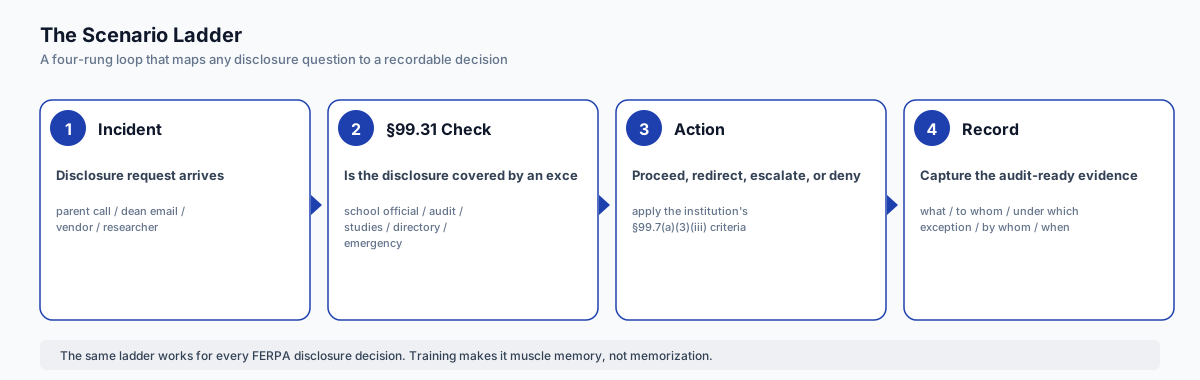
Strong FERPA training runs on what we will call the Scenario Ladder, a four-rung loop that maps any disclosure question to a recordable decision.
- Incident: A disclosure request arrives. The form varies. A parent calls, a dean emails, a vendor requests an integration, or a researcher asks for data.
- §99.31 exception check: Is the disclosure covered by an exception in the disclosure provisions? The exceptions include the school-official-with-legitimate-educational-interest exception under §99.31(a)(1)(i)(A), the audit and evaluation exception under §99.31(a)(3), the studies exception under §99.31(a)(6), directory information under §99.37, and the health-or-safety emergency exception under §99.36.
- Action: Proceed under the exception, redirect the request to an authorized office, escalate to the compliance officer, or deny the request.
- Record: What was disclosed, to whom, under which exception, by whom, on what date.
The same ladder works for every disclosure decision a faculty or staff member makes. The training’s job is to make the ladder muscle memory, not memorization.
Three Scenarios from Real Fact Patterns
Strong FERPA training puts three scenarios in front of the learner and asks them to walk each one up the ladder.
In the first scenario, a parent calls the registrar asking for their child’s grades. The eligible-student rule applies. Under §99.5, rights transfer to the student when the student is 18 or attends a postsecondary institution. The training has to teach the staff member that this is not a §99.31 question. It is a who-holds-the-rights question, and the answer is the student.
In the second scenario, a dean emails a faculty member asking for a course roster with student phone numbers. This is a school-official-with-legitimate-educational-interest question. The training has to teach the faculty member to apply the institution’s own §99.7(a)(3)(iii) criteria. The dean may or may not have a legitimate educational interest in phone numbers depending on the institution’s published criteria.
In the third scenario, a researcher emails the registrar requesting aggregated student data for an IRB-approved study. This is §99.31(a)(6), the studies exception. The training has to teach the staff member to confirm the written-agreement language the regulation requires under §99.31(a)(6)(iii)(C) before any data leaves the system.
Three scenarios. Three rungs of the ladder applied. Three audit-ready records produced. That is what scenario-based training looks like, and what compliance theater does not produce.
Faculty vs. Staff vs. Student-Worker Versions
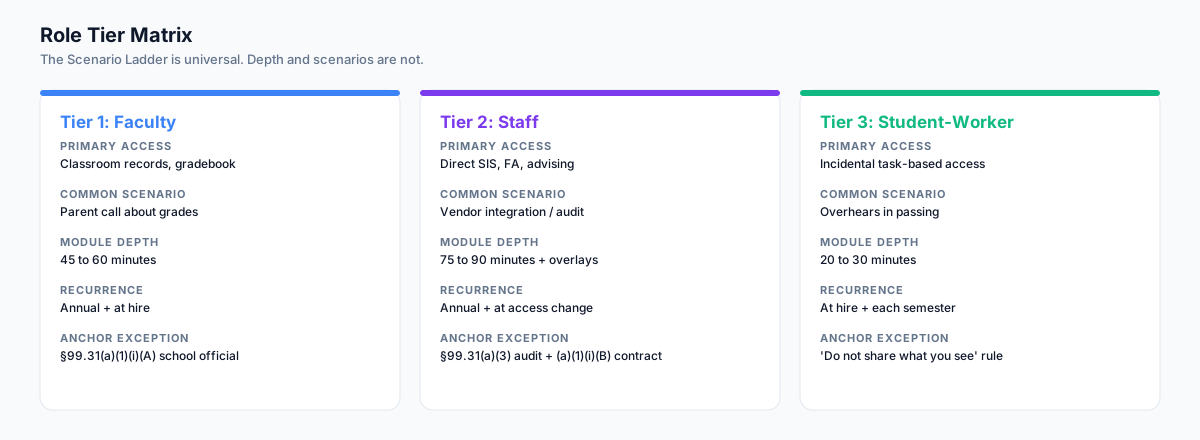
The Scenario Ladder is universal. The depth of training and the scenarios that populate it are not.
Tier 1: Faculty
Faculty (including adjuncts, graduate teaching assistants, and clinical instructors) encounter FERPA primarily through classroom records, grade disclosure, recommendation letters, course rosters, and parent contact. Training depth runs 45 to 60 minutes and emphasizes the §99.31 school-official exception applied to faculty-to-faculty disclosure, the eligible-student rule for parent inquiries under §99.5, and the recommendation-letter consent requirement.
Tier 2: Staff
Staff who handle student records as part of their job (registrar, financial aid, advising, student services, IT, residence life) face a deeper exception set. Training depth runs 75 to 90 minutes plus role-specific overlays. Registrar staff get the directory-information opt-out workflow under §99.37 and the third-party disclosure exceptions in detail. Financial aid staff get the audit and evaluation exception under §99.31(a)(3). IT staff get the school-official exception applied to contractors and consultants under §99.31(a)(1)(i)(B), which controls how vendor relationships are documented.
Tier 3: Student Workers
Student workers with incidental access to education records (peer tutors, resident assistants, work-study employees, student technology assistants) need a lighter but more frequent module. Depth runs 20 to 30 minutes, focused on the “do not share what you see” rule and the escalation path. The annual cycle is the floor; many institutions deliver this tier before each semester begins because the cohort turns over rapidly.
The governing test under §99.31(a)(1)(i)(A), “school official with legitimate educational interest,” is the same for all three tiers. The institution’s §99.7(a)(3)(iii) criteria are the same for all three tiers. What changes is the scenario set and the depth of the disclosure-exception coverage. The training has to deliver the right version to the right role on the right cadence, and produce an audit-ready record of each delivery.
Annual Refresh Cadence
Section 99.7(a)(1) requires annual notification of FERPA rights to parents and eligible students currently in attendance. The annual notification is the regulatory minimum for staff and faculty exposure to the framework, and most institutions use the same cadence for training refresh. The rule sets the floor. The practice has to clear it.
What Refresh Should Mean
Refresh that re-runs the same module against the same population year over year produces a completion record without producing a learning effect. Strong refresh has three components.
- First, new scenarios drawn from the prior year’s actual disclosure questions. Most compliance offices log the §99.31 questions they handled in the prior cycle. Those logs are the raw material for the next year’s scenarios. The training stays anchored to what the institution faced, not to a generic textbook.
- Second, regulatory updates. SPPO and PTAC issue technical assistance throughout the year. New court decisions land. New technology contexts (AI grading, learning analytics, third-party data brokers) raise new disclosure questions. The annual refresh has to surface what changed.
- Third, role transitions and access changes. A faculty member who moved from teaching one course to chairing a department has different disclosure exposure. The refresh has to fire on the role change, not only on the calendar.
A Mid-Sized State University, in 90 Minutes Less
Mini-case sketch (illustrative, not a real incident)
A composite mid-sized state university with 18,000 students and roughly 2,400 faculty and staff replaced its 90-minute annual FERPA video with a 25-minute scenario-anchored refresh plus a weekly two-minute micro-prompt sent to faculty during the academic year. The micro-prompts pulled from the prior year’s disclosure-question log. Completion rates moved from the high 70s to the high 90s. Reported disclosure incidents dropped over the following two semesters.
The instrument shift is what the refresh cycle is for. The compliance record is what survives the audit.
Protect Your Title IV Eligibility With a Higher-Ed FERPA Training Library Built for Audit
KnowledgeCity’s workforce development platform delivers role-tiered FERPA training to faculty, staff, and student workers; refreshes the catalog with new scenarios each year; and produces the per-learner record SPPO and the OIG ask for on the day the audit opens. Built for the institutions where federal funding depends on the answer.
See the KnowledgeCity Workforce Development Platform
How KnowledgeCity’s Learning Library and LMS Cover the FERPA Training Architecture
Holding the structure described above in a single system is what a workforce development platform built for higher education does. KnowledgeCity’s Learning Library and LMS were built to deliver role-tiered compliance training across federally regulated institutions, and the FERPA use case sits inside the higher education catalog.
Five Capabilities the Platform Holds
The five capabilities that turn the Scenario Ladder, the role tiers, the annual refresh, and the audit-ready record into an operating system are listed below.
- Role-tiered FERPA catalog: Faculty, staff, and student-worker modules can be delivered as separate assignment paths, each with its own depth and scenario set, anchored to the institution’s §99.7(a)(3)(iii) criteria.
- Scenario-based content: Modules are built on the Scenario Ladder pattern. Learners walk concrete fact patterns up the rungs, not policy text down the page. The same pattern carries the KC catalog for AI-powered LMS compliance training across regulated industries.
- Annual refresh automation: Calendar triggers fire the refresh on the institution’s chosen anchor date. Scenario rotation pulls new fact patterns into each cycle so the refresh is not a re-run.
- Audit-ready record per learner: Name, module version, completion date, delivery mode, supervisor sign-off, and scenario score sit in one record retrievable on the day SPPO or an OIG opens the file.
- System integration. Standards-based authentication and identity integration tie assignment to the institution’s existing identity and student-information systems, so role tier and access changes flow without manual intervention. For a broader background on the platform features higher-ed compliance teams expect, see the must-have LMS features for any employee training program.
Why This Matters for the §99.67 Enforcement Floor
34 CFR §99.67 sets the enforcement floor. If the U.S. Department of Education determines the institution is in violation and the institution does not come into compliance, the Department may withhold further payments under any applicable program, issue a cease-and-desist order, or terminate eligibility to receive funding. Title IV eligibility is the institution’s federal funding lifeline. The audit-ready record per learner is what protects it.
The Forward Look to 2027
By 2027, “Did you train them?” will no longer have meaning as an audit question. The question every institution will face from SPPO, accreditors, and the OIG will be “What evidence do you have that they applied the training in the past 12 months?” Institutions still running 90-minute compliance videos will be assembling that evidence after the audit opens. Institutions running scenario-anchored, role-tiered, refresh-automated training on a platform that holds the record will hand it over in two hours. The Scenario Ladder and the audit-ready record are the instrument that gets them there.
Built for the Institution That Has to Hand the Auditor a Record on Day One
KnowledgeCity’s workforce development platform brings 9 connected solutions into one operating model, spanning learning, compliance, competencies, performance, policy, and incident management. Higher-ed compliance teams use it to keep FERPA, Title IX, Clery, financial aid, and faculty/staff training on one audit-ready record per learner.
See the KnowledgeCity Workforce Development Platform
Frequently Asked Questions
1. What is the difference between “education records” and “directory information” under FERPA?
Under 34 CFR §99.3, “education records” are records directly related to a student and maintained by an educational agency or institution or by a party acting for the institution. Personally identifiable information from education records may not be disclosed without prior written consent except under the exceptions listed in §99.31. “Directory information” is a subset of education records that the institution has designated under §99.37; it may be disclosed without consent provided the institution has given public notice of the categories, the right to opt out, and the time window for opting out. Typical directory categories include name, photograph, dates of attendance, degrees and honors, major, and athletic participation.
2. Who counts as a “school official with a legitimate educational interest”?
The §99.31(a)(1)(i)(A) school-official exception lets an institution disclose PII to school officials whom it has determined to have legitimate educational interests. The institution publishes its own criteria under §99.7(a)(3)(iii). Most institutions extend the definition under §99.31(a)(1)(i)(B) to contractors, consultants, volunteers, and other outsourced parties under specific conditions, including being under the direct control of the institution with respect to the use and maintenance of the records. Training has to teach the institution’s own criteria, not a generic version.
3. Does FERPA require annual training for faculty and staff?
The text of §99.7 requires annual notification of rights to parents and eligible students. The regulations do not separately mandate annual staff training. In practice, SPPO guidance, accreditors, and institutional policy treat annual or more frequent training as the operating standard, because the annual notification’s effectiveness depends on faculty and staff being able to apply the published criteria when a disclosure question arrives. Most institutions align the staff training cycle with the §99.7 notification cycle.
4. What happens to an institution that violates FERPA?
Under 34 CFR §99.67 and 20 U.S.C. §1232g(b)(2), the enforcement remedy is the withholding or termination of federal funds administered by the U.S. Secretary of Education. SPPO can also issue cease-and-desist orders. The U.S. Supreme Court held in Gonzaga University v. Doe, 536 U.S. 273 (2002), that FERPA does not create a private right of action enforceable under 42 U.S.C. §1983. Enforcement runs through the federal funding relationship.
5. Does FERPA apply to online learning platforms and AI tools used in coursework?
Yes. An online learning platform or AI tool that receives, stores, or processes student PII from education records on behalf of the institution becomes a “school official” under the §99.31(a)(1)(i)(B) contractor exception if the institution treats it as such. The conditions include that the function is one the institution would otherwise use employees for, that the vendor is under the direct control of the institution with respect to the use and maintenance of the records, and that the vendor is subject to the requirements of §99.33(a) governing use of education records. Training has to cover how to evaluate vendor and AI tool deployments against this exception.
References
- U.S. Code, Office of the Law Revision Counsel. 20 U.S.C. §1232g, Family Educational Rights and Privacy Act. uscode.house.gov
- Electronic Code of Federal Regulations. 34 CFR Part 99, Family Educational Rights and Privacy. ecfr.gov
- Electronic Code of Federal Regulations. 34 CFR §99.3, Definitions. ecfr.gov
- Electronic Code of Federal Regulations. 34 CFR §99.7, Annual Notification of Rights. ecfr.gov
- Electronic Code of Federal Regulations. 34 CFR §99.31, Disclosure Without Consent Conditions. ecfr.gov
- Electronic Code of Federal Regulations. 34 CFR §99.37, Directory Information Disclosure Procedures. ecfr.gov
- Electronic Code of Federal Regulations. 34 CFR §99.67, Enforcement. ecfr.gov
- Gonzaga University v. Doe, 536 U.S. 273 (2002). supreme.justia.com
- U.S. Department of Education, Student Privacy Policy Office and Privacy Technical Assistance Center. studentprivacy.ed.gov
- U.S. National Center for Education Statistics. Digest of Education Statistics — Fall Enrollment in Postsecondary Institutions. nces.ed.gov